
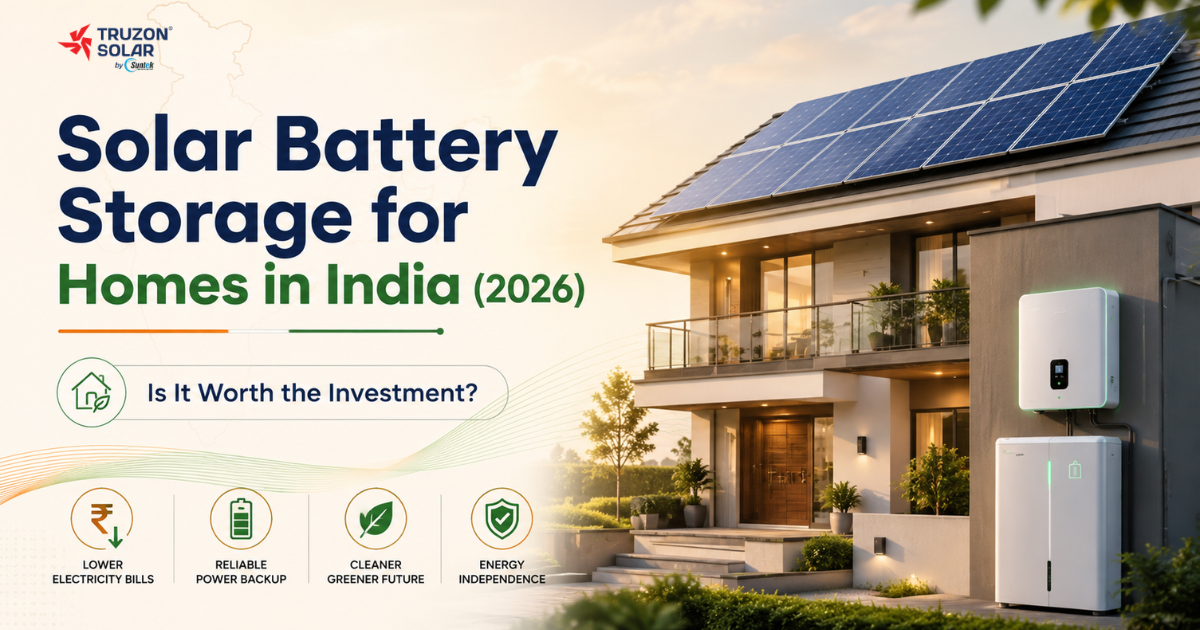
The Question Every Homeowner Is Asking in 2026
You install solar panels to save money on your electric bills and reduce power outages. Everything seems to be functioning for some time. Then comes the summer, when the electricity bill turns off at night, and your entire solar system suddenly can’t help you because the grid itself is down.
This is one of the biggest shocks to many Indians at home. During a power outage, most regular on-grid solar systems shut down for safety. That is even if your rooftop panels are producing power, your house remains dark without battery back-up.
Hence, more people now consider solar battery storage in their homes across Hyderabad, Telangana, Andhra Pradesh and other Indian states. The big issue really is, does it make sense to invest an additional battery in 2026?
This will depend on how much electricity you consume, the reliability of the power in your area and the level of backup you really require. Battery storage is no longer a luxury upgrade for many homes today.
What Exactly Does a Solar Battery Do?
The surplus electricity your solar panels produce will power up your solar battery, which will hold the power to be used at night. If the battery isn’t used, it stores the energy rather than feeding it back into the grid.
This stored energy can then be used to power your appliances at night, and during a power outage. The battery allows you to utilise a portion of your solar power instead of 100% from the electricity board.
Consider it a massive rechargeable power bank for your house. It harnesses the sun’s energy in the daytime to store it, then provides that energy when you need it at night.
This is one of the reasons why the use of hybrid solar systems is becoming more and more popular in India. They are a combination of solar panels, batteries and connection to the grid, and offer not only savings but back-up energy for homeowners.
Types of Solar Systems Available in India
There are three solar systems commonly used in most of the houses in India today.
An on-grid solar system is connected to the power grid. The most cost effective and suitable for lowering electric bills. It does not, however, protect against power outages.
Off-Grid solar systems are self-contained and consist of batteries only. They are generally installed in remote areas where the quality of the electricity grid is poor and are more costly.
A hybrid solar system incorporates the best of both worlds. It is still on the grid and it has some backup power, in the form of battery storage. As 2026 approaches, the integration of solar power with battery storage in residential settings is becoming increasingly popular in urban and semi-urban communities where residents are looking to have reliable power supplies while simultaneously lowering their electricity bills.
How Much Does Solar Battery Storage Cost in India?
The falling cost of batteries in recent years is one of the major reasons for the huge demand for hybrid solar in India.
The cost of a typical 3 kWh battery used for small home is in the range of ₹60,000 to ₹90,000. The cost of a 5 kWh battery for the majority of 2-3 BHK homes ranges between ₹90,000 to ₹1.4 lakh, which depends on the brand and technology used.
For larger homes with high electricity consumption, the hybrid installation cost can be anywhere between ₹3.5 lakh to ₹7 lakh and they are keen to opt for a battery system with a capacity of 7.5 kWh or 10 kWh.
Lithium Iron Phosphate (LFP) Batteries are now the most common batteries used by most Indian homeowners due to their high heat resistance and durability, longevity over conventional battery technologies, and ease of maintenance.
Lithium vs Lead-Acid Batteries: Which One Makes More Sense?
There are still some installers that will still install lead acid batteries because they are more affordable upfront. In real-world applications for long service, however, lithium batteries tend to be the more cost-effective option.
Lead Acid batteries are usually 3 to 5 years in use, and need upkeep frequently. This is because they are less efficient at charging and discharging.
Compared to lithium batteries, LFP lithium batteries typically have a long lifespan of 10 to 15 years and require very little maintenance. They are more efficient throughout their life and work better in Indian climatic conditions.
For these reasons, the most modern residential hybrid solar systems are changing over to lithium battery technology in 2026.
Can You Get Government Subsidies for Solar Batteries?
The Indian government’s PM Surya Ghar Muft Bijli Yojana is primarily geared towards rooftop solar panel subsidies. There remain some battery-only subsidies.
But for homeowners putting up full hybrids, there are still subsidies available for solar installation itself. There are also some schemes and DISCOM initiatives at the State level that are taking baby steps towards supporting battery storage projects.
Furthermore, most banks now offer green energy financing and EMI options for solar plus battery systems which made it more affordable for middle class households to install green energy systems.
India’s energy storage policies are still in a process of evolution and in the coming years, incentives on batteries could increase.
Is Solar Battery Storage Actually Worth the Money?
The most critical question, and it varies based on your circumstances.
When your region has regular power outages, you can definitely benefit from battery storage. Homes with a large inverter or a diesel generator will save a huge amount of running costs when they switch to a hybrid solar system.
If a family is spending lots of money on fuelling their generator and are dealing with a lot of power outages each day, for example, they will save money and be more convenient in recovery much sooner from installing the batteries.
But in areas with a reliable power grid and infrequent power failures, the battery pays back may be longer. Under such circumstances, a basic grid-tied solar power system might be a better immediate investment.
The important thing is to know the difference between power backups being a luxury or a real need.
Advantages of Solar Battery Storage
The biggest advantage of battery storage is its ability to keep providing power during a power outage. Unplugged appliances like your fridge, lights, WiFi and fans still function when the power goes out.
Battery systems can also help to reduce the need for expensive grid electricity during the night. Your house doesn’t need to rely on grid electricity after dark, when it isn’t being generated, if it has stored electricity from the sun.
Another excellent one is no diesel generators, and no more consistent inverter issues! Battery back-up power systems are becoming more popular than traditional back-up power for homes.
Battery storage also increases the overall energy independence and safeguards against future electricity tariff increases.
Important Things to Check Before Installation
When purchasing a solar battery system for your home, it is important to understand the battery life cycles and warranty details. For a battery to have a long cycle life it typically lasts a lot longer when used in the real world.
Another important question is whether the current inverter can be integrated with batteries or not. Having an older solar system may require an inverter upgrade before battery installation.
Installation quality is as crucial as battery quality. Correct system sizing, ventilation and a proper Battery Management System (BMS) are essential for long life and safety.
Many times, it may be more important to choose the right installer than the lowest battery price.
Final Verdict: Should You Buy a Solar Battery in 2026?
In regions where the power grid is unreliable, solar battery storage has been proven to be an investment for the future and a practical solution in many Indian households.
The cost of batteries is lower, the technology has improved dramatically, and the performance of hybrid systems has improved as well.
The benefit of battery storage may make a real difference to comfort and long-term savings if the home regularly faces outages, it is an inverter backup home, or it exports excess solar power to the grid at a low value.
Meanwhile, those living in households that have reliable power supply, and have lesser backup requirements would still be better suited to a regular on-grid solar.
The specific choice will depend on the geographic location, electric consumption, and energy targets. However, in India, one thing is certainly clear: Battery storage is no longer experimental. It is now playing an important role in the modern residential solar systems in 2026.
FAQ’s
Yes, in most cases it is possible to add a solar battery to an existing solar array. But compatibility is largely dependent on the inverter. Some systems may require a hybrid inverter upgrade.
Yes. A hybrid solar system is a type of system designed to generate power during power outages.
With proper installation and usage, the life of most high-quality LFP lithium batteries is about 10 to 15 years.
The modern LFP batteries can withstand higher temperatures than older battery technologies. Proper ventilation and installation are still important.
Yes. Now many banks and solar companies are providing EMI and green financing for hybrid solar systems.
About the Author