
Indian farmers have long relied on diesel pumps and the unpredictable electricity grid, which is on the brink of collapse, to regulate irrigation. Even in many villages in India, there is still power failure during farming, which adversely affects productivity and causes operational stress.
That’s why farmers in India are advancing rapidly toward solar power in 2026.
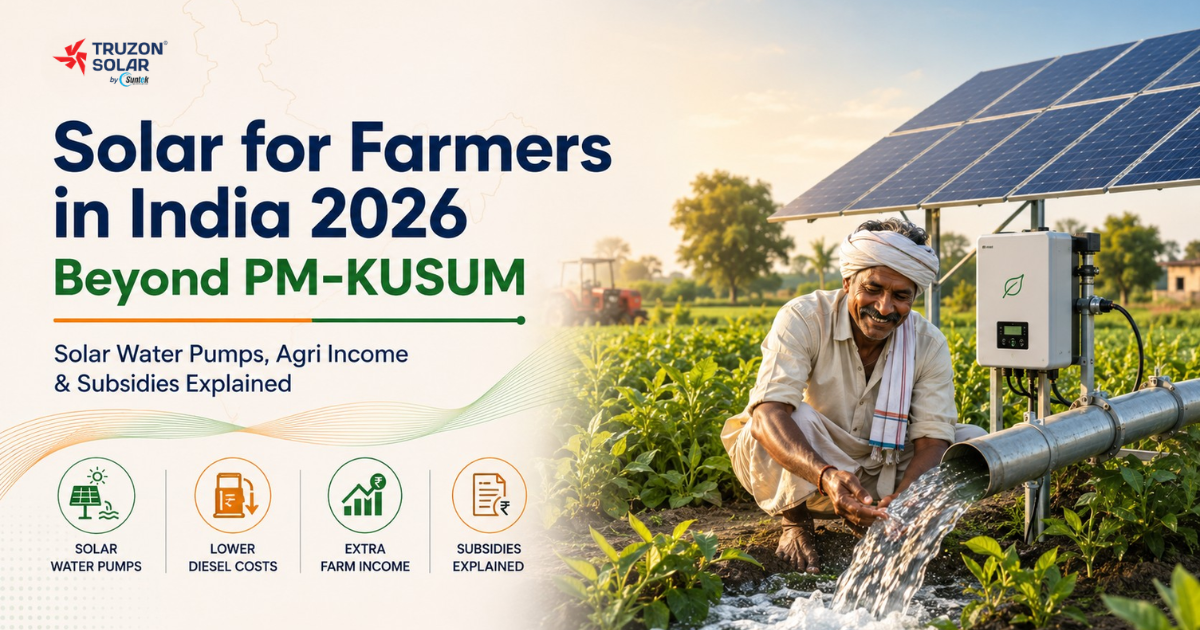
Nowadays, solar is not only a rooftop installation in cities. Today, farmers are employing solar water pumps and hybrid solar and agricultural solar to reduce their electric bills, improve irrigation reliability, and even generate extra income.
Even though schemes like PM-KUSUM solar pump 2026 have helped create awareness, there is a lack of understanding of the subsidy mechanisms, the systems suitable for them, and the profitability of investing in agri-solar.
The guide explains in simple language, from subsidies available in the Solar Pump in Andhra Pradesh to subsidies available in Agri Solar in Telangana, installation cost, savings and long-term benefits to farmers.
What is PM-KUSUM Solar Pump Scheme?
PM-KUSUM is one of the biggest renewable energy schemes in India aimed at helping farmers in their efforts to use solar power.
The overall objective of the scheme is straightforward – to decrease reliance on diesel and grid electricity by supporting farmers in the installation of solar powered irrigation systems.
Farmers can install under PM-KUSUM solar pump 2026:
- Standalone Solar Water Pumps
- Grid connected agricultural solar systems
- Solarized existing pumps
- Small scale solar power on farmland
Farmers can make solar installations more affordable thanks to subsidy support from the government, both at the central and state level.
With the rising price of diesel motor pump and summer irrigation problems, the demand for solar water pump for farmers India has been increased in the state of Telangana and Andhra Pradesh.
How Does a Solar Water Pump Work?
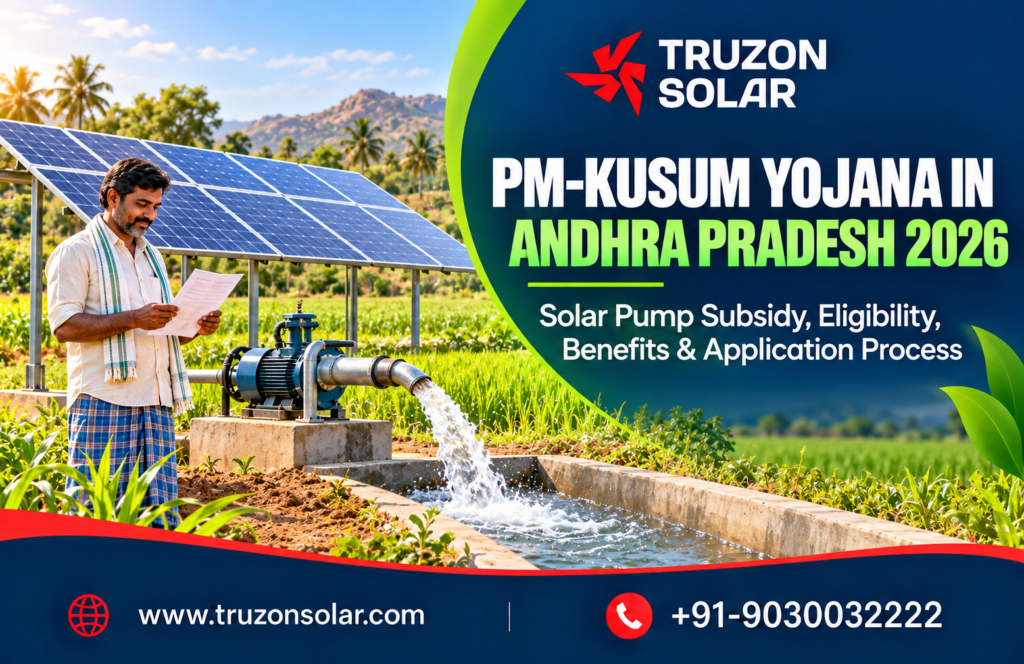
Solar Water Pump is a device that uses energy generated by solar panels to power irrigation pumps, thus reducing the electricity grid’s reliance on diesel fuel.
In the daytime, the Solar panels produce electricity which directly operates the motor pump, and which is used to pump water from borewells, lakes or Storage tanks.
This allows farmers to water fields when the sun is shining, without having to worry about fuel costs and power outages.
In recent times, many farmers in Andhra Pradesh have installed solar pumps, as farming in some parts of the state heavily relies on groundwater-based irrigation systems. Likewise, the farmer subsidy programs for agri-solar in the state of Telangana are enabling them to save on the long-term costs of irrigation.
Why Solar Pumps Are Becoming Popular Among Farmers
The most important factor contributing to the development of farmers solar water pump in India is cost savings.
The operation of diesel powered irrigation systems has become more costly. In the agricultural areas, also electricity supply is often restricted to certain hours, which will lead to uncertainty during critical farming periods.
Solar pumps address both these issues.
After installation, it produces free electricity for several years from the sun. Farmers will not need to spend time every day on diesel or waiting for the unpredictable supply of electricity.
Solar Pump Cost in India (2026)
Agricultural solar systems prices are primarily dependent on the capacity of the pump, water demand, and subsidy eligibility.
The cost of a 2 HP solar water pump is usually between ₹1.5 lakh and ₹2 lakh before subsidy. For larger farms, the 5 HP systems come in the range of ₹3 lakh to ₹5 lakh with consideration to the complexity of installation and panel capacity.
The PM-KUSUM solar pump 2026 project has a substantial subsidy from the government, leaving a significant portion of the farmer’s cost at a lower rate.
In many cases:
- Subsidy support from the central government.
- The State Government provides extra subsidy.
- Farmers bear only part of the total installation cost.
Due to such subsidies, solar energy for farmers in India is much more accessible than it was a couple of years ago.
Agri Solar Subsidy Telangana: What Farmers Should Know
With the surge in electricity demand in the rural farming areas, the agri solar subsidy Telangana initiatives have received a lot of interest lately.
State nodal agencies and solar vendors will facilitate farmers to apply for solar pump support in Telangana. Eligibility criteria can differ by land ownership, pump needs, and electric connection.
For Telangana farmers, the primary benefit is the stability of long-term irrigation. Previous diesel-powered water pumps are being replaced by farmers with solar powered water pumps to cut down on the cost of operation in the dry season.
The uptake of solar energy is particularly growing in parts of the districts where ground water is used for irrigation.
Solar Pump Andhra Pradesh: Growing Demand in Farming Belts
Andhra Pradesh solar pump installations also have surged up in recent years.
Irrigation is an important factor in agriculture productivity in Andhra Pradesh which is one of the major employment areas in the state. The use of solar systems is gaining momentum among farmers, as the electric grid has yet to become reliable during the irrigation season.
There are solar pumps that work along with scheduled power supply to assist farmers in irrigation of fields.
Some farmers use solar power along with drip irrigation to save water and electricity costs, too.
With the awareness campaign for PM-KUSUM solar pump 2026 gaining momentum, Andhra Pradesh is likely to be one of the best markets for the agricultural sector to embrace solar pumps.
Can Farmers Earn Additional Income Through Solar?
Among all the most interesting developments in agri solar, is the opportunity for an extra income. In some grid-connected solar configurations, farmers can earn excess electricity credits from the grid via net metering deals. This allows agriculture to be used as either an asset on the farm or an energy source. Some farmers are even trying out solar fencing, solar cold storage support and small agri-solar plants as a means of diversification of rural income.
Is Solar Really Worth It for Farmers?
The answer for many farmers is yes, particularly those who are already paying a lot for their farm’s diesel fuel or who are facing erratic power service from their ag electricity.
The largest money-saving advantage is achieved from the reduction of recurring operating costs. The running costs of solar systems are very low after installation compared to diesel pumps.
Most good quality solar water pump system can also use for many years and need little maintenance.
But the ROI will vary based on:
- Farm size
- Water usage
- Existing electricity access
- Subsidy eligibility
- Irrigation frequency
Solar systems can be seen to save money for farms that irrigate on a regular basis.
Important Things Farmers Should Check Before Installation
Prior to installing a solar water pump, the farmer must take into consideration the water needs and the borewell depth. It is very significant to size the system properly to get best performance.
Additionally, the use of approved vendors and quality equipment is important. Poor panels or pumps could also generate efficiencies issues and problems later in service.
Farmers should also verify:
- Subsidy eligibility
- Warranty coverage
- Installation support
- Availability of services in their area
In cases of rural agriculture projects, it is important to hire experienced installers.
Also Read: Solar Battery Storage for Homes in India (2026)
Final Verdict: Is Solar the Future for Indian Farmers?
As the cost of diesel is soaring, electricity usage is increasing, and more people are looking for alternative energy solutions, solar water pumps for farmers in India is no longer a government initiative, but is now a real necessity in farming.
Various solar pump schemes, such as PM-KUSUM solar pump 2026, agri solar subsidy Telangana, and solar pump Andhra Pradesh, are helping farmers save on their operational expenses and increasing the reliability of irrigation.
Solar is not just a cost-saver for many farmers, it’s also an energy-independent solution that can help achieve long-term farming stability.
With awareness spreading throughout rural India, agricultural solarization is likely to further ramp up in the coming years.
About the Author