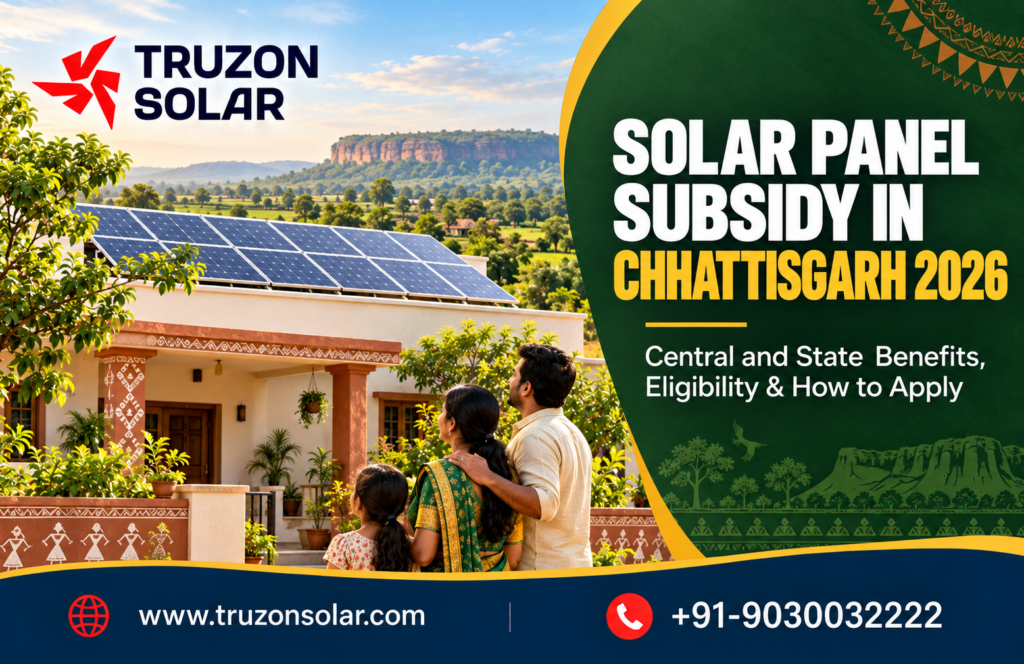
Rooftop solar has become more affordable for families in Chhattisgarh because eligible residential consumers can receive support from both the Central and State Governments. The combined assistance reduces the amount a household must arrange for installing an approved grid-connected solar system.
Under the current published structure, the solar panel subsidy in Chhattisgarh 2026 can reach ₹1.08 lakh for a qualifying system of 3 kW or more. However, the subsidy is not automatically available with every solar installation. Homeowners must apply through the official process, obtain approval and use eligible equipment installed by an authorised vendor.
Table of Contents
- What Is the Solar Panel Subsidy in Chhattisgarh?
- Central and State Subsidy Amounts
- Benefits of Installing Rooftop Solar
- Eligibility for Solar Subsidy
- Documents Required
- How to Apply for Solar Subsidy in Chhattisgarh
- What to Check Before Installation
- Frequently Asked Questions
What Is the Solar Panel Subsidy in Chhattisgarh 2026?
The solar panel subsidy in Chhattisgarh 2026 combines financial assistance available under PM Surya Ghar: Muft Bijli Yojana with additional support announced by the Chhattisgarh Government.
PM Surya Ghar is a Central Government programme created to encourage residential households to install rooftop solar. Eligible consumers apply through the National Portal, select a registered vendor and complete the installation and verification process through their electricity distribution company.
In Chhattisgarh, the State Government has announced additional assistance for domestic consumers. Chhattisgarh State Power Distribution Company Limited, commonly known as CSPDCL, is responsible for implementing the process alongside the national scheme.
Central and State Solar Subsidy Amounts
The published subsidy structure for residential rooftop solar in Chhattisgarh is:
| Solar-system capacity | Central subsidy | State subsidy | Total assistance |
| 1 kW | ₹30,000 | ₹15,000 | ₹45,000 |
| 2 kW | ₹60,000 | ₹30,000 | ₹90,000 |
| 3 kW | ₹78,000 | ₹30,000 | ₹1,08,000 |
| Above 3 kW | ₹78,000 | ₹30,000 | ₹1,08,000 |
The Central Government provides ₹30,000 per kW for the first 2 kW and an additional ₹18,000 for the third kW. Central assistance is capped at ₹78,000 for an individual residential system.
The Chhattisgarh Government’s published support adds ₹15,000 for a 1 kW system and ₹30,000 for systems of 2 kW and above. This takes the combined benefit to ₹45,000, ₹90,000 or ₹1.08 lakh, depending on capacity.
Because scheme budgets, eligibility limits and release procedures can change, applicants should confirm that the state component remains available when their application is submitted.
Benefits of the Solar Panel Subsidy in Chhattisgarh
Lower Cost of Installation
The biggest advantage is the reduction in the effective purchase cost. A qualifying 3 kW system receiving the full combined assistance may get support of up to ₹1.08 lakh.
Reduction in Monthly Electricity Bills
Solar panels generate electricity during daylight hours. The household first uses the power generated on the roof, reducing its dependence on electricity purchased from the distribution company.
A zero bill is not guaranteed. The final amount depends on solar generation, household consumption, tariff, fixed charges and net-metering adjustments.
Credit for Surplus Solar Power
When a grid-connected system produces more electricity than the house is using, the surplus can be exported through an approved net meter. CSPDCL adjusts exported and imported electricity according to the applicable regulations.
Long-Term Savings
Solar panels generally continue generating electricity for many years. Once the initial investment is recovered, the system can provide substantial savings over its remaining operating life.
Financing Support
Households unable to pay the complete amount upfront can explore rooftop-solar loans offered by participating banks. Loan approval, interest rate, tenure, EMI and security requirements depend on the lender’s prevailing conditions.
Eligibility for Solar Panel Subsidy in Chhattisgarh 2026
An applicant should generally meet the following conditions:
- The applicant must be an Indian citizen.
- The property must have a valid domestic electricity connection.
- The applicant should own the house or have legal permission to use the roof.
- The roof must have adequate space and be suitable for solar installation.
- The household should not have already received another subsidy for the same system.
- The application must be registered through the prescribed portal.
- Installation should begin only after the required feasibility approval.
- The system must be installed through an eligible or registered vendor.
The solar panel subsidy in Chhattisgarh 2026 is linked to the electricity connection and approved installation. Simply purchasing solar panels from the market does not establish subsidy eligibility.
Documents Required for Solar Subsidy
Applicants should normally keep these documents and details ready:
- Aadhaar card or accepted identity proof
- Recent domestic electricity bill
- CSPDCL consumer or service number
- Mobile number and email address
- Address or property-ownership details, if requested
- Applicant’s bank-account information
- Cancelled cheque or bank proof
- Rooftop solar quotation
- Vendor agreement
- Installation invoice
- Solar-panel and inverter specifications
- DCR declaration for eligible modules
- Geo-tagged photographs of the completed installation
- Net-meter application documents
- Inspection or commissioning certificate
The applicant’s name should be consistent across the electricity connection, subsidy application and bank account wherever required.
How to Apply for Solar Subsidy in Chhattisgarh
Step 1: Register on the PM Surya Ghar Portal
Visit the official PM Surya Ghar portal. Select Chhattisgarh and CSPDCL, then enter the electricity consumer number, mobile number and email address.
Step 2: Submit the Rooftop Solar Application
Log in and complete the application form. Select the proposed capacity after considering monthly electricity consumption, sanctioned load and available roof area.
As a broad guide, 1–2 kW may suit a home with modest electricity use, while 3 kW may be considered by households using around 150–300 units per month.
Step 3: Obtain Feasibility Approval
Wait for CSPDCL to issue the required technical-feasibility approval. The DISCOM may examine the proposed capacity, sanctioned load, connection details and availability on the local distribution network.
Do not begin installation merely because the application has been submitted.
Step 4: Select a Registered Vendor
Choose a vendor authorised under the scheme process. Ask for an itemised quotation covering panels, inverter, mounting structure, ACDB/DCDB, cables, earthing, lightning protection, installation, warranties and exclusions.
CSPDCL operates a unified rooftop-solar portal and provides consumer access, vendor information, resources and application support for rooftop connections.
Step 5: Install the Approved Solar System
After approval, the vendor installs the rooftop system according to the sanctioned capacity and technical specifications.
Step 6: Upload Installation Details
Submit the required installation information, invoice, equipment details, declarations and photographs through the portal. The vendor may assist, but the consumer should verify everything before submission.
Step 7: Apply for Net Metering and Inspection
CSPDCL inspects the installation and verifies whether it complies with the approved design and safety requirements. The prescribed meter is then installed, and the system is commissioned.
What to Check Before Installation
Before placing an order, confirm:
- Whether the quoted price is before or after subsidy
- Exact central and state benefits applicable to the application
- Panel wattage, technology and warranty
- Inverter brand, capacity and warranty
- DCR and scheme compliance
- Mounting structure and civil-work scope
- Net-metering and documentation charges
Never select a system only because it receives the highest subsidy. Capacity should match the household’s consumption, roof area and future requirements.
Read More:- Leading Hospital Solar Installation Company in Warangal: System Design, Reliability, Savings & Support
Frequently Asked Questions
1. What is the maximum solar subsidy available in Chhattisgarh?
Under the published combined structure, an eligible residential consumer may receive up to ₹78,000 from the Central Government and ₹30,000 from the State Government—a total of ₹1.08 lakh for a qualifying 3 kW or larger system.
2. Can I receive a subsidy after installing solar privately?
Eligibility may be denied if the system is installed before registration and feasibility approval or through an ineligible vendor. Complete the official application process before starting work.
3. Is the Chhattisgarh solar subsidy available for commercial properties?
The PM Surya Ghar household subsidy and the published additional state assistance are intended for eligible domestic consumers. Commercial and industrial applicants should examine non-subsidy solar options separately.
About the Author