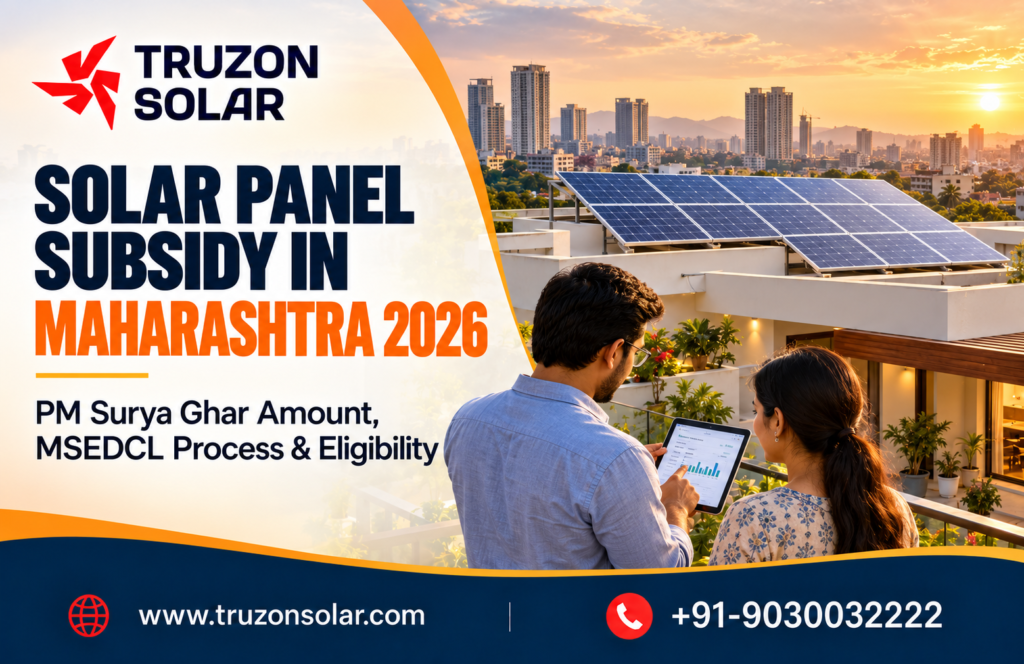
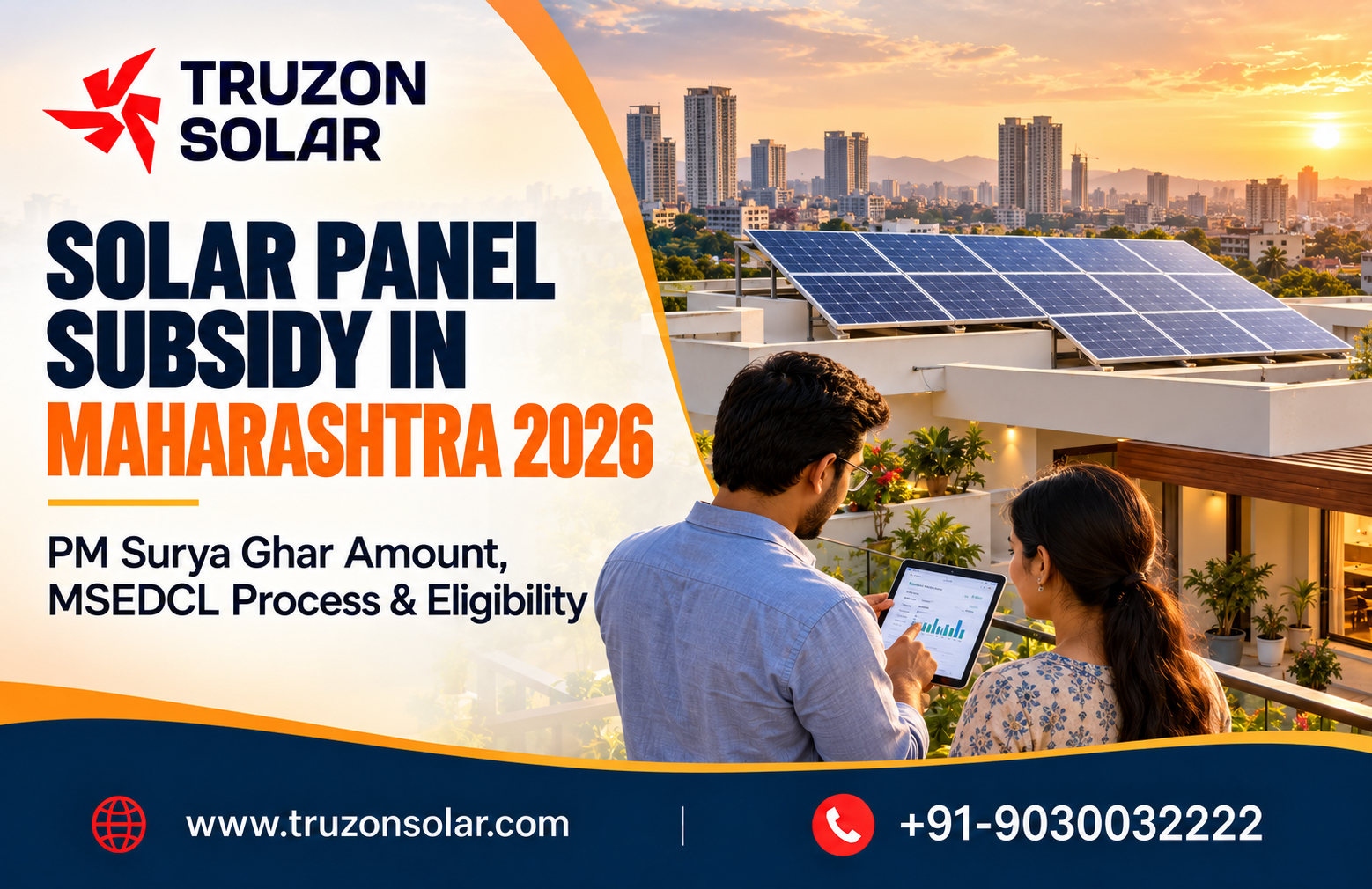
Rooftop solar can reduce a household’s dependence on grid electricity, but the installation cost often makes families postpone the decision. The solar panel subsidy in Maharashtra 2026 helps eligible residential consumers manage this initial investment through financial assistance under PM Surya Ghar: Muft Bijli Yojana.
Consumers connected to Maharashtra State Electricity Distribution Company Limited, or MSEDCL, can apply through the prescribed online system. The process covers registration, technical feasibility, vendor selection, installation, inspection, net-metering approval and subsidy transfer.
Table of Contents
- What Is the Solar Panel Subsidy in Maharashtra?
- PM Surya Ghar Subsidy Amount
- Is There a Separate Maharashtra State Subsidy?
- Benefits of Rooftop Solar
- Eligibility Conditions
- Documents Required
- MSEDCL Solar Subsidy Application Process
- Checks Before Selecting a Vendor
- Frequently Asked Questions
What Is the Solar Panel Subsidy in Maharashtra 2026?
The solar panel subsidy in Maharashtra 2026 is available to qualifying residential consumers under the Central Government’s PM Surya Ghar scheme.
The programme encourages households to install grid-connected rooftop solar systems and generate electricity for their own use. When the system generates more electricity than the house requires, the surplus may be exported through an approved net-metering arrangement.
In Maharashtra, applications involving MSEDCL consumers are processed through the national PM Surya Ghar portal and MSEDCL’s rooftop-solar system. The Maharashtra Energy Department describes the state’s process as faceless and paperless and directs applicants to the national portal.
PM Surya Ghar Subsidy Amount in Maharashtra
The current Central Financial Assistance is calculated according to the approved rooftop-solar capacity.
| Rooftop solar capacity | Maximum subsidy |
| 1 kW | ₹30,000 |
| 2 kW | ₹60,000 |
| 3 kW | ₹78,000 |
| More than 3 kW | ₹78,000 |
The first 2 kW receives ₹30,000 per kW. A further ₹18,000 is available for the additional capacity between 2 kW and 3 kW. No extra household subsidy is added beyond 3 kW, making ₹78,000 the maximum assistance for an individual residential system under the present structure.
Is There a Separate Maharashtra State Solar Subsidy?
The official MSEDCL information currently highlights the Central PM Surya Ghar assistance of ₹30,000 for 1 kW, ₹60,000 for 2 kW and ₹78,000 for 3 kW or larger residential systems.
It does not list a universal additional Maharashtra Government top-up for every residential applicant. Therefore, homeowners should not accept quotations that assume a separate state subsidy unless the vendor can provide a current official notification.
Any local incentive offered by a municipal body, housing programme or another authority should be verified separately. The amount shown on the applicant’s official portal record should be treated as the applicable subsidy.
Benefits of the Solar Panel Subsidy in Maharashtra
Reduced Installation Cost
The subsidy lowers the household’s effective investment. A qualifying 3 kW system can receive assistance of up to ₹78,000.
Lower Monthly Electricity Bills
Solar panels generate electricity during daylight hours. Using this electricity inside the home reduces the number of units purchased from MSEDCL.
Net-Metering Benefits
An approved bidirectional meter records electricity imported from and exported to the grid. The financial adjustment for surplus power is made according to the applicable Maharashtra Electricity Regulatory Commission and MSEDCL rules.
Maintenance Responsibility
MSEDCL’s I-SMART information states that the empanelled vendor is responsible for the operation and maintenance of the project for five years after commissioning. This responsibility should also be clearly mentioned in the consumer’s agreement.
Eligibility for Solar Panel Subsidy in Maharashtra 2026
An applicant should generally meet the following conditions:
- The applicant must be an Indian citizen.
- The property must have a valid residential electricity connection.
- The applicant should own the house or have legal authority to use the roof.
- The roof must have sufficient space and be structurally suitable.
- The household must not have received another subsidy for the same solar installation.
- The application must be submitted through the authorised portal.
- Technical feasibility must be obtained before installation.
- The system must be installed through an eligible registered vendor.
- The equipment must satisfy current technical and domestic-content requirements.
- MSEDCL must inspect and commission the plant.
Official scheme information identifies citizenship, ownership of a suitable house, a valid electricity connection and non-receipt of another solar-panel subsidy as basic eligibility requirements.
Documents Required for Solar Subsidy in Maharashtra
Applicants should usually keep the following ready:
- Aadhaar card or accepted identity proof
- Address proof
- Recent residential electricity bill
- MSEDCL consumer number
- Mobile number and email address
- Roof-ownership proof, where requested
- Applicant’s bank-account details
- Cancelled cheque or bank proof
- Solar quotation and vendor agreement
- Installation invoice
- Panel and inverter specifications
- DCR declaration for eligible modules
The applicant’s name should match the electricity connection and bank account wherever the portal requires it. Differences in names, account numbers or uploaded documents may delay the subsidy claim.
MSEDCL Solar Subsidy Application Process
Step 1: Register on the PM Surya Ghar Portal
Open the official portal and select Maharashtra and MSEDCL. Enter the electricity consumer number, mobile number and email address.
Step 2: Submit the Rooftop Solar Application
Log in and complete the application. Select the proposed capacity based on electricity usage, sanctioned load and roof area.
A household using up to approximately 150 units per month may consider 1–2 kW. Consumption between 150 and 300 units may support a 2–3 kW system. The final selection should follow an electricity-bill assessment and site survey.
Step 3: Obtain Technical Feasibility
MSEDCL reviews the application to confirm whether the proposed plant can be connected to its network. Installation should not begin until the required approval is received.
Step 4: Choose an Empanelled Vendor
Select a vendor from the approved list. MSEDCL states that the consumer submits the rooftop application, chooses an empanelled vendor, coordinates the installation, collects the documents and signs the joint inspection report.
Step 5: Complete the Installation
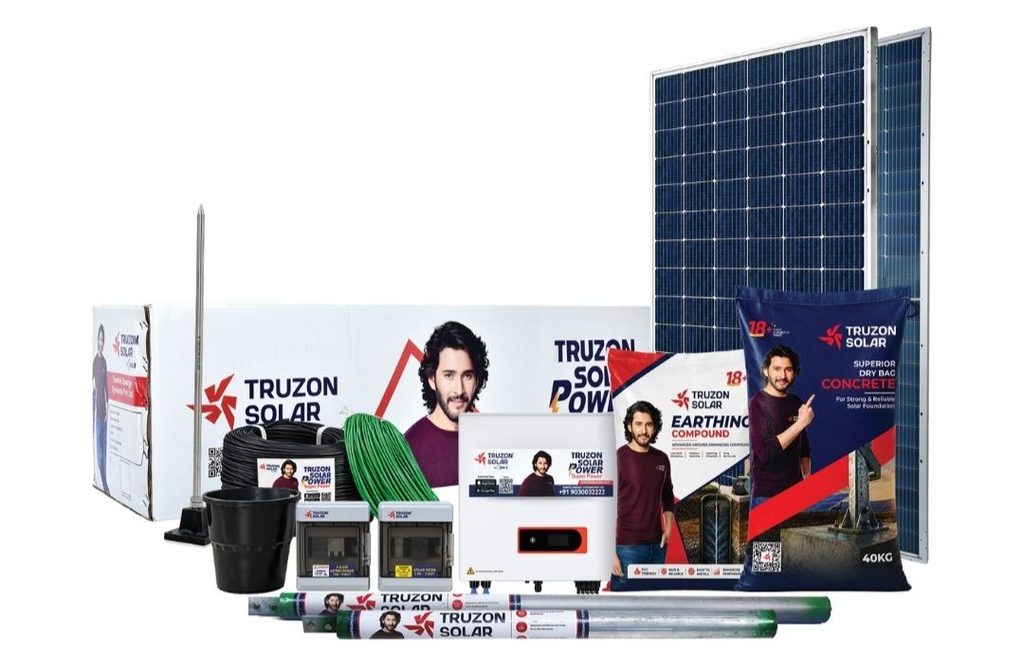
The vendor installs the panels, inverter, mounting structure, cables, protection boxes, earthing and other approved equipment according to MSEDCL specifications.
Step 6: Upload the Installation Details
After completion, upload the plant details, invoice, equipment information, declarations and photographs. The consumer must then apply for the prescribed metering arrangement.
Step 7: Inspection and Commissioning
MSEDCL scrutinises the documents, checks grid-interconnection and safety compliance, tests the system and signs the joint inspection report. Once approved, the system is commissioned and synchronised with the distribution network.
Checks Before Selecting a Solar Vendor
Before paying an advance, confirm:
- Vendor registration and MSEDCL eligibility
- Total price before and after subsidy
- System capacity and number of panels
- Panel technology, wattage and warranty
- Inverter brand and warranty
- DCR compliance
- Mounting structure and civil work
- Earthing and lightning protection
- Net-metering assistance and related charges
- Five-year operation and maintenance responsibility
- Taxes, transport and possible additional costs
The solar panel subsidy in Maharashtra 2026 should not be the only reason for choosing a system. Capacity must match the household’s actual consumption and rooftop conditions.
Read More:– Solar Panel Subsidy in Chhattisgarh 2026: Central and State Benefits, Eligibility & How to Apply
Frequently Asked Questions
1. What is the maximum solar subsidy available in Maharashtra?
An eligible residential consumer can receive up to ₹78,000 under PM Surya Ghar for an approved rooftop system of 3 kW or more.
2. Can I install the system before receiving MSEDCL approval?
This is not advisable. Submit the application and obtain technical-feasibility approval before installation. A system installed outside the authorised process may not qualify.
3. Is the subsidy available for shops and offices?
No. The PM Surya Ghar subsidy is intended for eligible residential electricity consumers. Commercial and industrial properties can install rooftop solar but ordinarily cannot claim this household subsidy.
About the Author