
The first question most homeowners ask about rooftop solar is, “How many kilowatts do I need?” It sounds simple, but the right answer cannot be found by counting bedrooms or looking at the system installed by a neighbour.
A family that uses air conditioners mainly at night will have different requirements from one that runs appliances, pumps, and work-from-home equipment during the day. Roof size, shade and electricity bills matter too.
That is why solar panel installation in Nizamabad should begin with a site survey and consumption review. Choosing the correct capacity at this stage can improve savings and prevent you from paying for a system that is either too small or unnecessarily large.
Table of Contents
- Choosing the Right Solar System Size
- Rooftop Options for Homes in Nizamabad
- On-Grid, Off-Grid or Hybrid Solar
- Benefits of Solar Panel Installation in Nizamabad
- Solar Installation Process
- Solar Payback in Nizamabad
- Why Choose Truzon Solar?
- Frequently Asked Questions
Choosing the Right Size for Solar Panel Installation in Nizamabad
A 1kW system is generally considered by households with limited consumption. In favourable conditions, it may generate about four to five units on a sunny day.
A 2kW system can work for a small family using lights, fans, a refrigerator, television and basic appliances. It may produce approximately eight to ten units on a good day.
For many independent homes, 3kW becomes the practical middle ground. It may generate around 12–15 units daily under favourable conditions and suit households with moderate use of air conditioning and other appliances.
Larger homes may consider 5kW, which could produce roughly 20–25 units on a clear day. A 10kW system is typically more suitable for very large homes, clinics, schools, offices, or properties with consistently high consumption.
Before planning solar panel installation in Nizamabad, collect at least six months of electricity bills. A full year is better because it captures the difference between summer and winter usage.
Rooftop Options for Homes in Nizamabad
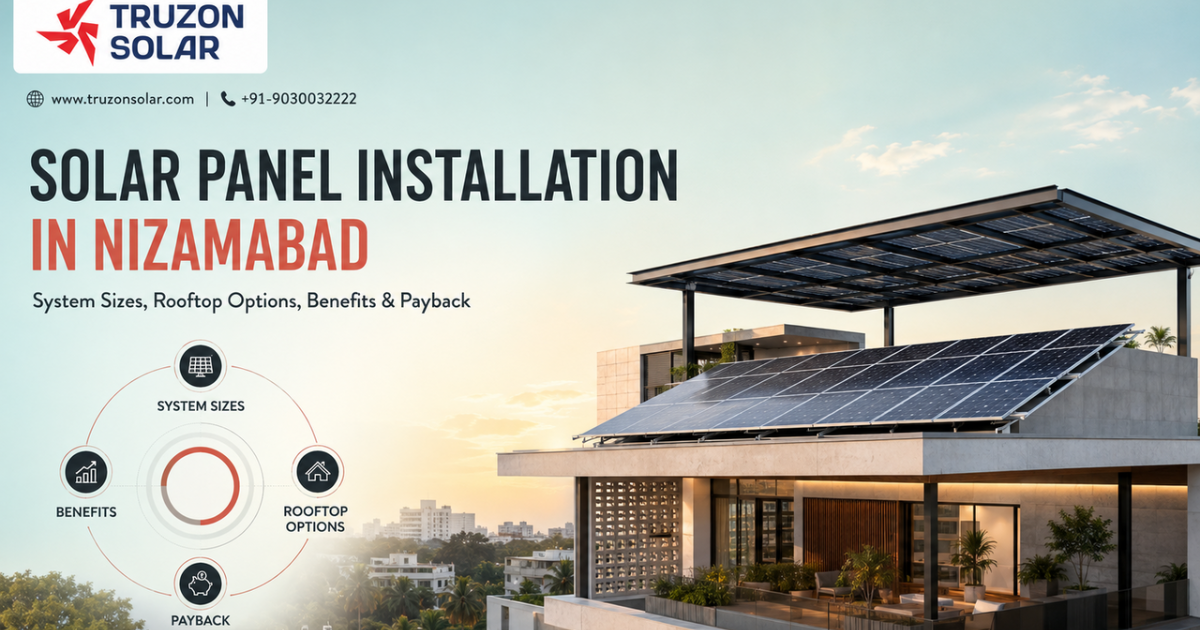
An open reinforced-concrete terrace is usually the easiest roof for solar. The structure can be positioned to receive sunlight while leaving walking space for cleaning and maintenance.
Some homeowners prefer an elevated structure so the terrace remains usable. It can create shade beneath the panels or leave space for household activities. However, the structure needs careful engineering because added height increases wind exposure and project cost.
Solar can also be installed on sloped or metal roofs, but the mounting arrangement will differ. The installer must check the roof’s material, strength, age and waterproofing before beginning work.
Shade is often the bigger problem. Water tanks, trees, nearby buildings and parapet walls can reduce production during important sunlight hours. A rooftop may look spacious and still have less usable solar area than expected.
A proper survey for rooftop solar in Nizamabad should identify these obstacles before the capacity is finalised.
On-Grid, Off-Grid or Hybrid Solar?
Most urban households consider an on-grid system because it is comparatively economical and works with a grid-connected metering arrangement. The home uses solar electricity while the panels are generating, and any eligible surplus power can be exported in accordance with the applicable rules.
An ordinary on-grid system shuts down during a power cut for safety. This sometimes surprises buyers who assume panels will keep the house running whenever sunlight is available.
An off-grid system uses batteries and can provide power independently, but battery storage increases the price and requires eventual replacement.
A hybrid system combines grid connectivity with battery backup. It can suit homes where outages are frequent or certain appliances must remain operational, although it costs more than a standard on-grid plant.
Before approving a solar panel installation in Nizamabad, decide whether your main goal is to reduce electricity bills, receive backup during outages, or achieve both. That choice affects the inverter, battery requirement and overall budget.
Benefits of Solar Panel Installation in Nizamabad
The most visible benefit is a reduction in electricity purchased from the grid. Once installed, the panels generate power from sunlight without a recurring fuel cost.
Solar can also make future electricity expenses more predictable. Grid tariffs may change, but part of the household’s consumption is being met from its own rooftop.
Another advantage is the system’s long operating life. Good-quality panels are usually supplied with long performance warranties. Inverters have shorter warranty periods and may require replacement sooner, so this should be factored into long-term return estimates.
The greatest benefit comes when solar panel installation in Nizamabad is carefully matched to the property’s actual electricity usage.
Solar Installation Process in Nizamabad
The process begins with electricity bills and a rooftop visit. The installer measures the available area, studies shade and checks how cables can be routed safely.
A detailed proposal is then prepared. It should mention the system capacity, panel and inverter models, structure, expected generation, warranties and everything included in the price.
For a subsidy-linked residential system, the consumer must follow the PM Surya Ghar registration and technical feasibility procedures. After the necessary stage is completed, the structure, panels, inverter, protection equipment and earthing are installed.
The physical installation of a standard home system may take only a few days. Inspection, commissioning and grid-connected metering formalities can take longer.
What Is the Solar Payback Period in Nizamabad?
Payback refers to the time required for accumulated electricity savings to recover the amount invested.
Suppose a 3kW system generates around 4,500 units a year. If each unit saves an average of ₹7, the annual benefit would be approximately ₹31,500. The subsidy can reduce the homeowner’s effective investment and shorten the recovery period.
Actual solar payback in Nizamabad will depend on the system price, subsidy eligibility, electricity tariff, generation and consumption. A household paying a higher tariff may recover its investment sooner because every solar unit replaces more expensive grid power.
Why Choose Truzon for Solar Panel Installation in Nizamabad?
Truzon Solar provides residential, commercial and industrial solar solutions across Telangana and has a local presence in Nizamabad. Its work covers the rooftop survey, system design, installation, net-metering coordination, subsidy assistance and after-sales service.
With more than decades years of experience in the solar sector, Truzon assesses the property before recommending capacity. This makes the proposal easier to understand, and the savings estimate more realistic.
Also Read: 10kW Solar Panel Price in India with Subsidy – 2026
Frequently Asked Questions
Which solar system size is suitable for a normal home?
A 2kW or 3kW system may suit many households, but the correct size depends on electricity bills, roof space and usage.
Can rooftop solar supply electricity during a power cut?
A standard on-grid system typically shuts down during an outage; battery-backed off-grid or hybrid systems are needed for backup power.
How long does residential solar take to recover its cost?
The payback may broadly fall between four and seven years, depending on the price, subsidy, generation and electricity tariff.
About the Author