

Solar energy for the residential sector is a good option, and the Indian government is backing up with various incentives to encourage its adoption. More importantly, you can offset your costs against extra electricity generated by using the net metering option.
In this blog, let’s understand how net metering works, the difference between net metering vs net billing and how on-grid solar system users can benefit from net metering.
What is Solar Net Metering?
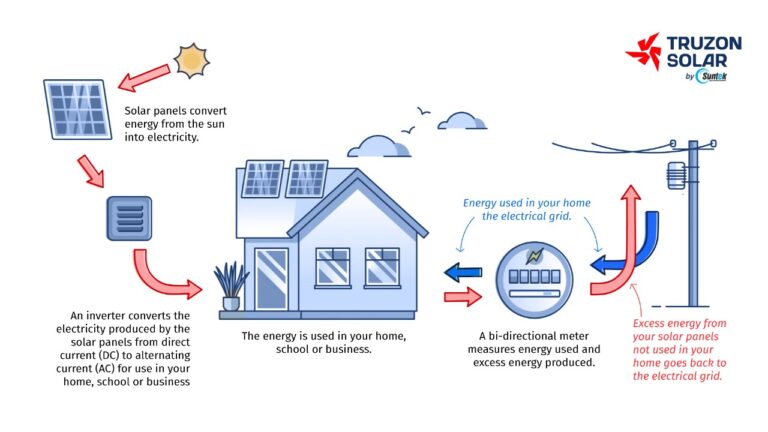
Solar net metering is a billing arrangement in which solar system owners can connect their photovoltaic (PV) systems to the electric grid. The excess energy generated by the solar system can be fed back to the grid and the owner receives the credits for surplus energy.
Key Facts about Solar Net Metering
A single bi-directional meter is installed at the point of supply where energy is imported from the grid, and the energy exported from the grid-interactive rooftop solar PV of a consumer is computed at two different tariffs.
The amendment to the Electricity (Rights of Consumers) 2020 rules allows net metering to prosumers for loads up to 500 kW or the sanctioned load, whichever is lower.
30% of the total cost is being facilitated by the government as a subsidy for equipping net metering system.
Merits of Net Metering
- Net metering allows consumers to generate clean and green electricity using solar energy.
- Surplus energy produced during sunlight hours is exported to the grid under net metering, reducing electricity bills.
- Helps manage peak load demand during the day and minimizes load shedding.
- Assists State DISCOMS in reducing transmission and distribution (T&C) wheeling losses.
- Corporations, industrial establishments, and educational institutes benefit by saving on electricity bills with net metering.
- The grid acts as a virtual battery bank, storing excess solar power for use during lean times.
- Due to net metering, minimal maintenance is required as the primary components (solar modules and inverter) have no moving parts.
- Provides valuable data by recording energy generated, consumed, and exported to the grid.
Demerits of Net Metering
- Consumers in semi-urban areas are often limited to smaller rooftop solar PV systems due to connected load restrictions.
- Certain entities, like Indian Railways, cannot benefit from net metering due to policy limitations.
- Residential owners in multi-story buildings lack rooftop rights to install net metering systems.
- Shared rooftop spaces in housing societies are underutilized as net metering provisions allow only one consumer per generation point.
- Lack of awareness among consumers about interpreting net metering bills.
- Consumers face limitations in using surplus energy during grid outages.
How does Solar Net Metering work?
Solar net metering allows homeowners with rooftop solar systems to balance energy production and consumption. During daylight hours, when the system generates more electricity than needed, the surplus is sent to the grid.
At the end of the month, the homeowner is billed only for the “net” energy used—this is the difference between the electricity consumed from the grid and the energy produced by the solar system.
Depending on local policies, any surplus energy sent to the grid may earn credits, which will offset the cost of electricity drawn during non-sunny periods. This means you only pay for your net energy usage, making solar energy cost-effective.
What are the Benefits of Net Metering?
- Net metering allows solar system owners to offset electricity bills by generating excess energy and receiving credits for surplus production, leading to significant financial savings.
- It promotes renewable energy by encouraging solar power adoption, increasing clean energy share, reducing emissions, and combating climate change.
- Solar systems connected through net metering stabilize the electricity grid by feeding excess energy, reducing strain on power plants, and limiting infrastructure upgrades.
- The adoption of net metering fosters job creation in installation, maintenance, and monitoring, boosting the renewable energy sector and driving economic growth.
- Net metering enables energy independence, letting users generate their own electricity, ensuring resilience against outages and price fluctuations.
What are the Steps to Avail Solar Net Metering?
- Determine eligibility for net metering based on local regulations and system size.
- Contact the utility provider to inquire about their net metering program and requirements.
- Install a solar PV system with the help of a reputable installer, ensuring compliance and permits.
- Submit an application to the utility provider with system details and required documentation for the net metering request.
- Allow the utility provider to inspect the system and connect it to the grid.
- Sign the net metering agreement outlining terms, credits, and billing procedures.
- Start generating electricity and receive credits for surplus energy fed into the grid.
- Regularly monitor system performance and conduct maintenance for optimal efficiency.
Take a step towards energy independence with Truzon Solar…
Net metering offers solar system owners a compelling financial advantage while promoting the adoption of renewable energy solutions. By seamlessly integrating solar power into the grid, net metering contributes significantly to a sustainable energy future. However, it’s essential to understand that net metering procedures can vary across regions, and consulting your local utility provider to follow specific guidelines is highly recommended.
Choosing a reliable partner like Truzon Solar can simplify the process further, as their expertise ensures smooth system installation, compliance with regional policies, and ongoing support to help you maximize the benefits of net metering and solar energy.
About the Author