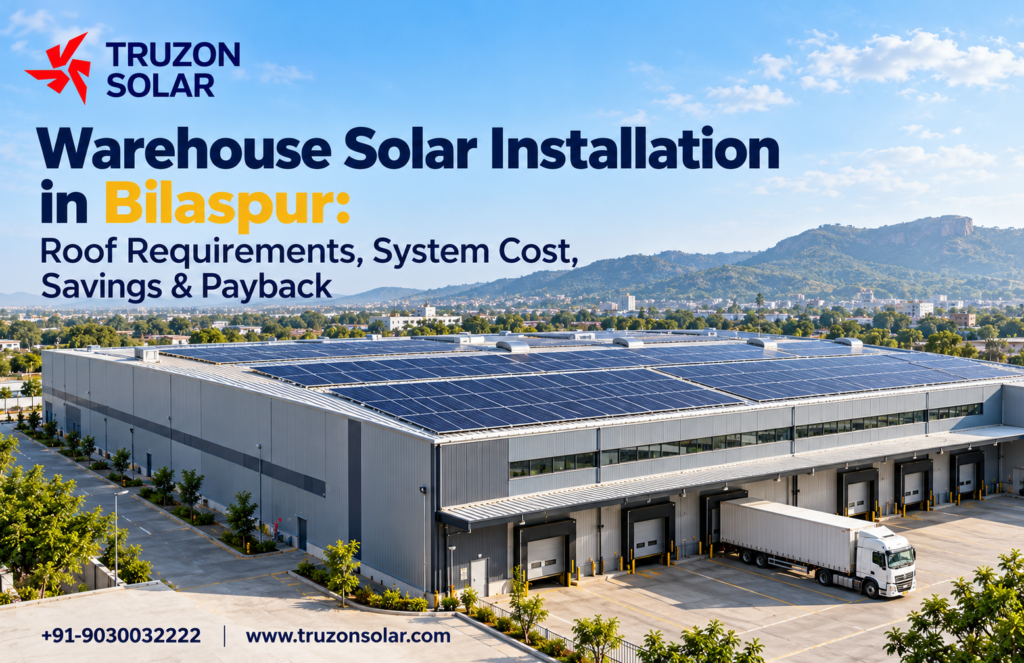

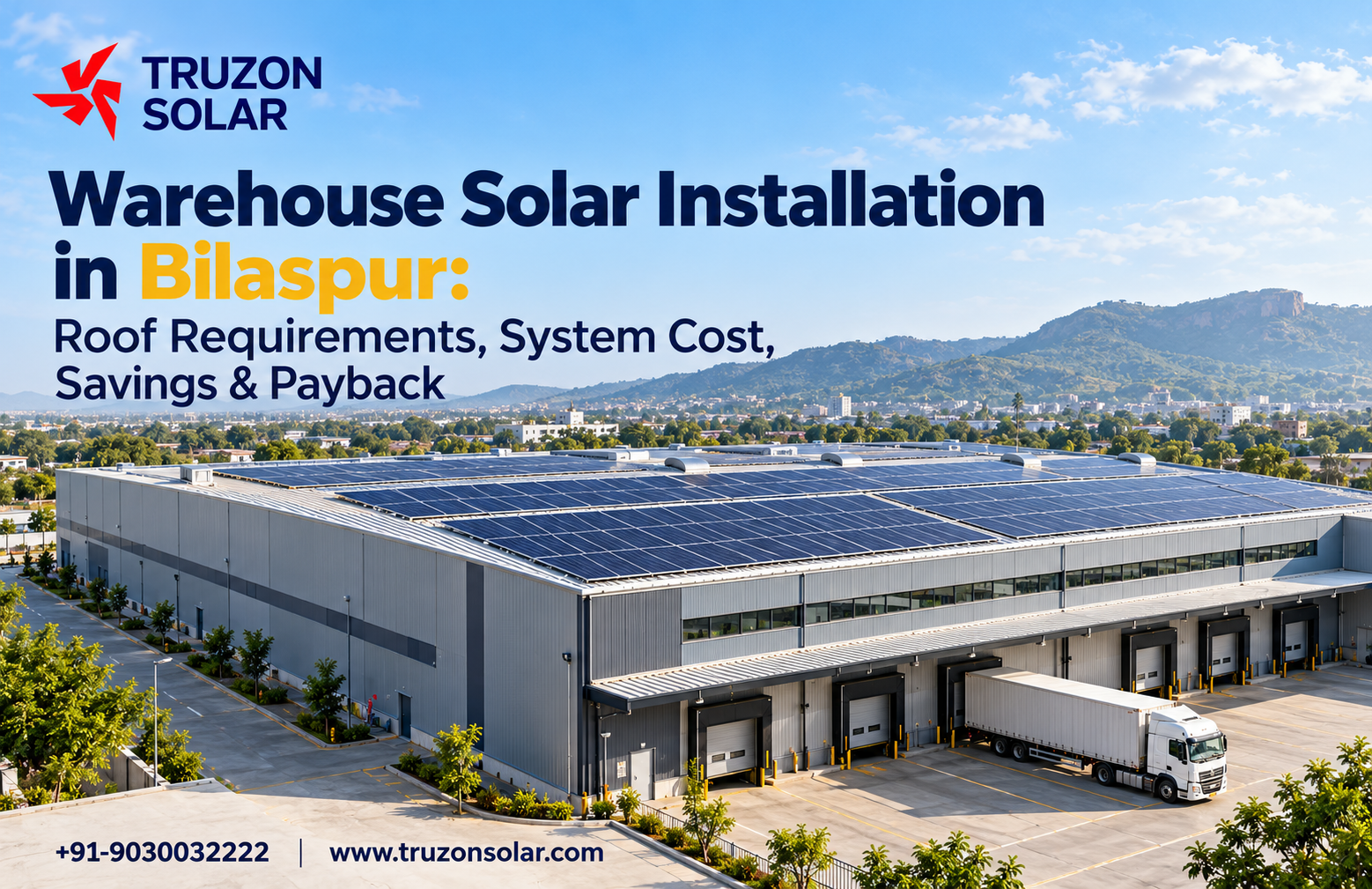
Warehouses often have something solar developers value: a broad, unobstructed roof. Logistics facilities, distribution centres and cold-storage buildings around Bilaspur may have enough surface area for hundreds of kilowatts of generation. Yet a large roof is only the beginning. Its strength, ownership, orientation and remaining life determine whether a project is practical.
Warehouse solar installation in Bilaspur can lower electricity costs from lighting, ventilation, material-handling equipment and refrigeration. It may also allow an otherwise unused roof to support a productive business asset.
Table of Contents
- Why Warehouses Consider Solar
- Roof Requirements
- System Capacity
- Project Cost
- Savings and Payback
- Installation Procedure
- Maintenance and Safety
- FAQs
Why Warehouse Solar Installation Makes Sense
A dry warehouse may have a modest electricity requirement, while a cold-storage facility can consume power continuously. The correct solar strategy is different for each.
In a standard warehouse, solar may support daytime lighting, fans, office equipment, conveyors and charging systems. In cold storage, it can offset refrigeration compressors and auxiliary machinery. Facilities that charge electric forklifts during the day may achieve particularly useful self-consumption.
An energy study should be completed before filling the roof with panels. Generating far more electricity than the warehouse uses can weaken the business case unless the proposed export arrangement is permitted and financially worthwhile.
Roof Requirements for a Bilaspur Warehouse
Metal-sheet roofs are common in warehousing, but they must be inspected before solar equipment is added. Engineers should check the sheeting, purlins, trusses, fasteners and existing leakage.
The roof should provide:
- Adequate structural load capacity
- Sufficient remaining service life
- Safe access for installation and cleaning
- Clear drainage paths
- Space around skylights and vents
- Fire and emergency pathways
- Minimal shadow during productive hours
- Suitable anchoring points
Panels should not be installed over severely corroded sheets that will soon require replacement. Removing an entire solar array for roof repairs can be expensive and disruptive.
For reinforced-concrete roofs, the design must consider slab strength, waterproofing and wind load. Ballasted structures can reduce penetrations in some cases, but they add weight and require proper engineering.
Capacity Based on Roof Area
A preliminary calculation may use 70–100 square feet for every kilowatt.
| Usable roof area | Approximate capacity |
| 5,000 sq. ft. | 50–65 kW |
| 20,000 sq. ft. | 200–260 kW |
| 50,000 sq. ft. | 500–650 kW |
| 1,00,000 sq. ft. | 1–1.3 MW |
The final layout should leave room for maintenance and emergency access. Packing modules too tightly may increase installed capacity but make cleaning and repairs unnecessarily difficult.
Warehouse Solar System Cost in 2026
| System size | Indicative investment |
| 50 kW | ₹22–₹30 lakh |
| 100 kW | ₹42–₹55 lakh |
| 250 kW | ₹95 lakh–₹1.30 crore |
| 500 kW | ₹1.80–₹2.50 crore |
| 1 MW | ₹3.40–₹4.80 crore |
These prices are planning ranges. Roof reinforcement, new electrical panels, transformer changes, long cable runs or specialised walkways may increase the investment.
The Central residential rooftop subsidy generally should not be included in the calculation for a commercial warehouse. Owners should obtain professional advice regarding depreciation, taxation and financing rather than treating them as automatic benefits.
Electricity Savings and Payback
A 250 kW plant in Bilaspur might generate approximately 3.5–3.9 lakh units annually under favourable operating conditions. If 85% of that production is effectively consumed or adjusted at an average value of ₹8.50 per unit, the annual gross benefit could be around ₹25–₹28 lakh.
If the project costs ₹1.10 crore, simple payback may fall near four to five years. A warehouse with low daytime consumption, however, could take longer despite having the same solar output.
For a cold-storage unit with a steady load, self-consumption may be high. A lightly used storage building may need a smaller system or a carefully assessed grid arrangement.
Chhattisgarh’s framework allows eligible consumers to feed surplus energy into the grid for adjustment under the applicable rules. The state guidelines also specify technical studies, sanctioned-load limitations and interconnection requirements.
Warehouse Solar Installation Process
The project begins with electricity-data collection and roof inspection. Engineers then prepare the plant layout, structural assessment, single-line diagram and generation projection.
After commercial approval, the installer handles the applicable permissions, equipment procurement and site planning. Installation typically covers mounting hardware, modules, DC cables, inverters, AC panels, protection devices, earthing and monitoring.
Testing must confirm that electrical protections operate correctly before grid synchronisation. The owner should receive as-built drawings, warranties, datasheets, test reports and a maintenance schedule at handover.
Maintenance, Fire Safety and Roof Protection
Warehouse operators should maintain clear access routes and prevent stored goods from obstructing electrical equipment. Inverters and panels must not interfere with fire vents, hydrants or smoke-release systems.
Dust should be monitored because a warehouse near busy roads or handling areas may need more frequent cleaning. Technicians should inspect connections, cable supports, roof fasteners, corrosion and inverter alarms.
Truzon can evaluate warehouse electricity use, roof condition and financial objectives before recommending capacity. The final plan should protect the building as carefully as it protects generation.
A properly maintained plant can operate for decades, but it should never be considered maintenance-free. Small problems noticed through remote monitoring are easier and cheaper to correct than faults discovered after several months of lost output.
Read More:- Solar Power for Hotels in Kolhapur: Installation Cost, Energy Savings, Capacity & ROI
Frequently Asked Questions
1. Can an old warehouse roof support solar panels?
Possibly, but only after structural and condition assessments. Weak or corroded sections should be repaired or replaced before installation.
2. Does warehouse solar require batteries?
Not necessarily. Most cost-saving projects are grid-connected without batteries. Storage is added only when backup or another operational objective justifies its cost.
3. How quickly can the investment be recovered?
A project with strong daytime consumption may achieve simple payback in approximately four to six years. Low utilisation or major structural work can extend the period.
About the Author