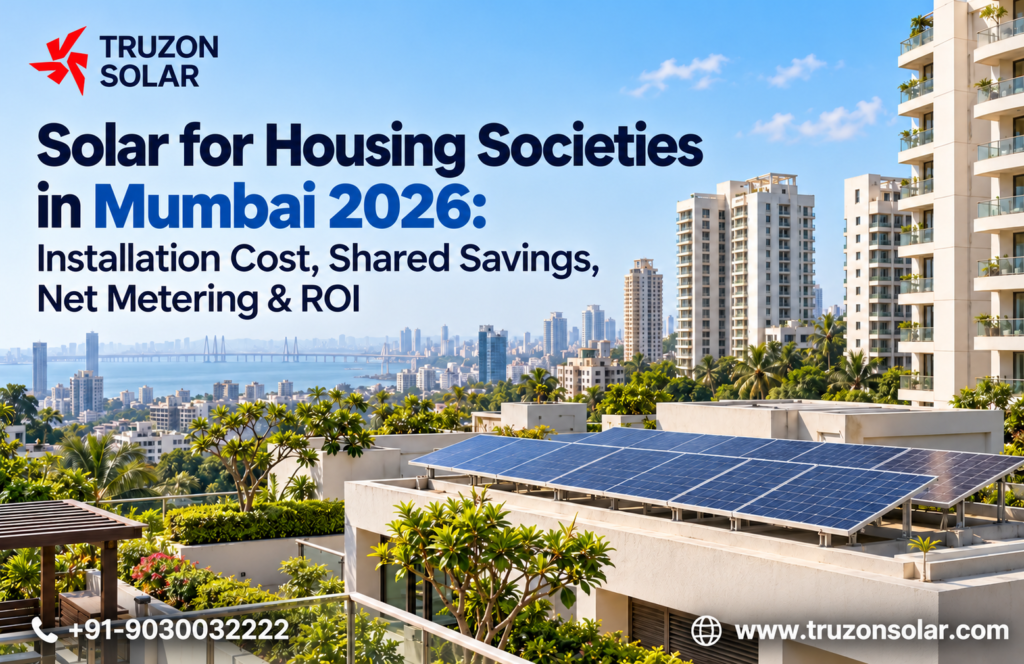

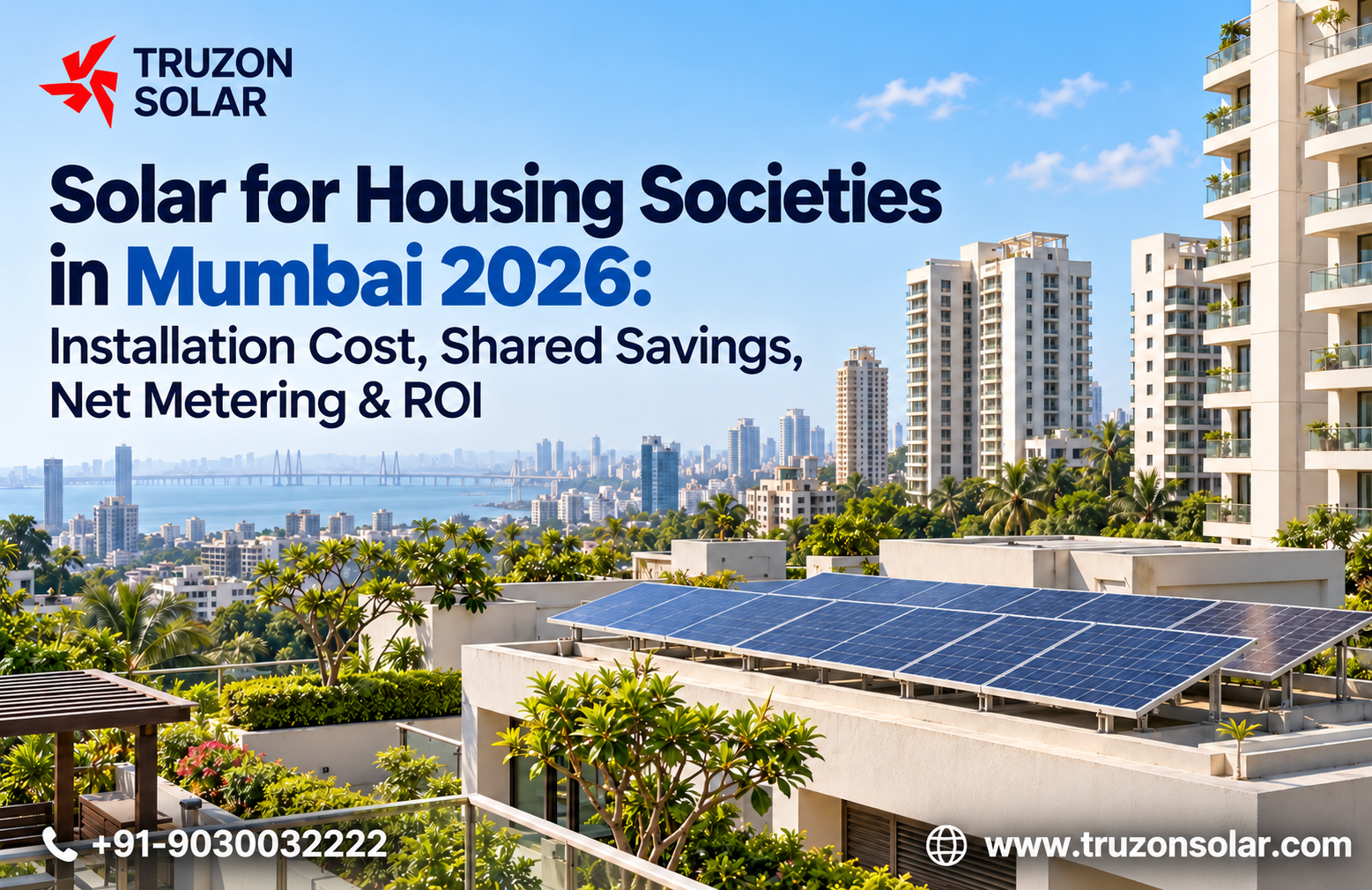
Apartment buildings across Mumbai spend a considerable amount every month on lifts, water pumps, passage lighting, security systems, clubhouses and parking ventilation. These common-area facilities operate throughout the year and are normally paid for through maintenance collections. Installing solar for housing societies in Mumbai can reduce this recurring expense without changing the electricity supply available to individual apartments.
A society solar plant is not simply a collection of panels placed on a terrace. It involves structural assessment, common-load analysis, member approval, electrical design and coordination with the applicable electricity distribution company. When planned correctly, it can become a long-term asset that lowers society expenses for more than two decades.
Table of Contents
- How Society Solar Works
- Suitable Capacity
- Installation Cost
- Subsidy and Net Metering
- Shared Savings and ROI
- Installation Process
- Selecting an Installer
- FAQs
How Solar for Housing Societies in Mumbai Works
A grid-connected society solar plant produces electricity during daylight hours. The generated power can be used against eligible common-area consumption, such as lifts, pumps, corridor lights, society offices, CCTV equipment and electric-vehicle charging.
The usual objective is not to run every apartment independently from one rooftop system. The first task is to identify the meters connected to common services and examine their billing history. The installer can then recommend an arrangement permitted by the society’s electricity distributor.
Depending on the location, a Mumbai property may be served by BEST, Adani Electricity, Tata Power or MSEDCL. Therefore, the application and metering process must follow the requirements of the correct distribution licensee.
How Much Solar Capacity Does a Society Need?
Capacity should be selected from actual electricity consumption rather than the number of flats alone. A 40-flat building with basic common services may need a smaller system than a 25-flat tower with multiple lifts, mechanical parking and a large water-pumping load.
As an initial guide:
| Society type | Possible capacity |
| Small building with one lift | 10–20 kW |
| Medium society with several common loads | 25–50 kW |
| Large residential complex | 75–200 kW |
| Multi-tower project | 200 kW and above |
Every kilowatt generally requires around 80–100 square feet of usable roof area. Setbacks, water tanks, lift rooms, fire-access routes and shadows from neighbouring towers can reduce the space available for panels.
Solar Installation Cost for Mumbai Housing Societies
Commercial-scale rooftop systems usually cost less per kilowatt than very small residential plants. Nevertheless, Mumbai projects may need elevated mounting structures, additional waterproofing protection, longer cable routes or corrosion-resistant components.
| System size | Indicative project cost |
| 10 kW | ₹5.5–₹7 lakh |
| 25 kW | ₹12–₹16 lakh |
| 50 kW | ₹22–₹30 lakh |
| 100 kW | ₹42–₹58 lakh |
| 200 kW | ₹80 lakh–₹1.10 crore |
These are broad 2026 estimates before any eligible financial assistance. The quotation should clearly mention modules, inverters, structure, safety equipment, earthing, installation, approvals, monitoring and taxes.
Subsidy for Housing Society Solar in 2026
Under the PM Surya Ghar framework, eligible group housing societies and resident welfare associations can receive Central Financial Assistance for solar installations serving common facilities, including EV charging. The published support is ₹18,000 per kW for eligible capacity up to 500 kW, subject to a limit calculated at 3 kW per dwelling and adjusted for individual rooftop systems already installed by residents.
Eligibility is not automatic. The society must apply through the prescribed channel, follow the approved technical standards and meet documentation requirements. Before including subsidy in the financial proposal, the managing committee should obtain written confirmation based on the society’s specific case.
Net Metering and Shared Savings
Net metering allows eligible surplus generation to be exported to the grid and adjusted according to the applicable regulations. Maharashtra’s current framework includes the original 2019 rooftop regulations and subsequent amendments, so societies should rely on the latest procedure issued by their distribution licensee. MERC
A society should ideally size its plant around common-area consumption. Heavy daytime loads improve direct use of solar energy and reduce dependence on exported units.
For example, a 50 kW system may generate approximately 70,000–80,000 units annually under suitable conditions. If the effective value of each useful unit averages ₹10, the annual benefit may reach ₹7–₹8 lakh. After allowing for cleaning, insurance and maintenance, a project costing ₹25 lakh could potentially recover its net cost in approximately three to five years, depending on subsidy, tariff and generation.
Savings may be used to reduce monthly maintenance, build a repair fund or support other efficiency projects. The distribution method should be approved transparently through society resolutions and recorded in the accounts.
Installation Process for a Mumbai Society
The committee should begin by collecting twelve months of common-meter bills. A solar company then surveys the terrace, examines shadows and checks the building’s electrical infrastructure.
The normal sequence includes:
- Presenting the feasibility report to society members.
- Passing the required general-body resolution.
- Verifying structural stability and roof ownership.
- Finalising capacity, equipment and commercial terms.
- Applying through the appropriate portal or DISCOM.
- Installing the structure, panels and electrical system.
- Completing inspection and metering formalities.
- Commissioning the plant and activating monitoring.
Waterproofing responsibilities must be documented before work begins. The agreement should also explain who will remove and reinstall panels if major roof repairs become necessary.
Choosing the Right Solar Partner
A capable installer should understand high-rise safety, coastal corrosion, DISCOM procedures and society decision-making. Truzon can support housing societies with consumption analysis, engineering, documentation, installation and performance monitoring.
The committee should compare warranties, safety provisions and projected generation—not merely the lowest price. Ask every bidder to specify whether generation estimates are guaranteed, indicative or dependent on external conditions.
Read More:– Solar Panel Installation in Nashik 2026: Prices, Subsidy, Installation Process & ROI
Frequently Asked Questions
1. Can society solar reduce individual flat bills?
A common-area system ordinarily reduces electricity expenses connected to society meters. Benefits reach residents indirectly through lower maintenance costs unless an approved virtual or group arrangement allocates energy differently.
2. Is subsidy available to every housing society?
Only eligible projects meeting the applicable PM Surya Ghar and DISCOM conditions can receive assistance. The society should confirm eligibility before approving its budget.
3. What is the expected payback period?
A well-sized project may achieve simple payback in approximately three to six years. Roof conditions, tariff, subsidy, consumption and financing determine the actual period.
About the Author