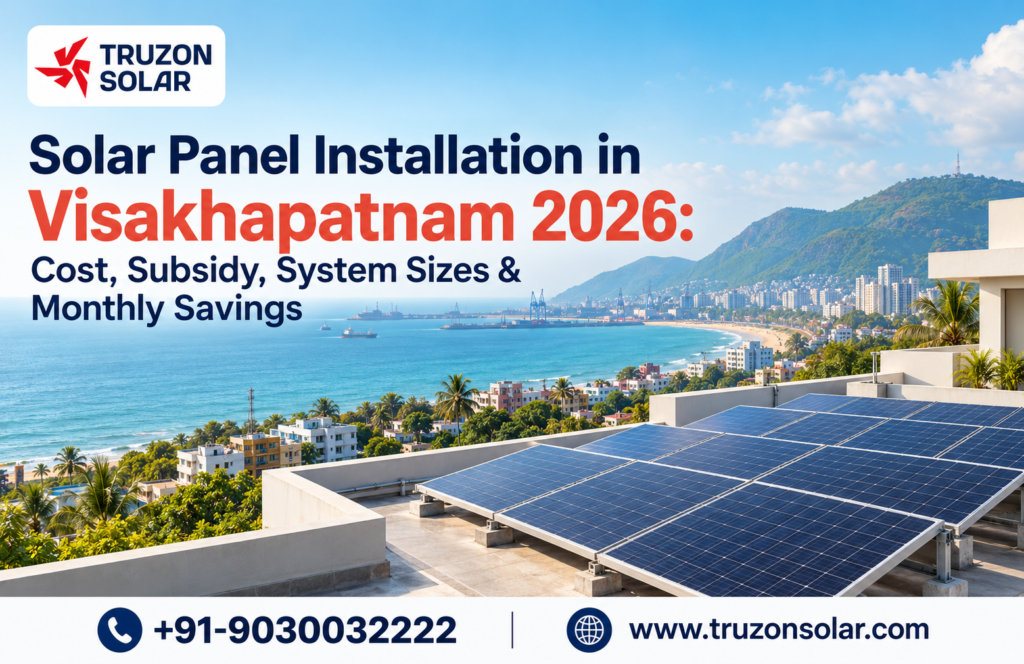

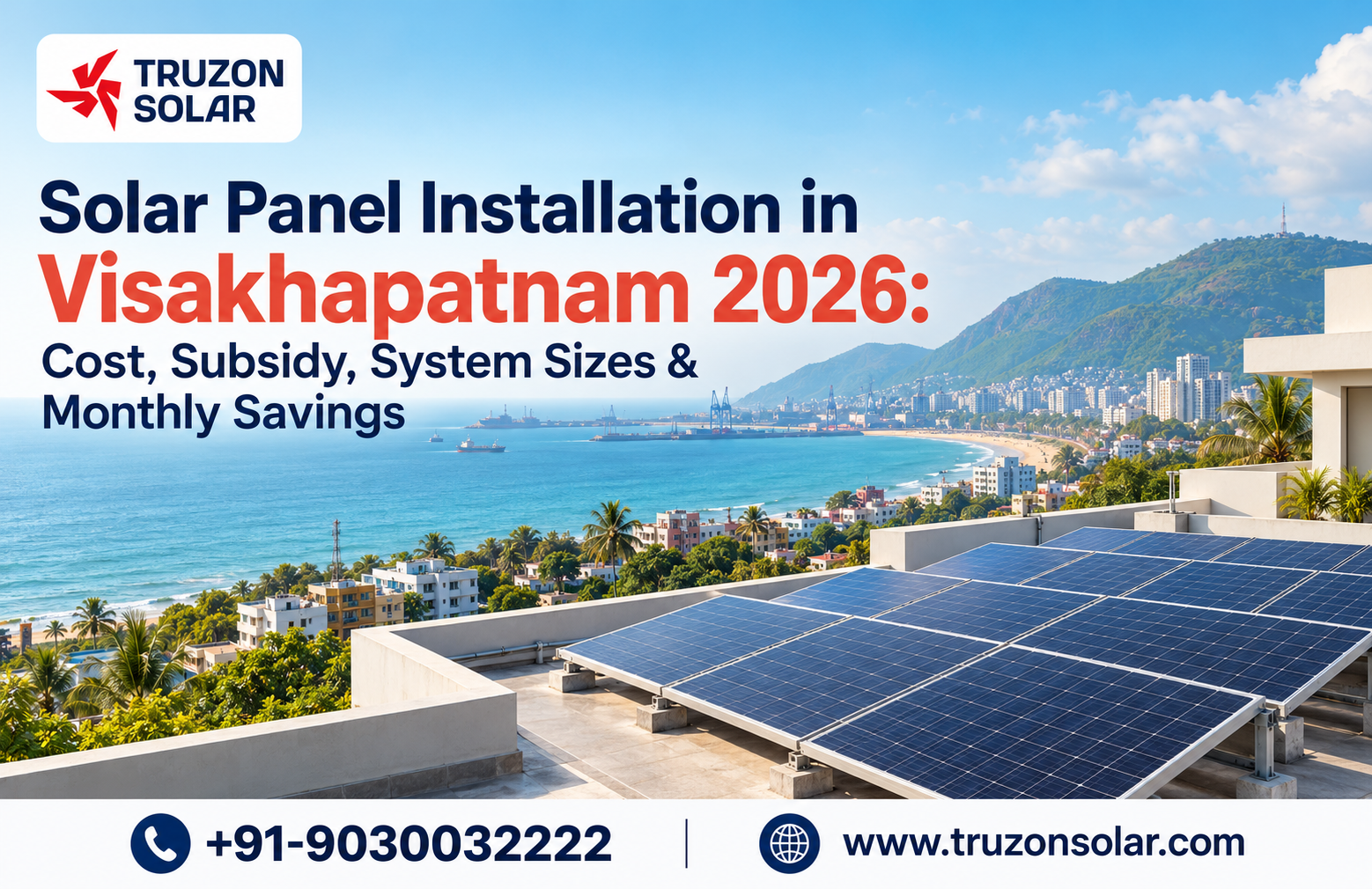
Visakhapatnam’s sunny coastal weather gives homes a good opportunity to generate electricity from their rooftops. A solar system can reduce dependence on grid power, but the result depends on choosing the correct capacity and using equipment suitable for a humid, salt-heavy environment.
Before planning solar panel installation in Visakhapatnam, homeowners should review their electricity bills, inspect the roof and understand how the subsidy process works. Buying the largest system available is not always the right decision. The plant should match the household’s actual consumption and budget.
Table of Contents
- Is Rooftop Solar Suitable for Visakhapatnam?
- Solar Installation Cost in 2026
- Choosing the Right System Size
- PM Surya Ghar Subsidy
- Monthly Generation and Savings
- Solar Installation Process
- Selecting a Reliable Installer
- Frequently Asked Questions
Is Solar Panel Installation in Visakhapatnam Worth It?
Visakhapatnam receives strong sunlight during much of the year. A rooftop without heavy shade can therefore generate a meaningful part of a household’s electricity requirement.
Local estimates suggest that 1kW of rooftop capacity may produce around four to four-and-a-half units on a reasonably sunny day. Generation will be lower during cloudy weather and the monsoon.
Being a coastal city, Visakhapatnam also presents a few installation challenges. Salty air and humidity can speed up corrosion. The mounting structure, fasteners, outdoor boxes and cable connections should therefore be chosen and installed carefully.
Panels may also collect dust, salt residue and bird droppings. Periodic cleaning is necessary, but harsh chemicals or abrasive brushes should not be used.
Solar Panel Installation Cost in Visakhapatnam
The cost of a rooftop system depends on capacity, panel technology, inverter, structure, protection equipment and roof conditions.
Indicative prices for on-grid residential systems in 2026 are:
| System size | Approximate cost before subsidy | Approximate cost after subsidy |
| 1kW | ₹70,000–₹90,000 | ₹40,000–₹60,000 |
| 2kW | ₹1.35–₹1.60 lakh | ₹75,000–₹1 lakh |
| 3kW | ₹1.85–₹2.30 lakh | ₹1.07–₹1.52 lakh |
| 5kW | ₹2.80–₹3.60 lakh | ₹2.02–₹2.82 lakh |
| 10kW | ₹4.50–₹6 lakh | ₹3.72–₹5.22 lakh |
These prices are estimates, not fixed rates. One Visakhapatnam installer places a standard 3kW system near ₹2.30 lakh before subsidy and ₹1.52 lakh after subsidy. Market figures for larger systems vary according to the equipment and work included.
Elevated structures, difficult cable routes, waterproofing and premium equipment can raise the quotation. A hybrid system with batteries will also cost more than an ordinary on-grid system.
Choosing the Right Solar System Size
1kW Solar System
A 1kW system may suit a small house with light electricity use. It can generate approximately 110–135 units per month and needs around 80–100 square feet of clear roof area.
2kW Solar System
A 2kW system may work for a small family using fans, lights, a refrigerator, television and basic appliances. Expected monthly generation can be around 220–270 units.
3kW Solar System
A 3kW system is often suitable for medium-sized homes. It may produce approximately 330–405 units per month and generally needs 250–300 square feet of roof space.
It can be a practical option for families whose electricity use rises because of air conditioners, pumps or home-office equipment.
5kW Solar System
A 5kW system may suit a large home with several air conditioners, water pumps and other high-load appliances. Monthly generation may fall between 550 and 675 units.
This capacity usually needs around 400–500 square feet of clear space. Since the residential subsidy stops increasing beyond 3kW, the additional capacity should be chosen only when the household can use it effectively.
PM Surya Ghar Subsidy in Visakhapatnam
Eligible residential consumers can apply under PM Surya Ghar: Muft Bijli Yojana.
The current Central subsidy is:
- ₹30,000 for 1kW
- ₹60,000 for 2kW
- ₹78,000 for 3kW
- ₹78,000 maximum for systems above 3kW
The first 2kW receives ₹30,000 per kW. The third kW receives another ₹18,000. No additional Central assistance is available beyond 3kW.
Visakhapatnam falls under Andhra Pradesh Eastern Power Distribution Company Limited, or APEPDCL. Its website provides PM Surya Ghar information, consumer agreements, vendor details, net-meter guidance and the stepwise application process.
The benefit applies to qualifying residential, grid-connected systems. Commercial and industrial consumers ordinarily cannot claim the household subsidy.
A vendor may assist with the paperwork but cannot independently guarantee approval. The application, equipment and installation must satisfy the official conditions.
Monthly Generation and Savings
The table below gives a realistic broad estimate:
| Capacity | Monthly generation | Possible monthly saving |
| 1kW | 110–135 units | ₹700–₹1,000 |
| 2kW | 220–270 units | ₹1,400–₹2,000 |
| 3kW | 330–405 units | ₹2,100–₹3,000 |
| 5kW | 550–675 units | ₹3,500–₹5,000 |
The actual rupee saving depends on electricity tariff, fixed charges and how much solar energy is used directly. A unit consumed inside the house may be financially more valuable than a unit exported to the grid.
Output also changes with panel direction, temperature, shade, dirt and equipment performance. Homeowners should be cautious when anyone guarantees a fixed monthly generation figure without surveying the roof.
A well-sized residential system may recover its post-subsidy investment in roughly four to six years. Payback will be faster for households paying higher electricity tariffs and using more power during the day.
Solar Panel Installation Process in Visakhapatnam
Step 1: Study the Electricity Bills
The installer should review six to twelve months of consumption. Summer and monsoon usage may differ, so one bill is not enough for accurate sizing.
Step 2: Conduct a Roof Survey
The survey checks clear area, shadows, roof strength, inverter location, cable routing and the need for an elevated structure.
Step 3: Register on the Official Portal
The consumer registers through PM Surya Ghar using the APEPDCL service number, mobile number and other required details.
Step 4: Complete Approval and Select a Vendor
The applicant follows the prescribed feasibility and vendor-selection process. A detailed quotation should be obtained before paying an advance.
Step 5: Install the System
The installer sets up the mounting structure, panels, inverter, cables, protection boxes, earthing and lightning protection. Corrosion-resistant material is especially important near the coast.
Step 6: Inspection and Net Metering
After installation, the required documents and photographs are uploaded. APEPDCL verifies the plant, completes the metering process and approves commissioning.
Step 7: Claim the Subsidy
Once the commissioning certificate is issued, the consumer submits bank details and a cancelled cheque. The approved subsidy is transferred to the beneficiary’s bank account.
Selecting a Solar Installer in Visakhapatnam
A reliable installer should provide:
- Electricity-bill analysis
- Physical roof and shadow survey
- Itemised quotation
- Named panel and inverter models
- Corrosion-resistant structure
- Proper earthing and electrical protection
- APEPDCL and subsidy assistance
- Written warranties
- Local maintenance support
Truzon Solar provides residential, commercial and industrial solar services in Andhra Pradesh, including Visakhapatnam, and reports more than 18 years of solar EPC experience.
Customers should compare at least two or three detailed proposals. A lower price may exclude structure upgrades, electrical protection, government charges or after-sales service.
Read More:- Solar Panel Installation in Bhopal 2026: System Cost, Subsidy, Payback & Installer Guide
Frequently Asked Questions
1. How much does a 3kW solar system cost in Visakhapatnam?
A standard 3kW on-grid system may cost approximately ₹1.85–₹2.30 lakh before subsidy and ₹1.07–₹1.52 lakh after the ₹78,000 subsidy.
2. How many units can a 5kW system generate monthly?
A properly installed 5kW system may generate roughly 550–675 units per month, depending on sunlight, shade, temperature and maintenance.
3. Will an on-grid solar system work during power cuts?
No. A normal on-grid inverter shuts down during an outage for safety. Backup requires a compatible hybrid or off-grid system with batteries.
About the Author