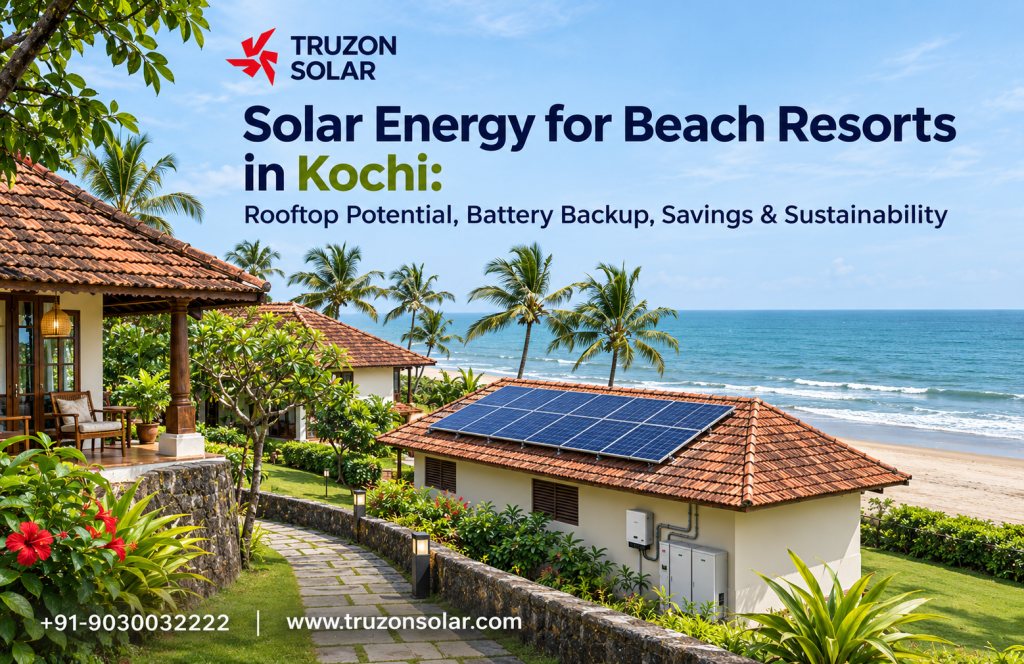

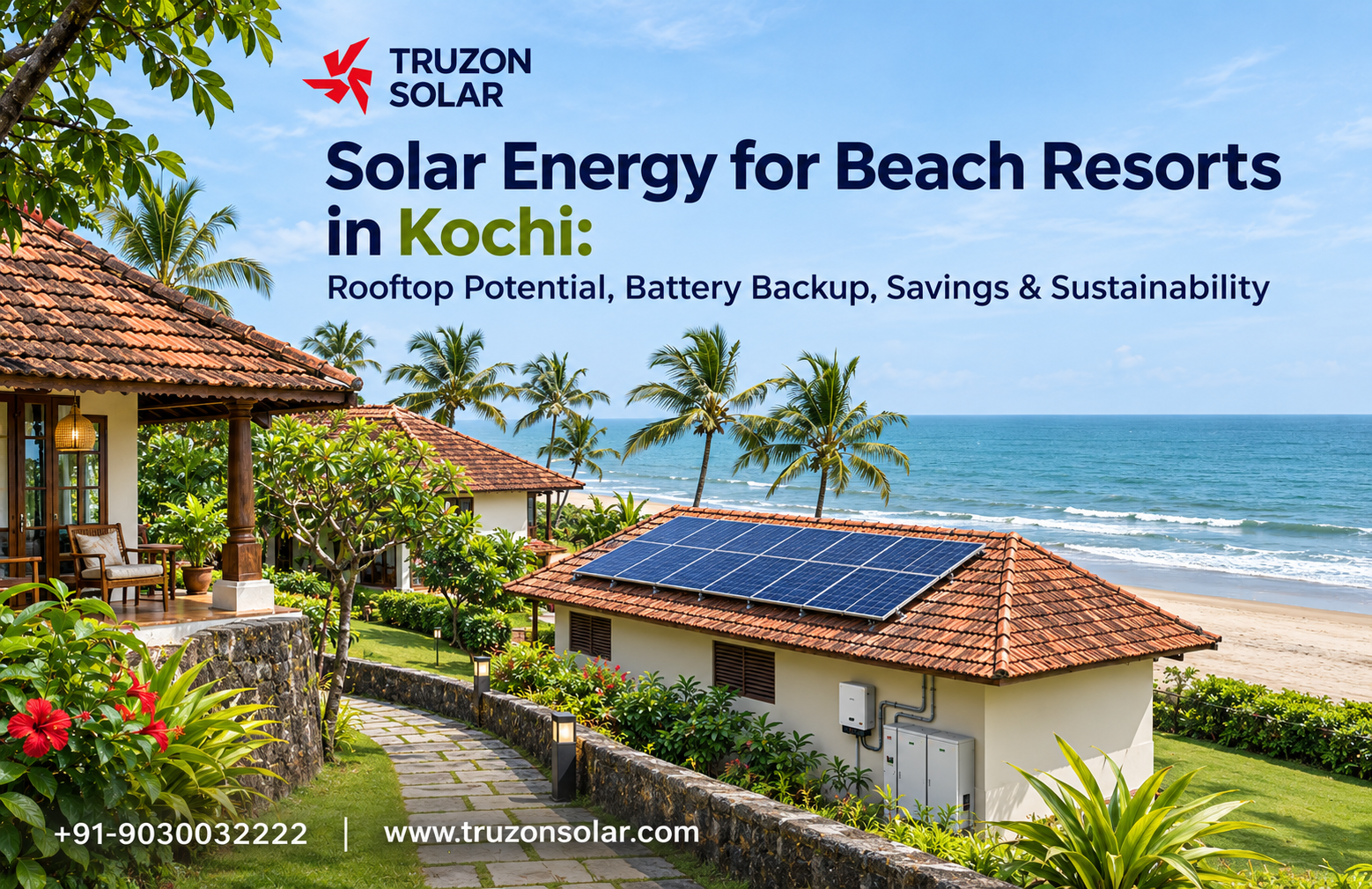
A beach resort faces an unusual energy combination. Cooling and refrigeration are essential, outdoor lighting runs late, and the property may be exposed to salty air, strong winds and heavy rain. Solar can reduce electricity costs, but equipment designed for an ordinary inland roof may not be suitable for a coastal site.
Solar energy for beach resorts in Kochi must balance generation, corrosion protection, aesthetics and guest comfort. The most successful project is one that quietly works in the background without changing the character of the property.
Table of Contents
- Beach-Resort Energy Use
- Rooftop and Parking Potential
- Coastal Solar Design
- Installation Cost
- Battery Backup
- Savings and ROI
- Maintenance and Sustainability
- FAQs
Energy Requirements of a Beach Resort
A resort’s demand may include room cooling, kitchen equipment, laundry, water pumps, swimming-pool systems, refrigeration, security and landscape lighting.
Solar generation is available during daylight, while a meaningful part of resort consumption occurs at night. Capacity should therefore be based on daytime consumption and the approved treatment of surplus electricity.
The energy study should examine monthly bills, occupancy, banquet events, kitchen schedules and generator usage. Monsoon occupancy and generation should also be reflected in the financial model.
Rooftop Potential in Kochi
Guest-room blocks, restaurants, administration buildings and staff facilities may all provide usable space. Solar carports can add capacity without covering landscaped areas and give guests shaded parking.
A preliminary estimate is 70–100 square feet per kilowatt. The actual layout must preserve:
- Roof drainage
- Fire access
- Maintenance pathways
- Views from guest areas
- Access to water tanks and HVAC equipment
- Safe distance from roof edges
- Space for future repairs
Sloping tiled roofs can support solar, but installation may be more complex. The mounting method must protect tiles and waterproofing.
Designing Solar for a Coastal Environment
Salt-laden air can accelerate corrosion. Mounting structures, fasteners, cable trays and enclosures must be selected for coastal exposure. High-quality galvanisation or appropriate aluminium components may be justified even if the initial cost is higher.
Wind-load calculations are essential. The structure must be engineered for the building, roof type and local conditions. Panels should not be installed using generic mounting details.
Heavy rain also makes drainage and cable sealing important. Inverters should be placed in ventilated, protected locations away from direct spray and guest activity.
Installation Cost
| System capacity | Indicative project cost |
| 25 kW | ₹12–₹16 lakh |
| 50 kW | ₹22–₹31 lakh |
| 100 kW | ₹43–₹60 lakh |
| 250 kW | ₹1–₹1.35 crore |
Coastal-grade materials, specialised roofing work and solar carports can push the price toward the upper end.
A beach resort is a commercial consumer, so residential rooftop subsidy should not be assumed. Investment should be evaluated against electricity savings and the resort’s sustainability goals.
Does a Beach Resort Need Battery Backup?
A normal on-grid system stops during an outage. Resorts usually maintain generators for essential services, but batteries may improve guest experience by supporting selected circuits without generator noise.
Suitable battery-backed loads may include:
- Reception and reservation systems
- Wi-Fi equipment
- CCTV and access control
- Emergency lighting
- Selected guest-room lights and fans
- Communication equipment
Backing up central air-conditioning, kitchens and laundry requires much larger storage. The cost may be difficult to justify unless outages are frequent and service continuity has high commercial value.
Battery capacity must be calculated from kilowatts of critical load and required hours—not from the number of solar panels. Lithium batteries also require suitable temperature control, fire-safety planning and a defined replacement strategy.
Savings and Financial Return
A 100 kW plant in Kochi may generate approximately 1.35–1.5 lakh units annually, depending on shade, weather and monsoon conditions.
If 1.35 lakh units are productively used at an avoided value of ₹9 per unit, gross annual savings may be about ₹12.15 lakh. A project costing ₹52 lakh could achieve simple payback in around four-and-a-half to six years.
Battery storage normally extends the financial payback because it adds cost and will require replacement sooner than the panels. Its value should be measured through avoided generator fuel, quieter operation and improved continuity as well as electricity savings.
Installation Around Resort Operations
Construction should be planned around occupancy and events. Material lifting, drilling and temporary closures must be coordinated with property management.
The installation process includes an energy audit, roof survey, structural engineering, system design, permissions, procurement, construction, testing and commissioning.
The contractor should take responsibility for debris control and waterproofing. Guest-facing areas must remain clean and secure throughout the work.
Maintenance and Sustainability
Rain may wash away loose dirt, but it does not eliminate the need for cleaning. Salt film, bird droppings and organic deposits can still reduce output.
Technicians should inspect corrosion, fasteners, earthing, cables and equipment seals. Inverters require ventilation and should be monitored remotely.
Truzon can help beach resorts prepare a system suited to coastal conditions rather than adapting an ordinary inland design.
Solar can strengthen the resort’s sustainability story, but public claims should be accurate. Reporting annual solar generation or the percentage of common electricity offset is more credible than claiming the property is entirely carbon-neutral.
Read More:- Solar Power for Manufacturing Units in Chennai: Captive Consumption, Investment, Maintenance & ROI
Frequently Asked Questions
1. Will salty air damage solar panels?
Quality modules can operate near the coast, but mounting components, fasteners and electrical equipment must be selected and maintained for corrosive conditions.
2. Can batteries run every resort room?
Technically possible, but often expensive. Most resorts begin by backing up selected critical services.
3. Does Kochi’s monsoon make solar unsuitable?
No. Annual generation can still be useful, although output falls during cloudy periods. Financial projections must include seasonal variation.
About the Author