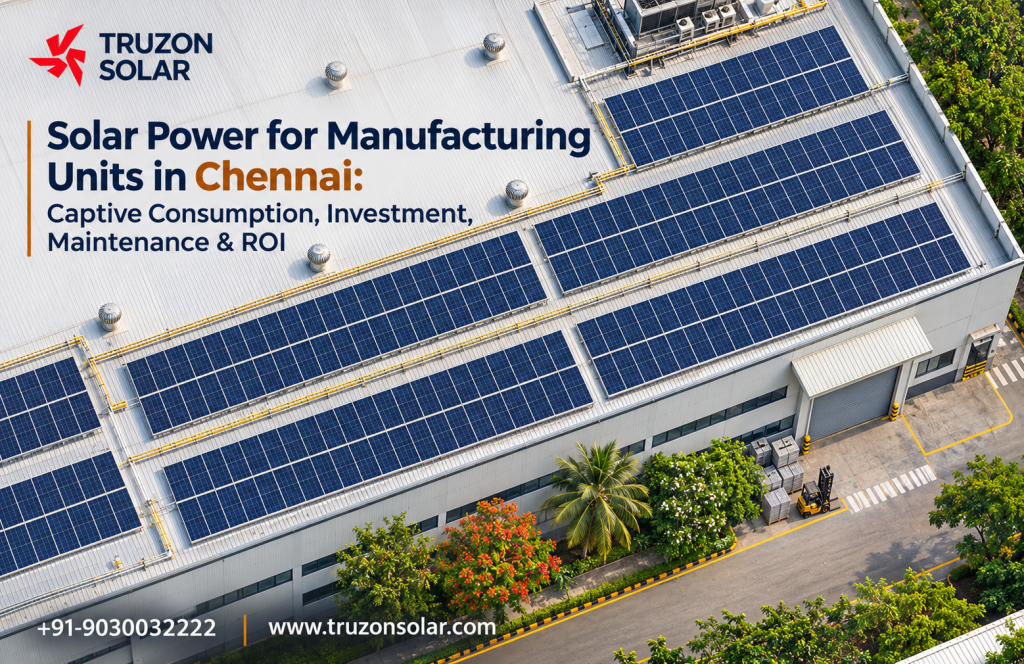

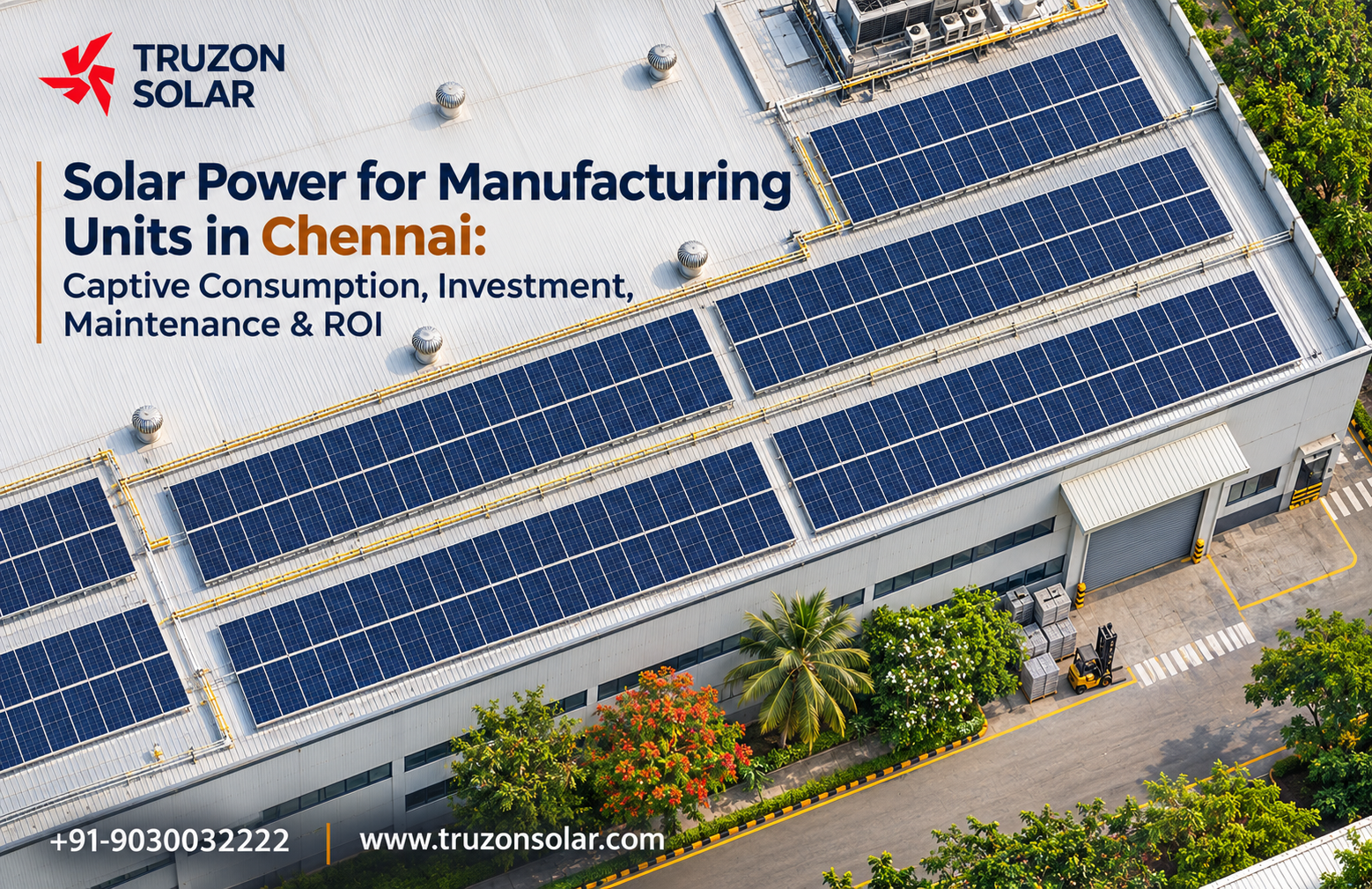
A manufacturing plant does not need solar power because it wants a greener roof. It needs solar when the project can reduce production costs without interfering with output, safety or expansion plans.
Solar power for manufacturing units in Chennai is particularly useful where machinery operates through the day. The city’s industrial corridors contain factories with broad roofs, high electricity consumption and a business reason to control long-term energy expenses.
Table of Contents
- Captive Solar Consumption
- Capacity Planning
- Roof and Equipment Design
- Project Investment
- Savings and ROI
- Installation
- Maintenance in Chennai
- FAQs
What Captive Solar Consumption Means
Captive rooftop solar produces electricity at the factory premises for use within the same facility. During sunny hours, the factory consumes solar energy first and imports the remaining requirement from the grid.
The value of captive consumption comes from avoiding grid electricity at the applicable industrial rate. The factory does not have to stop machines when clouds pass because grid power balances generation automatically.
The design should account for production holidays, maintenance shutdowns and night shifts. A plant running mainly at night may have less scope for rooftop solar than a daytime operation with similar monthly consumption.
Planning System Capacity
Engineers should review twelve months of bills and interval load data. Contract demand, maximum demand, sanctioned load, power factor and shift schedules all affect the recommendation.
A capacity study must include:
- Minimum daytime load
- Peak production demand
- Weekend operations
- Seasonal variations
- Planned machinery additions
- Transformer loading
- Export rules
- Roof or ground availability
Suppose a factory’s daytime load remains between 700 kW and 1.2 MW. A 500–700 kW system may offer strong internal use, while a much larger proposal would need additional analysis of surplus production.
Chennai-Specific Design Considerations
Factories near the coast need materials and workmanship suitable for humidity and corrosive air. Galvanisation, fastener quality, cable protection and equipment enclosures deserve careful attention.
Roofs must be checked for structural capacity, corrosion and remaining life. Panels should not obstruct smoke vents, skylights, utility lines or fire routes.
Wind-load calculations matter because coastal weather can be severe. Mounting structures must be engineered for the building and site—not copied from an inland project.
Approximately 70–100 square feet of usable area may be required for every kilowatt. Efficient modules can improve capacity, but access and safety clearances should never be sacrificed.
Investment Required
| Solar capacity | Indicative cost |
| 100 kW | ₹42–₹55 lakh |
| 250 kW | ₹95 lakh–₹1.30 crore |
| 500 kW | ₹1.80–₹2.50 crore |
| 1 MW | ₹3.40–₹4.80 crore |
Roof strengthening, specialised coatings, transformer upgrades and high-voltage evacuation may add to the investment.
Manufacturing projects generally do not receive the residential PM Surya Ghar subsidy. The company should assess internal funding, a term loan, equipment finance or a RESCO arrangement.
Under a RESCO model, another party invests and sells solar electricity to the manufacturer. This protects capital but introduces a long-term contract involving tariff escalation, roof access and exit terms.
Savings and Return on Investment
A 1 MW solar plant in Chennai may generate approximately 14–15 lakh units annually under suitable conditions. Heat can reduce instantaneous module efficiency, but strong sunlight supports useful annual production.
If 14 lakh units are consumed internally at an avoided electricity cost of ₹9 per unit, gross annual savings may reach ₹1.26 crore. After maintenance and insurance, net savings will be slightly lower.
A system costing ₹4 crore may recover its cost in roughly three-and-a-half to five years. The calculation should include:
- Loan interest
- Production shutdowns
- Module degradation
- Inverter replacement provision
- Maintenance costs
- Applicable taxes
- Tariff movement
ROI should be evaluated over the useful life of the plant, not only through simple payback. A project that returns its cost in five years may continue producing useful electricity for many more years.
Installation at an Operating Factory
Construction must be coordinated with environment, health and safety teams. Roof access, lifting plans, work permits and fall protection should be approved before mobilisation.
Cable routes must avoid production equipment, heat sources and hazardous areas. Final electrical integration may require a shutdown, which should be planned around production.
Commissioning should include insulation resistance, polarity, protection settings, earthing, inverter operation and emergency isolation tests. As-built drawings and equipment records should be handed over to the plant team.
Maintenance in Chennai’s Climate
Humidity, salt-laden air in coastal areas and seasonal rain can accelerate corrosion if components are poorly selected. Regular inspections should examine mounting members, fasteners, cable glands and inverter enclosures.
Panels need cleaning, but the schedule should reflect local dust and rainfall. Water quality matters because mineral deposits can remain on the glass.
Monitoring software should compare expected and actual output. A sudden fall may indicate inverter failure, shading, soiling or an electrical issue.
Truzon can help Chennai manufacturers assess captive consumption, engineer the structure, plan installation and monitor output. A proposal should specify the assumed energy yield and expected self-consumption percentage, two numbers that have a major influence on ROI.
Read More:- Solar Installation for IT Parks in Bengaluru: System Design, Open Access Options & Cost Savings
Frequently Asked Questions
1. Can solar power heavy manufacturing machinery?
Yes. Solar contributes electricity to the factory network, while the grid supplies the remaining demand and supports fluctuations.
2. Will a captive solar system work during a power cut?
A normal on-grid plant will not. Backup operation requires a compatible hybrid, battery or generator-integration design.
3. What is the typical industrial solar payback?
Many projects with strong daytime use may achieve simple payback in approximately three-and-a-half to six years.
About the Author