
A resort’s electricity use begins before guests wake up and continues long after dinner. Kitchens prepare breakfast, pumps fill overhead tanks, landscaping systems operate, and cooling equipment works through Jaipur’s warmest months. Banquets and destination weddings can add large but irregular loads.
Rooftop solar for resorts in Jaipur can reduce daytime electricity costs without compromising guest comfort. The system must reflect the property’s actual routine, including seasonal occupancy, events and the difference between daytime and night-time consumption.
Table of Contents
- Resort Energy Requirements
- Selecting Solar Capacity
- Suitable Installation Areas
- Project Cost
- Savings and ROI
- Installation Process
- Maintenance and Guest Safety
- FAQs
Understanding Resort Electricity Consumption
Room count alone cannot determine solar capacity. A 50-room business hotel may consume less than a 30-room resort with villas, banquet lawns, a heated pool and extensive landscaping.
A resort energy review should cover:
- Room air-conditioning
- Kitchens and refrigeration
- Laundry equipment
- Water and sewage-treatment pumps
- Swimming-pool filtration
- Banquet and wedding loads
- Pathway and landscape lighting
- Staff accommodation
- EV chargers
- Generator operation
Twelve months of bills reveal seasonal changes, while interval data shows how much electricity is consumed during solar-producing hours.
Jaipur’s summer cooling requirement usually creates strong daytime consumption. Wedding seasons can increase demand, but capacity should not be based solely on a few large events.
Choosing Rooftop Solar Capacity for Resorts in Jaipur
A small resort may begin with 30–75 kW. A larger property with banquet facilities may need 100–500 kW or more.
| Resort profile | Possible system range |
| Boutique resort | 25–60 kW |
| Medium leisure property | 75–150 kW |
| Resort with banquet facilities | 150–300 kW |
| Large destination property | 300–750 kW |
The final recommendation depends on consumption, roof or parking space, sanctioned load and regulatory feasibility.
Approximately 70–100 square feet may be needed per kilowatt. Guest-room roofs, service blocks and parking areas can sometimes be combined into one project.
Where Can a Resort Install Solar?
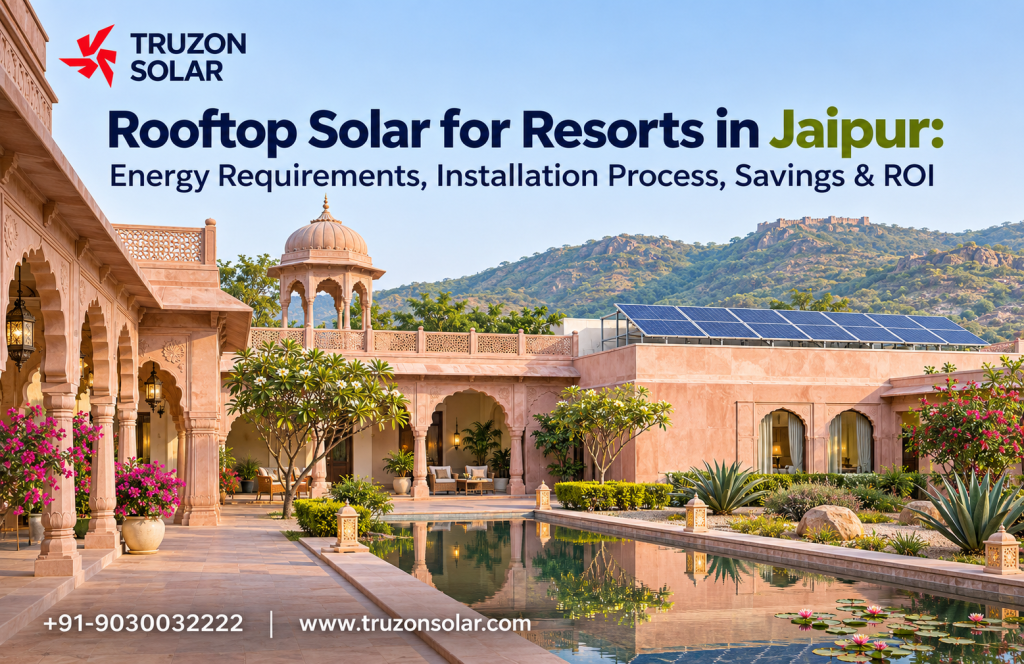
The main roof is not the only option. Panels can be installed over administrative blocks, kitchens, staff areas and parking spaces. Solar carports are more expensive than simple rooftop structures but provide shaded parking—an attractive benefit in Jaipur.
The layout should protect the property’s appearance. Panels should not obstruct heritage façades, scenic viewpoints or guest terraces. Cable routes and inverters should be located away from guest circulation areas wherever practical.
Structural stability, waterproofing, wind load, drainage and fire access must be addressed before construction. If the resort roof needs repair within a few years, completing that work first is usually wiser.
Installation Cost in 2026
| Solar capacity | Indicative cost |
| 50 kW | ₹22–₹30 lakh |
| 100 kW | ₹42–₹55 lakh |
| 250 kW | ₹95 lakh–₹1.30 crore |
| 500 kW | ₹1.80–₹2.50 crore |
Elevated structures, carports, roof strengthening and premium monitoring can increase the investment. Battery storage is separate.
Resorts are commercial consumers and should not assume eligibility for residential PM Surya Ghar assistance. The business case should remain attractive without depending on a household subsidy.
Expected Savings from Rooftop Solar
A 100 kW solar plant in Jaipur may produce approximately 1.5–1.65 lakh units annually under suitable conditions. Jaipur’s sunlight is favourable, although dust and high module temperatures can affect performance.
If the resort uses 1.5 lakh solar units at an avoided cost of ₹9.50 each, the annual gross benefit may be about ₹14.25 lakh. Maintenance and insurance should be included before calculating net savings.
A project costing ₹48 lakh could have a simple payback of roughly three-and-a-half to five years. If daytime occupancy is low or a large part of generation receives less favourable export treatment, recovery may take longer.
Fixed charges, demand charges and night-time electricity will continue. Solar should therefore be presented as a substantial reduction in energy expenditure—not a guaranteed elimination of the entire bill.
Resort Solar Installation Process
The first stage is an energy and roof assessment. The installer then prepares the proposed capacity, equipment specifications, expected generation, financial model and installation schedule.
After management approval, the project proceeds through the applicable DISCOM process, procurement and site preparation. Installation should be timed around guest occupancy, weddings and conferences.
Material lifting, drilling and electrical shutdowns may be scheduled during low-occupancy periods. Work areas must be barricaded, and technicians should not use guest pathways for unrestricted material movement.
Testing includes earthing, insulation, polarity, inverter protection and meter verification. Resort engineers should receive system training and monitoring access before handover.
Battery Backup: Is It Necessary?
A normal on-grid plant shuts down during a power failure. Resorts typically retain generators or existing backup systems for essential services.
Batteries may be considered for reception systems, Wi-Fi, selected lighting, security equipment and other critical circuits. Backing up every air conditioner and banquet load would require considerably more storage and investment.
Battery capacity should be selected from the critical load and required backup duration, not from the solar-panel capacity alone.
Maintenance and Sustainability Value
Jaipur’s dust means cleaning cannot be ignored. The operations team should monitor soiling and clean panels when the generation loss justifies it, using suitable water and non-abrasive equipment.
Technicians should inspect inverters, cables, mounting hardware, earthing and lightning protection. Performance should be reviewed against expected generation, not only the previous month.
Truzon can help resort owners combine technical planning with guest-sensitive installation. Once commissioned, the resort may communicate verified annual solar generation and emissions reduction in its sustainability materials. Claims should be measurable rather than vague.
Read More:- Solar Power for Textile Industries in Surat: System Capacity, Installation Cost, Savings & Payback
Frequently Asked Questions
1. Can rooftop solar run resort air conditioners?
It can offset electricity used by air-conditioning during daylight. The grid supplies the remaining demand and all non-solar-hour requirements.
2. Can panels be installed above resort parking?
Yes. Solar carports generate electricity and provide shade, although their stronger structure increases the project cost.
3. How quickly can a resort recover the investment?
A well-utilised project may achieve simple payback in approximately three-and-a-half to six years.
About the Author