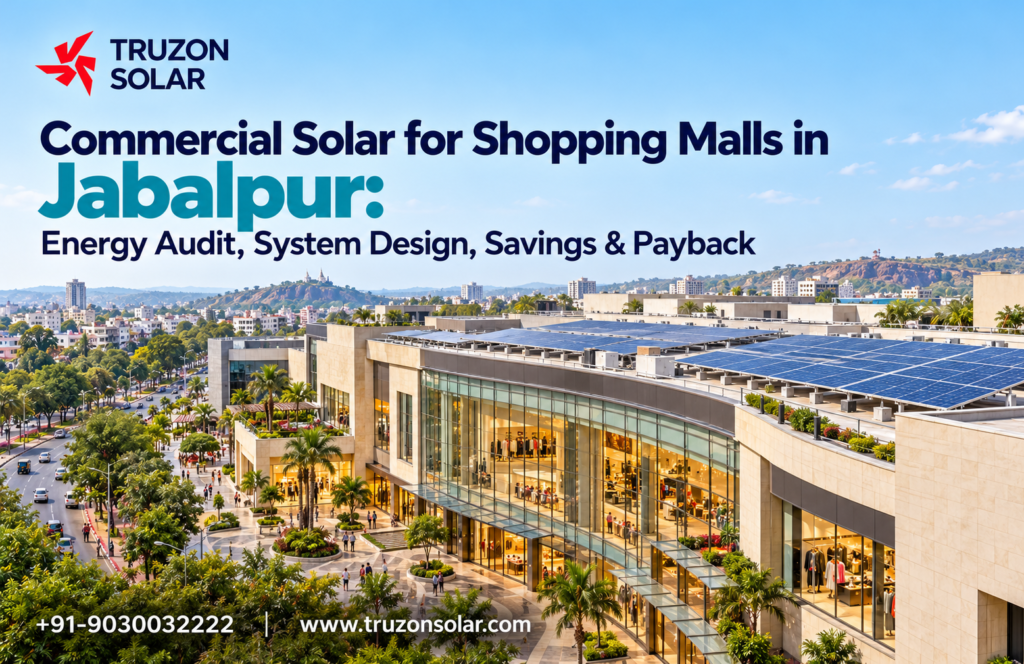

A shopping mall can appear quiet before opening hours, but its electricity meter rarely gets a break. Air-conditioning systems start early, escalators operate throughout the day, food courts run refrigeration equipment, and parking areas require ventilation and lighting. These continuous loads make electricity one of the largest controllable expenses for a mall.
Commercial solar for shopping malls in Jabalpur can reduce daytime grid consumption without disrupting normal operations. The real value, however, comes from correct sizing. A solar plant designed around actual demand will usually perform better financially than one designed simply to cover every available section of the roof.
Table of Contents
- Why Shopping Malls Are Suitable for Solar
- Conducting an Energy Audit
- Designing the Solar System
- Installation Cost
- Savings and Payback
- Installation and Maintenance
- Choosing a Solar Partner
- FAQs
Why Commercial Solar Works for Shopping Malls
Shopping malls have a strong daytime electricity requirement. Chillers, air-handling units, lifts, escalators, pumps, common-area lighting, digital displays and tenant services all consume power while solar panels are producing electricity.
An on-grid solar installation works alongside the existing electricity connection. Solar energy is used within the mall as it is generated, while the grid supplies any shortfall. This arrangement allows the property to reduce purchased electricity without depending entirely on sunlight.
A conventional on-grid plant does not provide backup during a grid failure. Anti-islanding protection shuts the system down to protect technicians and the network. If backup is needed for selected loads, battery storage or another power source must be designed separately.
Energy Audit Before Solar Installation
A commercial solar project should begin with an energy audit rather than a panel quotation. At least twelve months of electricity bills should be reviewed to understand seasonal consumption, maximum demand, tariff structure and power-factor penalties.
The audit should examine:
- Cooling and ventilation loads
- Lighting in common areas and parking levels
- Escalators and lifts
- Water pumps and fire systems
- Food-court refrigeration
- Tenant operating hours
- Diesel-generator usage
- Weekend and holiday demand
- Planned property expansion
Interval data is particularly useful because it shows how consumption changes during the day. If the mall’s base load remains above 800 kW during sunny hours, a substantial solar system may be absorbed internally. If consumption falls sharply on certain days, the design should account for possible surplus generation.
System Design for a Shopping Mall in Jabalpur
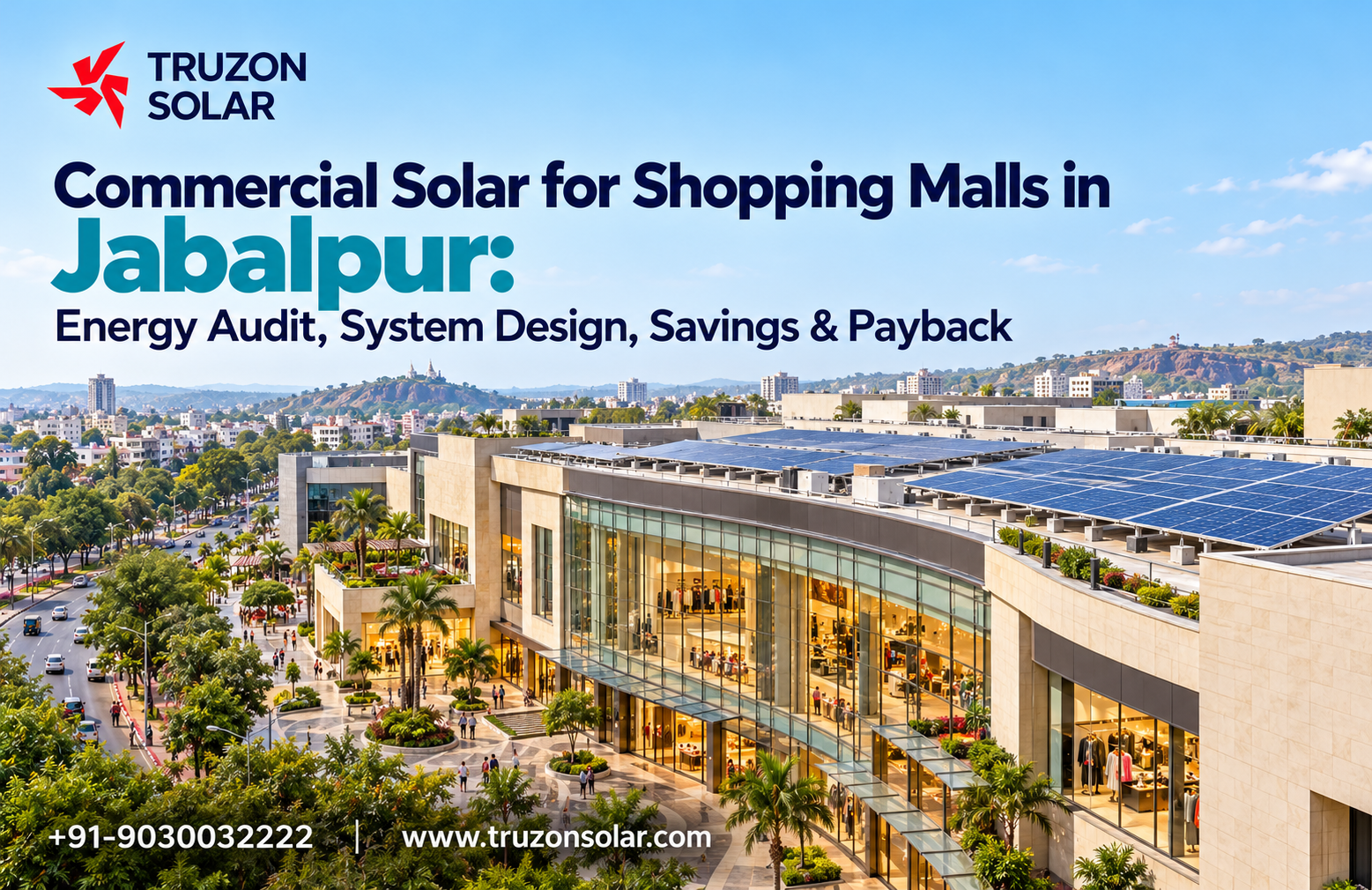
Panels may be installed on the main roof, service-block roofs or parking canopies. Parking-area solar can provide electricity while also giving vehicles shade, though the civil structure makes it more expensive than a straightforward rooftop installation.
A usable roof normally accommodates approximately 10–14 watts per square foot after considering fire routes, equipment, setbacks and spacing. Therefore, a clear area of 50,000 square feet may hold roughly 500–650 kW.
The engineering plan should cover:
- Structural capacity and wind resistance
- Shadow from cooling towers and signage
- Safe access to HVAC equipment
- DC and AC cable routes
- Inverter location and ventilation
- Lightning protection and earthing
- Fire-safety clearances
- Monitoring at inverter and plant level
Solar equipment should never restrict access to chillers, ducts or emergency exits.
Commercial Solar Installation Cost
Indicative 2026 investment ranges are:
| Capacity | Approximate cost |
| 100 kW | ₹42–₹55 lakh |
| 250 kW | ₹95 lakh–₹1.30 crore |
| 500 kW | ₹1.80–₹2.50 crore |
| 1 MW | ₹3.40–₹4.80 crore |
The cost changes with module technology, inverter design, roof strengthening, cable distance, transformer requirements and monitoring features. Parking-canopy installations generally cost more because the structure also functions as a permanent shelter.
Shopping malls are commercial consumers, so the residential PM Surya Ghar subsidy should not be assumed. The investment should be justified through electricity savings and any lawfully available financial or tax treatment.
Energy Savings and Payback
A 500 kW solar plant in Jabalpur may produce around 7–8 lakh units annually under favourable conditions. Actual output depends on shade, temperature, dust, equipment efficiency and maintenance.
Suppose the mall effectively uses 7.2 lakh solar units annually and each unit avoids ₹9.50 of grid expense. The gross annual benefit would be approximately ₹68 lakh. After allowing for maintenance, insurance and minor repairs, the net annual saving may be slightly lower.
If the installation costs ₹2.15 crore, simple payback could fall within three-and-a-half to five years. Financing charges, tariff changes, equipment downtime and module degradation will influence the actual return.
Savings should be calculated using the avoidable energy charge, not simply the highest number appearing on the bill. Fixed charges and some demand-related costs may continue even after solar is installed.
Installation Without Disturbing Mall Operations
Work should be planned around customer movement, tenant deliveries and peak shopping periods. Heavy material lifting may be scheduled before opening or during controlled hours. Roof zones must remain barricaded, and electrical shutdowns should be approved in advance.
The normal process includes an energy audit, structural survey, detailed engineering, statutory application, procurement, installation, testing and grid synchronisation.
The handover package should contain drawings, equipment serial numbers, test reports, warranties and emergency shutdown instructions. Mall facility staff should be trained to recognise inverter alarms and access monitoring data.
Maintenance and Performance Monitoring
Jabalpur’s dry periods can leave dust on modules, reducing output if cleaning is neglected. Cleaning frequency should be based on actual soiling and generation loss rather than a fixed calendar.
Technicians should inspect cables, connectors, mounting fasteners, earthing, surge protection and inverter ventilation. Thermal imaging can help locate hot connections or underperforming modules.
Truzon can assist mall owners with energy auditing, layout planning, commercial evaluation, installation and performance monitoring. The best proposal is not necessarily the one promising the highest generation. It is the one that explains its assumptions and connects capacity to actual consumption.
Read More:- Solar Power for Rice Mills in Durg: System Capacity, Installation Cost, Benefits & ROI
Frequently Asked Questions
1. Can solar operate a mall’s air-conditioning system?
Solar electricity can offset part of the power consumed by chillers and air-handling systems during daylight. The grid automatically supplies the remaining requirement.
2. Does a shopping mall need batteries?
Not usually for electricity-cost reduction. Batteries are considered when the mall requires backup, peak management or another defined operational benefit.
3. What payback period can a mall expect?
A well-sized project with high daytime consumption may recover its cost in approximately three to six years. The final period depends on tariff, generation, financing and self-consumption.
About the Author