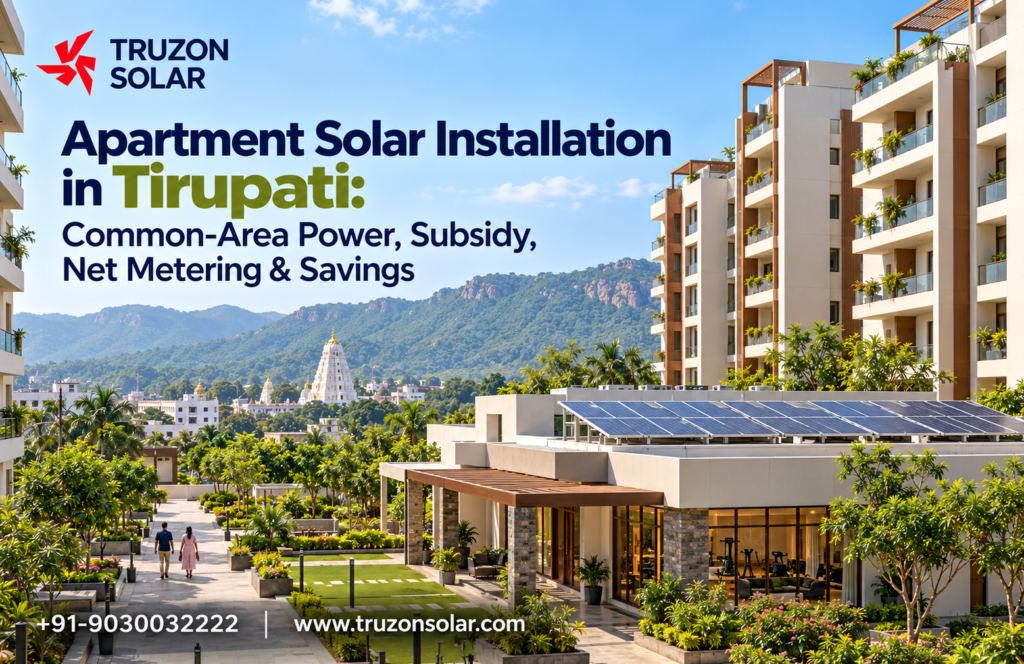

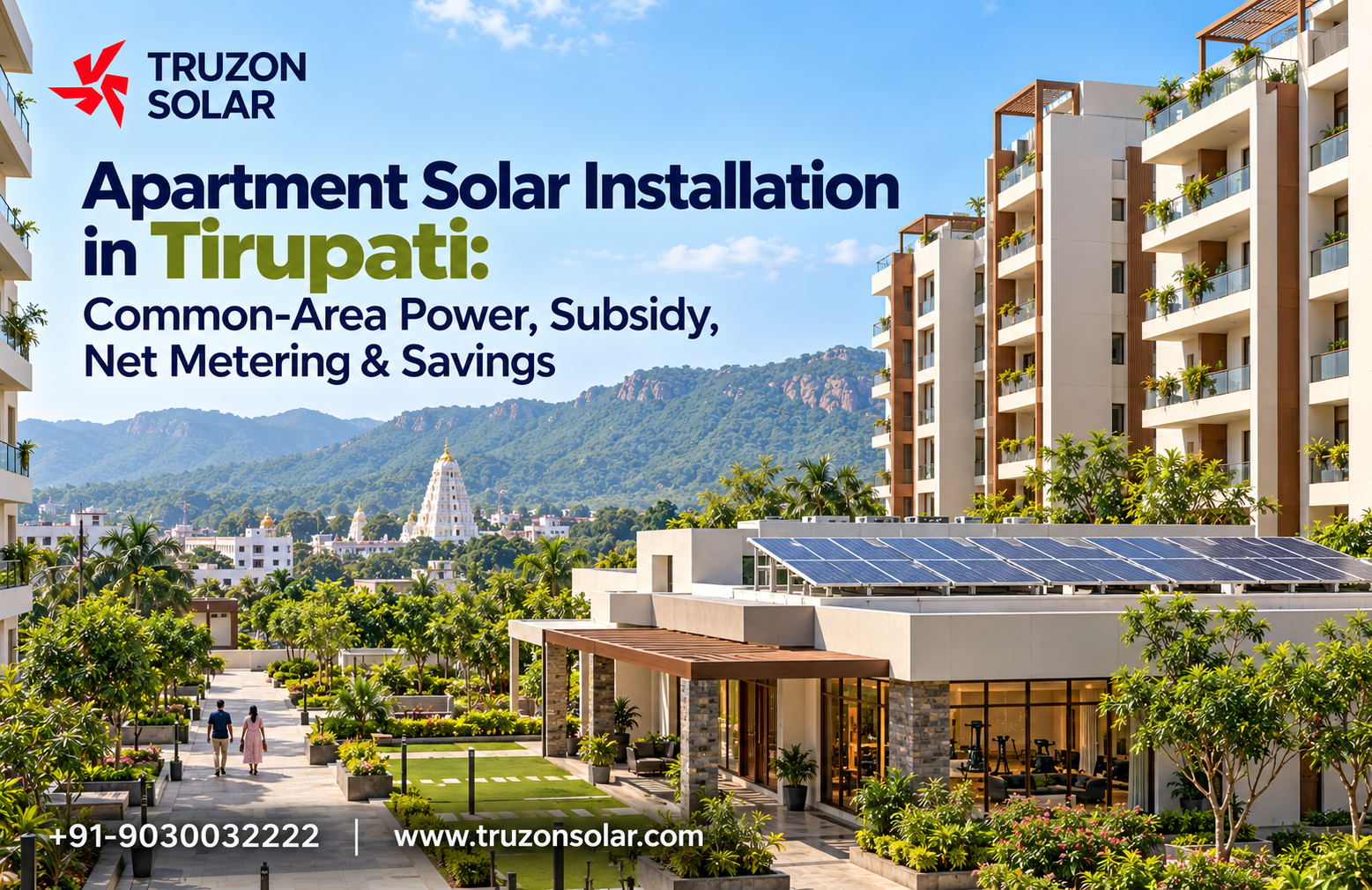
Apartment residents may receive separate electricity bills, but they also share a second energy expense through monthly maintenance. Lifts, water pumps, corridors, security systems, gates and parking lights are generally connected to common meters paid by the association.
Apartment solar installation in Tirupati can reduce this common electricity expense and create a long-term asset for residents. The project should begin with a clear decision about where the solar energy will be used. A system intended for common facilities is simpler to plan than one expected to divide benefits directly among numerous flats.
Table of Contents
- How Apartment Solar Works
- Common-Area Capacity
- Installation Cost
- Subsidy Eligibility
- Net and Virtual Metering
- Savings and Payback
- Installation Process
- FAQs
Using Solar for Apartment Common Areas
A grid-connected apartment system generates electricity during daylight hours. The common-area equipment operating at that time uses solar power first, and the grid supplies the balance.
Typical shared loads include:
- Lifts
- Borewell and transfer pumps
- Sewage-treatment equipment
- Corridor and parking lights
- Security cabins and CCTV
- Clubhouse facilities
- Association office equipment
- Common EV-charging infrastructure
Night-time loads continue drawing power from the grid unless the system includes battery storage. For most associations, batteries are not essential when the main objective is bill reduction.
Selecting Capacity for Apartment Solar Installation in Tirupati
The number of flats alone cannot determine capacity. A low-rise apartment with one lift may use less common power than a smaller high-rise property with multiple pumps and extensive ventilation.
The association should collect twelve months of common-meter bills and note any expected additions such as EV charging or a second lift.
| Apartment profile | Possible system range |
| Small building | 5–15 kW |
| Medium apartment | 15–40 kW |
| Large gated community | 50–200 kW |
| Multi-tower development | 200–500 kW |
Usable roof space, sanctioned load and regulatory limits must also be considered. Approximately 80–100 square feet per kW is a reasonable initial planning figure.
Water tanks, staircases, lift rooms and neighbouring buildings may create shadows. Fire-access paths and maintenance areas must remain open even if that means installing fewer panels.
Apartment Solar Installation Cost
| System capacity | Indicative cost |
| 10 kW | ₹5.5–₹7 lakh |
| 25 kW | ₹12–₹16 lakh |
| 50 kW | ₹22–₹30 lakh |
| 100 kW | ₹42–₹58 lakh |
| 200 kW | ₹80 lakh–₹1.10 crore |
These broad 2026 ranges may change due to structure height, roof condition, module selection and cable distance. The association should obtain a detailed bill of materials rather than compare quotations only by total price.
Waterproofing responsibilities must be documented. If the terrace needs repairs within the next few years, completing them before solar installation can prevent expensive dismantling later.
Subsidy for Apartment Solar in Tirupati
Under PM Surya Ghar, eligible group housing societies and resident welfare associations may receive Central Financial Assistance for common facilities, including EV charging. The notified rate is ₹18,000 per kW for eligible capacity up to 500 kW, subject to the limit of 3 kW per dwelling and adjustment for individual rooftop systems already installed by residents.
Subsidy should never be treated as guaranteed merely because the property is residential. The association must follow the official application route, meet technical requirements and use eligible equipment and vendors.
The managing committee should confirm the applicable procedure through the PM Surya Ghar portal and APSPDCL before approving the final budget. Tirupati falls within APSPDCL’s service area, and its official website provides rooftop-solar registration access.
Net Metering and Virtual Net Metering
Net metering measures import from and export to the electricity network under the approved regulatory arrangement. A common-area plant can be linked to the relevant service connection after feasibility and approval.
Virtual net metering is designed to allocate eligible exported solar energy among participating connections according to an approved proportion. Andhra Pradesh’s amended framework defines virtual net metering for a group or society and provides for adjustment among connections within the same distribution-licensee area, subject to applicable losses, charges and settlement rules. aperc.gov.in
Virtual allocation is more complex than using solar against a single common meter. The association should obtain written confirmation on eligibility, billing treatment and documentation before promising residents a specific reduction in individual bills.
Monthly Savings and Return on Investment
A 50 kW apartment system in Tirupati may generate approximately 6,000–7,000 units in a favourable month and around 75,000–80,000 units annually. Weather, shade, heat and cleaning frequency affect production.
If useful electricity is valued at ₹8 per unit, annual gross savings may reach ₹6–₹6.4 lakh. Suppose the project costs ₹26 lakh and receives eligible assistance of ₹9 lakh at ₹18,000 per kW. The association’s effective investment would fall to approximately ₹17 lakh, subject to final approval and eligible cost treatment.
Under those assumptions, simple payback could be close to three years. Without subsidy or with lower electricity utilisation, the period may be four to six years.
The association can use savings to reduce common electricity collections, strengthen its maintenance reserve or fund other improvements. The chosen approach should be approved and recorded transparently.
Apartment Solar Installation Process
The process normally begins with electricity-bill analysis and a terrace survey. The association then obtains a technical and commercial proposal and passes the required resolution.
The main stages are:
- Confirm roof ownership and society authority.
- Review structural stability and waterproofing.
- Select capacity based on common consumption.
- Verify subsidy and metering eligibility.
- Submit the prescribed application.
- Complete installation and safety testing.
- Arrange DISCOM inspection and metering.
- Commission the plant and submit the subsidy claim.
- Monitor generation every month.
Truzon can assist apartment associations with load analysis, system design, installation and coordination. The agreement should clearly divide responsibilities among the association, installer and DISCOM.
Read More:- Solar Installation for Petrol Pumps in Gwalior: Capacity, Cost, Battery Backup & Benefits
Frequently Asked Questions
1. Will apartment solar reduce every resident’s bill?
A system connected to the common meter primarily reduces society electricity expenses. Individual allocation requires an approved virtual or group arrangement.
2. Can the terrace still be used after installation?
Yes, if the layout preserves access routes and usable areas. Elevated structures may retain more terrace space but increase project cost.
3. Is battery backup necessary for lifts?
Solar alone is not lift backup. Lift continuity requires a separate backup design involving suitable batteries, a generator or another approved system.
About the Author