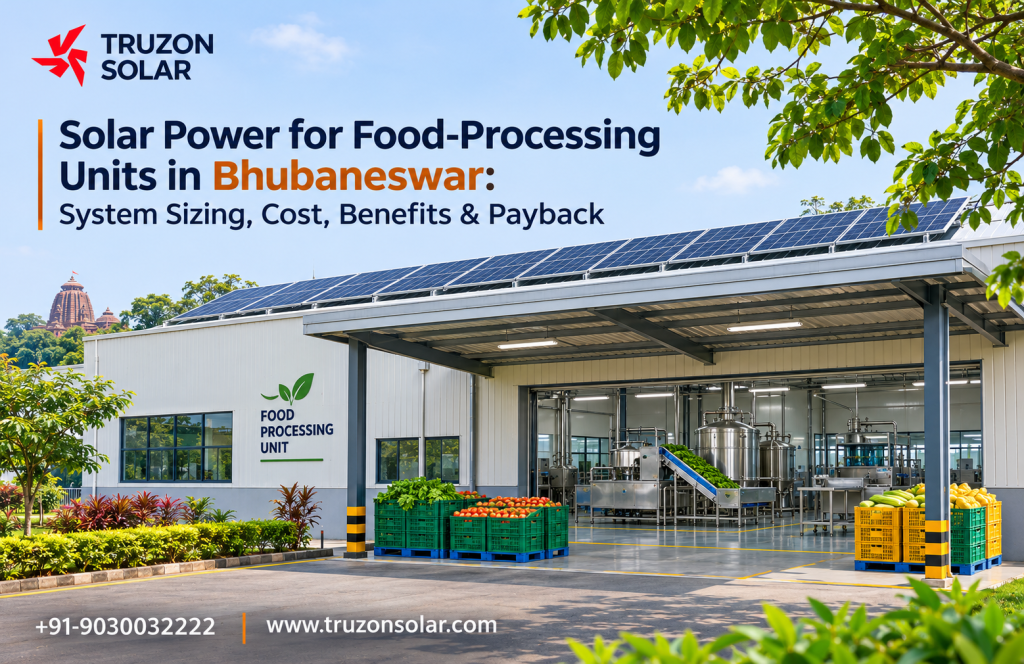

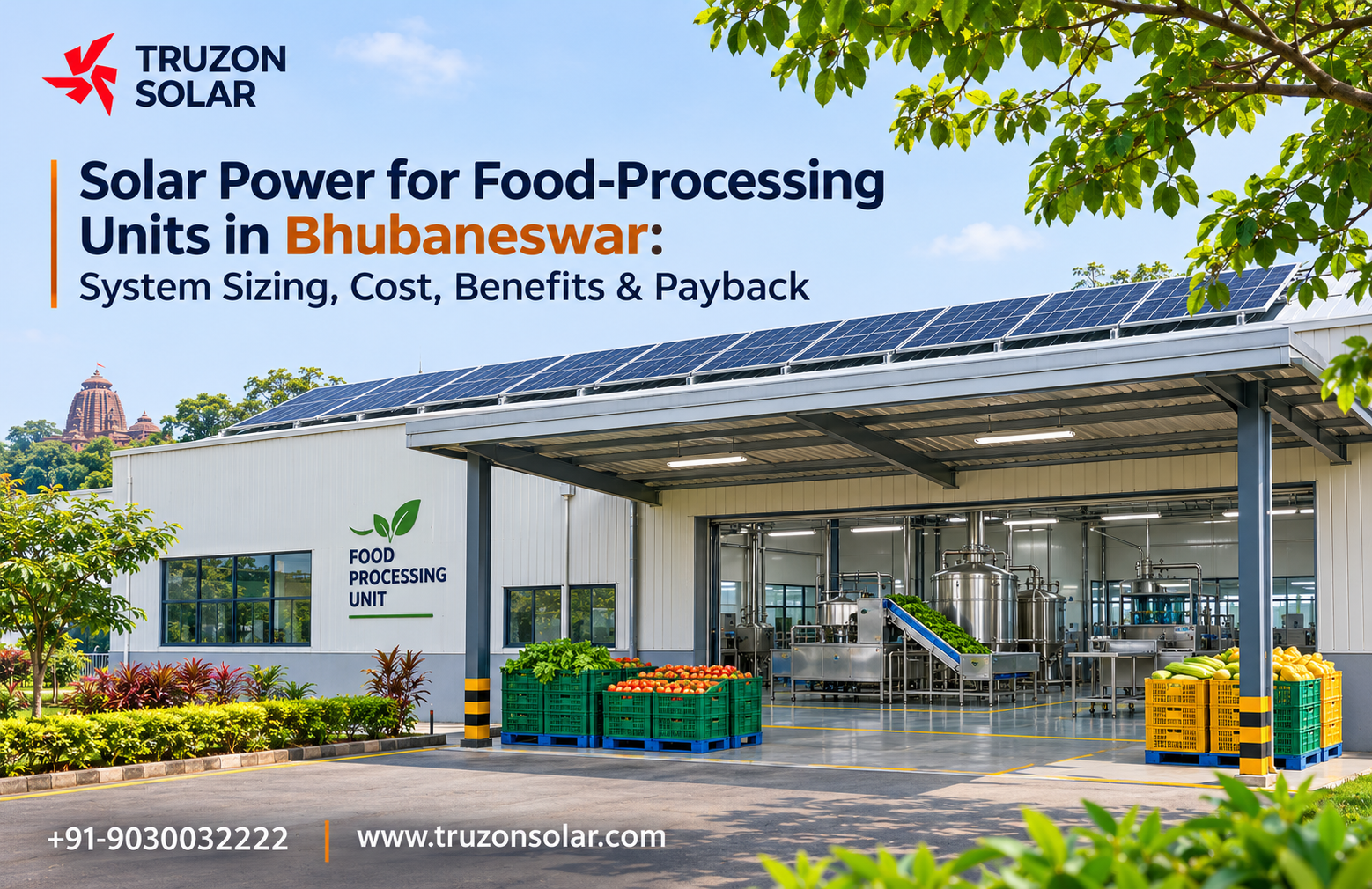
Food processing combines motors, refrigeration, heating support, pumping and hygiene systems under one roof. Production may begin early, continue through the day and change with the harvest or procurement season. These patterns make electricity a significant cost—but also create a strong opportunity for solar.
Solar power for food-processing units in Bhubaneswar can lower daytime electricity purchases while allowing the grid to support fluctuating production. Correct capacity selection matters because a processing plant may operate at full load for one season and much less during another.
Table of Contents
- Electricity Use in Food Processing
- System Sizing
- Roof and Hygiene Requirements
- Installation Cost
- Savings and Benefits
- Payback
- Maintenance
- FAQs
Where Food-Processing Units Use Electricity
Electricity requirements vary by product. A grain-processing unit uses motors and conveyors, while dairy and frozen-food businesses depend heavily on refrigeration. Beverage facilities may have pumps, chillers, bottling lines and water-treatment systems.
Common loads include:
- Sorting and grading machines
- Crushers, mixers and grinders
- Conveyors
- Refrigeration and cold rooms
- Pumps and compressors
- Packaging equipment
- Ventilation
- Water-treatment systems
- Laboratory and office loads
A solar system should be designed around equipment operating during daylight. Night-time refrigeration remains dependent on the grid or another power source.
System Sizing for a Food-Processing Plant
At least twelve months of electricity bills should be reviewed. Where production is seasonal, two or three years of consumption data may provide a better picture.
Engineers should examine contract demand, operating shifts, production months, shutdown periods and planned capacity expansion.
| Monthly consumption | Possible starting capacity |
| 8,000–12,000 units | 50–80 kW |
| 20,000–30,000 units | 150–200 kW |
| 40,000–60,000 units | 300–400 kW |
| Above 75,000 units | 500 kW or more |
These figures are preliminary. An oversized plant may export substantial energy during the off-season, weakening returns if exported units are less valuable than direct consumption.
Roof, Ground and Hygiene Considerations
Panels may be installed on processing roofs, warehouses, cold-storage buildings or available land. Roof condition and remaining life should be checked before installation.
Food facilities require careful placement. Modules should not obstruct ventilation, exhaust systems or pest-control measures. Cable entries must be sealed properly so they do not compromise hygienic areas.
Bhubaneswar experiences heavy rain and cyclonic weather. Structures require appropriate wind-load engineering, secure anchoring and clear drainage. Generic mounting designs should not be accepted for exposed industrial sites.
Approximately 70–100 square feet per kilowatt may be needed on a roof. Ground-mounted plants require additional spacing, fencing and drainage.
Installation Cost in 2026
| Capacity | Indicative cost |
| 50 kW | ₹22–₹30 lakh |
| 100 kW | ₹42–₹55 lakh |
| 250 kW | ₹95 lakh–₹1.30 crore |
| 500 kW | ₹1.80–₹2.50 crore |
| 1 MW | ₹3.40–₹4.80 crore |
Structural reinforcement, transformer upgrades, specialised cable routes and ground development may increase the investment.
Food-processing businesses are commercial or industrial consumers and should not assume residential rooftop subsidy. Financing and tax treatment should be verified with the lender and tax adviser.
Benefits Beyond the Electricity Bill
The primary benefit is lower purchased electricity during production hours. Additional advantages may include:
- Better control over long-term energy expenses
- Reduced generator use during suitable operating conditions
- Productive use of warehouse roofs
- Lower operational emissions
- Support for customer sustainability requirements
- Improved ESG reporting for larger buyers
Solar does not guarantee continuous production during an outage. A normal grid-connected plant switches off when the grid fails.
Savings and Payback
A 250 kW system in Bhubaneswar may generate approximately 3.5–3.8 lakh units annually under suitable conditions.
If 90% of 3.6 lakh units is used effectively and each unit avoids ₹9 of electricity expense, annual gross savings may be around ₹29 lakh. Maintenance and insurance should be deducted for a net estimate.
For a project costing ₹1.10 crore, simple payback may fall between four and five years. Seasonal shutdowns, financing interest and lower self-consumption can extend it to six years or more.
The proposal should show generation and consumption month by month. A mango-processing business, for example, should not be modelled as though it runs at identical capacity throughout the year.
Installation and Safety
The installer must coordinate with production and food-safety teams. Drilling or cable work above active processing areas may need to be scheduled during shutdowns.
The work sequence normally includes energy analysis, structural assessment, engineering, permission, procurement, installation, testing and commissioning.
Handover documents should include drawings, warranties, protection settings, cleaning instructions and emergency-isolation procedures.
Maintenance for Reliable Output
Processing dust, oil vapour or bird activity may cause localised soiling. The cleaning schedule should be based on the facility’s environment.
Technicians should inspect module surfaces, connectors, cable supports, inverters, earthing and lightning protection. Structures require special attention after severe weather.
Truzon can help food businesses match capacity with production seasons and roof conditions. The strongest project is one that continues to make financial sense in a conservative production year.
Read More:- Solar Energy for Beach Resorts in Kochi: Rooftop Potential, Battery Backup, Savings & Sustainability
Frequently Asked Questions
1. Can solar operate cold rooms?
Solar can offset refrigeration electricity during daylight. The grid or backup system remains necessary at night and during outages.
2. Is ground-mounted solar better than rooftop solar?
Neither is universally better. Rooftops save land, while ground systems may offer easier orientation and maintenance. Site conditions decide.
3. How long is the payback period?
A well-utilised installation may achieve simple payback in approximately four to six years.
About the Author