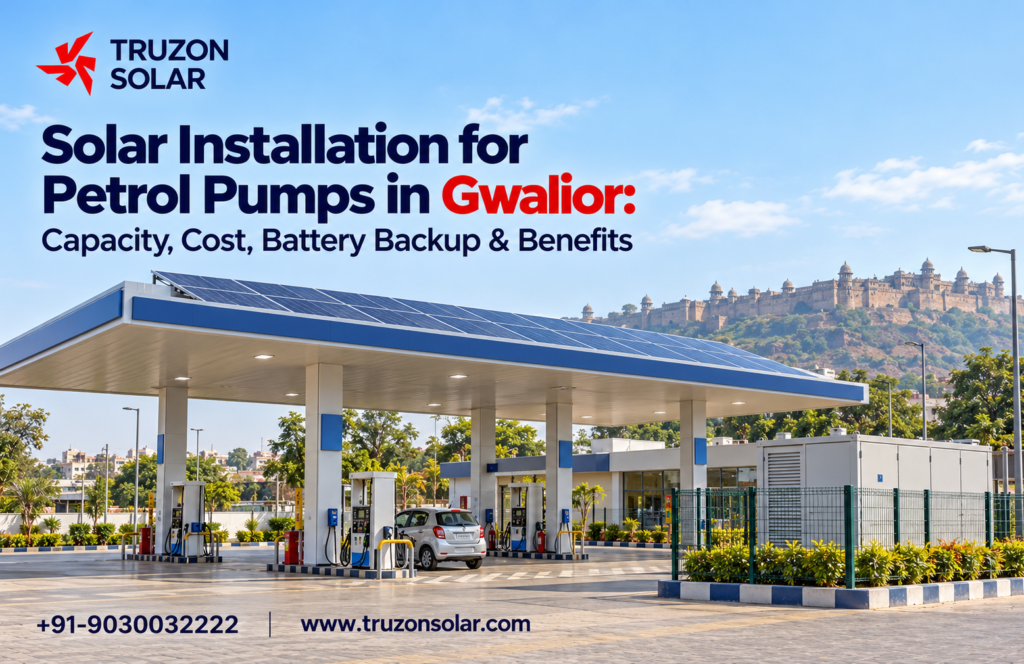

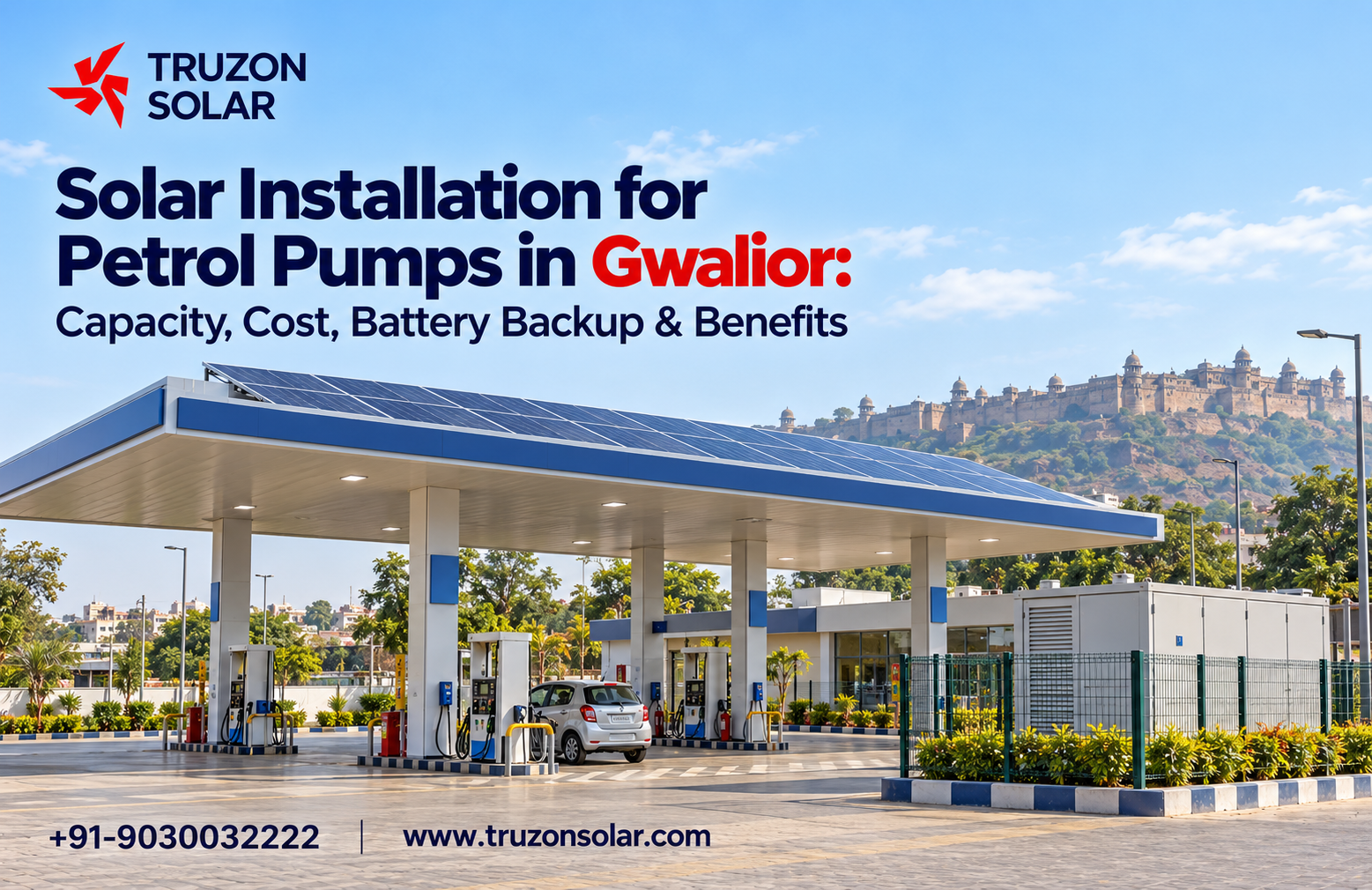
A petrol pump needs dependable electricity for dispensers, lighting, billing machines, air compressors, surveillance cameras and office equipment. Even a short interruption can delay transactions and inconvenience customers. At the same time, operating lights and equipment for long hours produces a recurring electricity expense.
Solar installation for petrol pumps in Gwalior can address part of this cost while giving the outlet a more efficient energy setup. The system must be designed carefully because a fuel station is a regulated environment where electrical safety is more important than fitting the maximum number of panels.
Table of Contents
- Electricity Use at Petrol Pumps
- Selecting Solar Capacity
- Solar Installation Cost
- Battery Backup Options
- Benefits and Savings
- Safe Installation Process
- Maintenance
- FAQs
Understanding a Petrol Pump’s Electricity Load
No two outlets have identical consumption. A small roadside station may operate a few dispensing units and basic lighting. A large urban outlet may also have a convenience store, nitrogen machine, automatic air compressor, digital signage, food counter and vehicle-washing equipment.
The installer should study:
- Monthly electricity consumption
- Day and night operating hours
- Number of dispensing machines
- Canopy and forecourt lighting
- Office and billing equipment
- Air compressors and pumps
- Convenience-store refrigeration
- Generator usage
- Critical loads requiring backup
A load survey helps separate equipment that needs continuous backup from appliances that only need lower-cost daytime electricity.
Solar Capacity for a Petrol Pump in Gwalior
Smaller petrol pumps may consider systems between 10 kW and 25 kW. Larger outlets with extensive lighting, shops or washing facilities may need 30–75 kW.
| Monthly consumption | Possible starting capacity |
| 1,500–2,000 units | 10–15 kW |
| 3,000–4,000 units | 20–30 kW |
| 5,000–7,000 units | 40–50 kW |
| Above 8,000 units | Site-specific design |
These are planning figures, not final recommendations. Consumption timing matters as much as the total number of units. Petrol pumps operating around the clock may still buy substantial electricity at night because panels only produce during daylight.
The canopy may provide useful installation space, but its drawings and structural condition should be examined. Panels must not interfere with signage, lighting, drainage or safety systems.
Cost of Solar Installation for Petrol Pumps
Indicative 2026 on-grid prices are:
| System size | Approximate cost |
| 10 kW | ₹5.5–₹7 lakh |
| 20 kW | ₹10–₹13 lakh |
| 30 kW | ₹14–₹19 lakh |
| 50 kW | ₹22–₹30 lakh |
| 75 kW | ₹32–₹43 lakh |
Battery storage, extensive canopy reinforcement and specialised electrical work will increase the investment. Petrol pumps are commercial establishments and should not calculate project viability using the residential PM Surya Ghar subsidy.
Every quotation should identify the panel make, inverter capacity, structure, protection equipment, earthing, monitoring, installation and approval responsibilities. “Complete system” should never be accepted without a written list of inclusions.
Does a Petrol Pump Need Battery Backup?
A battery is not compulsory for solar savings. A standard on-grid plant lowers electricity purchases while the grid is available, but it switches off during a power cut.
A hybrid installation can keep selected equipment running when the grid fails. However, backing up the entire outlet may require a large and expensive battery. A more sensible approach is often to create a critical-load circuit covering:
- Billing computers
- Internet equipment
- CCTV cameras
- Selected lights
- Essential control systems
- Limited dispensing equipment, where technically permitted
Heavy equipment, air compressors and vehicle-washing systems may remain outside the battery-backed circuit.
Battery size should be calculated from the critical load and required backup duration. For example, maintaining a 5 kW essential load for four hours requires considerably more usable storage than a small office backup. Battery chemistry, depth of discharge, inverter efficiency and future degradation must be included in the calculation.
Existing generators can sometimes continue serving longer outages while batteries cover the transition or selected loads. Any integration must be engineered properly to prevent unsafe back-feeding.
Savings and Business Benefits
A 30 kW plant in Gwalior may generate approximately 42,000–47,000 units annually under suitable conditions. If most production is used at an average avoided cost of ₹9 per unit, the gross annual benefit may be roughly ₹3.8–₹4.2 lakh.
A system costing ₹16.5 lakh could therefore achieve simple payback in approximately four to five-and-a-half years. Battery storage usually extends the financial payback because batteries add substantial cost and have a shorter replacement cycle than solar panels. Their main value is continuity, not necessarily faster returns.
Other advantages include reduced generator usage, lower daytime grid dependence, better lighting-cost control and visible environmental positioning. Solar can also support future EV charging, provided the electrical system and commercial model are assessed separately.
Safety-Focused Installation Process
A petrol pump is not an ordinary rooftop. Fuel storage, vapour zones, vehicle movement and operational regulations require disciplined planning. The solar installer must coordinate with the outlet operator and follow applicable petroleum, electrical, fire and oil-company requirements.
Inverters, isolators and other electrical equipment should be placed outside hazardous zones. Cable routing must avoid fuel lines and operational obstructions. Earthing and lightning protection require particular attention.
The usual process includes load assessment, canopy survey, structural verification, hazardous-area review, system design, approvals, installation, testing and commissioning. Work should be scheduled so that customers and fuel-delivery vehicles remain protected.
Maintenance and Long-Term Operation
Modules installed above a forecourt collect road dust and vehicle emissions. Cleaning may therefore be required more frequently than at a residential property.
Maintenance should include inverter-alarm review, cable inspection, earthing tests, structure checks and cleaning. Staff should know whom to contact if monitoring shows a sudden generation drop.
Truzon can help petrol-pump operators compare on-grid and hybrid designs, identify critical loads and estimate realistic returns. Safety documentation and service capability should carry more weight than the lowest quotation.
Read More:- Commercial Solar for Shopping Malls in Jabalpur: Energy Audit, System Design, Savings & Payback
Frequently Asked Questions
1. Can dispensers run on solar power?
Solar can offset the electricity used by dispensing and support equipment through the approved internal network. Backup operation requires a properly designed hybrid arrangement.
2. How much battery capacity does a petrol pump need?
It depends on the selected critical load and desired backup duration. A load study is necessary; choosing a battery only from the solar-system size can lead to overspending.
3. How long will the solar investment take to recover?
An on-grid project may achieve simple payback in roughly four to six years. Adding battery backup generally lengthens financial recovery but improves continuity.
About the Author