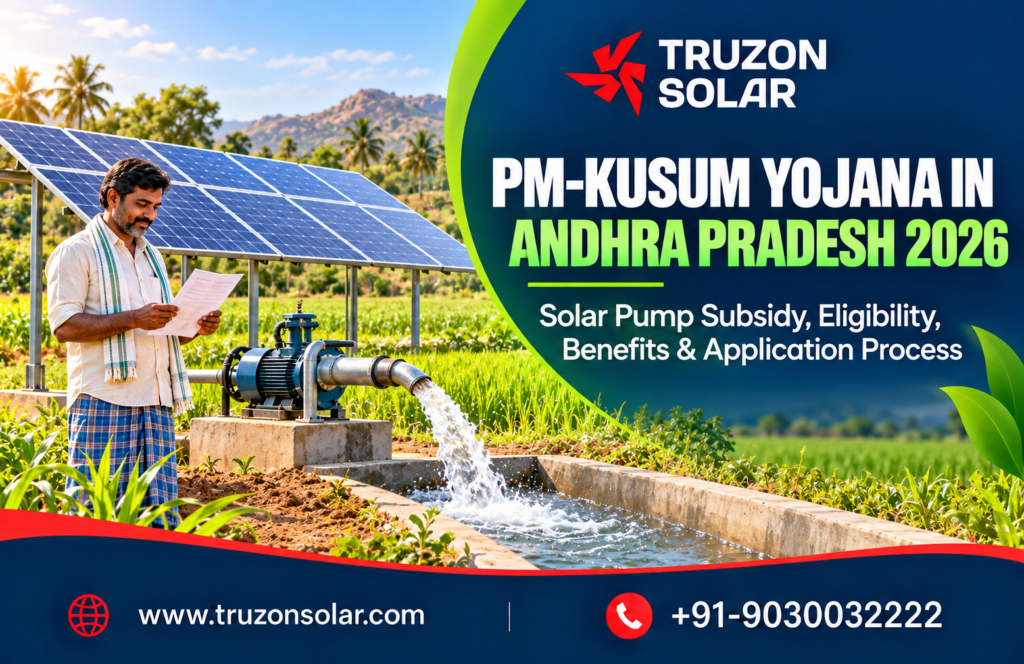

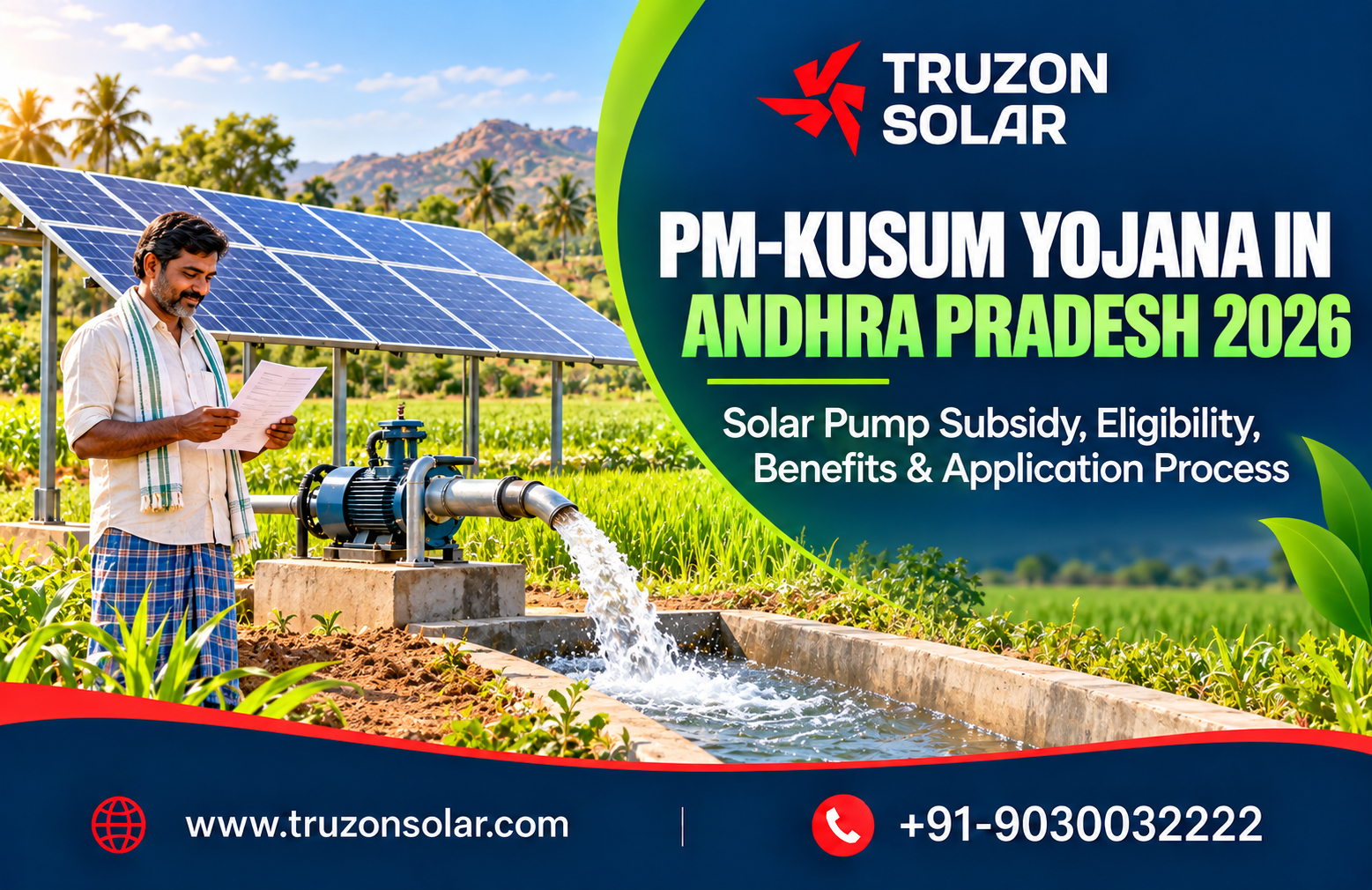
Irrigation is one of the largest recurring expenses for farmers who depend on diesel pumps or an irregular electricity supply. The PM-KUSUM Yojana in Andhra Pradesh 2026 helps eligible farmers move towards solar-powered irrigation, reducing fuel expenses and improving access to daytime power.
The scheme supports standalone solar pumps, solarisation of existing agricultural pumps and small solar-power projects on farmland. However, benefits depend on government allocations, state notifications and technical approval. Farmers should therefore follow official channels rather than paying private agents who promise guaranteed selection.
Table of Contents
- What Is PM-KUSUM Yojana?
- Components of PM-KUSUM
- Solar Pump Subsidy
- Benefits for Farmers
- Eligibility Conditions
- Documents Required
- Application Process
- Frequently Asked Questions
What Is PM-KUSUM Yojana in Andhra Pradesh 2026?
PM-KUSUM stands for Pradhan Mantri Kisan Urja Suraksha evam Utthaan Mahabhiyan. It is a Central Government scheme designed to promote solar energy in agriculture, reduce dependence on diesel and improve the income and energy security of farmers.
KUSUM 1.0 has been extended until 31 March 2027, allowing eligible projects and state allocations to continue during 2026–27.
In Andhra Pradesh, solar-pumping programmes are implemented through agencies such as the New and Renewable Energy Development Corporation of Andhra Pradesh, commonly called NREDCAP, AP electricity distribution companies and the Agriculture Department.
Applications may not remain open throughout the year. Farmers can apply when the concerned agency announces targets, eligible districts, pump capacities and beneficiary-selection conditions.
Components of PM-KUSUM Yojana
Component A: Solar Plants on Farmland
Component A allows farmers, farmer groups, cooperatives, panchayats, Farmer Producer Organisations and Water User Associations to establish decentralised renewable-energy plants.
Projects generally range from 500 kW to 2 MW, although smaller projects may be permitted where technically feasible. Plants can be developed on barren or fallow land. They may also be installed on raised structures over cultivable land, allowing farming to continue underneath.
Component B: Standalone Solar Pumps
Component B supports standalone solar agricultural pumps in off-grid locations where reliable electricity is unavailable. It is especially useful for farmers who currently use diesel pumps.
The standard scheme supports pumps up to 7.5 HP. A complete system normally includes solar panels, a pump, controller, mounting structure, cables and associated equipment.
Component C: Solarisation of Existing Pumps
Component C supports solarisation of grid-connected agricultural pumps. Solar electricity is used for irrigation, while surplus power may be supplied to the DISCOM under the approved arrangement.
It also covers feeder-level solarisation, where a larger solar plant supplies an agricultural feeder serving several pumps. The Ministry of New and Renewable Energy identifies decentralised plants, standalone pumps and pump or feeder solarisation as the three principal parts of PM-KUSUM.
Solar Pump Subsidy in Andhra Pradesh
For eligible projects under Components B and C, the standard funding pattern is generally:
| Funding source | Indicative contribution |
| Central Government | 30% |
| State Government | At least 30% |
| Farmer | Up to 40% |
The subsidy is calculated on the approved benchmark cost or tender price, whichever is lower. A farmer may also obtain bank finance for part of the remaining contribution. Under the standard model, the farmer may initially pay around 10%, while another portion may be covered through an approved loan.
The actual subsidy under PM-KUSUM Yojana in Andhra Pradesh 2026 may vary with pump capacity, approved tender rate, state contribution, beneficiary category and available allocation. Farmers should check the current notification before calculating their contribution.
Benefits of PM-KUSUM for Farmers
Lower Irrigation Expenses
Solar pumps reduce recurring diesel purchases and the cost of operating conventional pumps. Sunlight is available without a fuel bill, making irrigation costs easier to manage.
Daytime Power Availability
Farmers can operate the pump during daylight hours rather than waiting for an uncertain or late-night agricultural electricity supply. This makes irrigation safer and more convenient.
Reliable Irrigation
A correctly selected solar pump can provide dependable water supply where grid electricity is weak or unavailable. Output depends on sunlight, water depth, pump size and irrigation demand.
Additional Income
Under Component A, farmers may earn money by selling solar electricity or leasing land for a solar project. Eligible Component C systems may also allow surplus electricity to be exported to the DISCOM.
Eligibility for PM-KUSUM in Andhra Pradesh
Eligible applicants may include:
- Individual farmers
- Farmer groups
- Cooperatives
- Farmer Producer Organisations
- Panchayats
- Water User Associations
- Other categories mentioned in the notification
For Component B, the farmer should normally possess agricultural land, have a genuine irrigation requirement and access to a suitable water source. The location should generally lack reliable grid supply.
Component C applicants usually need an existing grid-connected agricultural pump or must be served by a feeder selected for solarisation.
Component A applicants require suitable land that meets grid-connectivity and project conditions. Land near a notified electricity substation may receive preference because power must be transferred to the distribution network.
Documents Required for PM-KUSUM
Farmers should generally keep the following documents ready:
- Aadhaar card
- Passport-sized photograph
- Mobile number and address proof
- Land-ownership or possession documents
- Pattadar passbook or relevant revenue records
- Bank passbook and cancelled cheque
- Agricultural electricity-connection details
- Existing pump information for Component C
- Proof of water source
- Category certificate, where applicable
- Consent from joint landowners, if required
- FPO, cooperative or farmer-group registration documents
Names, survey numbers and bank details should be consistent across all records. Errors or mismatches may delay verification.
How to Apply for PM-KUSUM in Andhra Pradesh
Step 1: Check the Official Notification
Visit the NREDCAP, Agriculture Department, APDISCOM or official PM-KUSUM website. Confirm whether applications are open in the relevant district.
Step 2: Select the Correct Component
Choose Component B for a standalone pump, Component C for solarising a grid-connected pump or Component A for a decentralised solar plant.
Step 3: Complete the Application
Enter the farmer’s personal details, land records, water-source information, bank details and pump requirement. Upload clear copies of the requested documents.
Step 4: Verification and Selection
The implementing agency verifies the application and may inspect the proposed site. Selection depends on eligibility and available allocation.
Step 5: Pay the Farmer’s Contribution
Selected farmers receive official payment instructions. Payment should be made only through the authorised channel against a proper receipt.
Step 6: Installation and Commissioning
An empanelled vendor installs the system. The responsible agency inspects it before commissioning and handover. NREDCAP states that Andhra Pradesh’s solar-pumping programme is implemented with APDISCOMs and the Agriculture and Fisheries Departments.
Read More:- Solar Panel Subsidy in Maharashtra 2026: PM Surya Ghar Amount, MSEDCL Process & Eligibility
Frequently Asked Questions
1. How much subsidy is available under PM-KUSUM?
The standard structure provides 30% Central assistance and at least 30% state support for eligible Components B and C projects. The actual Andhra Pradesh amount depends on the current notification and tender.
2. Can every farmer apply for a solar pump?
Farmers can apply only when the relevant application window is open. Selection depends on eligibility, district allocation, water-source suitability and technical verification.
3. Can farmers sell surplus solar electricity?
Components A and C may allow electricity to be supplied to the DISCOM. Income depends on generation, metering arrangements, tariffs and state implementation rules.
Please note: Subsidies, pump capacities and application windows can change. Confirm the latest details through NREDCAP, the relevant APDISCOM or the official PM-KUSUM portal before paying any amount.
About the Author