
An IT park may house software companies, data rooms, cafeterias and shared facilities under one address, but its energy profile is far from simple. Cooling systems operate for long hours, server rooms demand reliability, and common-area services continue even when individual offices are lightly occupied.
Solar installation for IT parks in Bengaluru can take more than one form. Rooftop solar uses the property’s own space, while open access may allow qualifying consumers to procure renewable electricity from an off-site project. Some campuses can benefit from a combination of both.
Table of Contents
- Understanding IT-Park Loads
- Rooftop System Design
- Open Access Options
- Investment and Procurement Models
- Cost Savings
- Reliability and Batteries
- Maintenance
- FAQs
Energy Use Inside a Bengaluru IT Park
Cooling is often the largest controllable load. Chillers, air-handling units, pumps and ventilation operate alongside office lighting, lifts, cafeterias, parking systems and water treatment.
Data centres or server rooms create a steady requirement that continues at night. Rooftop solar only generates during daylight, so the design should distinguish between continuous consumption and the load present while the sun is available.
A meaningful study should examine:
- Fifteen- or thirty-minute load data
- Contract demand
- Tenant and common-area meters
- HVAC operating schedules
- Weekend occupancy
- Data-centre consumption
- Diesel-generator usage
- EV-charging plans
- Lease and roof-right arrangements
If different buildings have separate connections, electricity generated on one roof cannot automatically be credited to every tenant. The metering and contractual structure must be reviewed first.
Rooftop Solar System Design
Modern IT campuses contain cooling towers, ducts, satellite equipment and service pathways. The usable roof area may therefore be much smaller than the total area shown in architectural drawings.
A preliminary estimate is 70–100 square feet for each kilowatt. A 1 MW rooftop plant may need approximately 70,000–1,00,000 square feet of genuinely usable space.
The design should include:
- Structural and wind-load assessment
- Shade analysis
- Fire and maintenance pathways
- Inverter-room ventilation
- AC and DC protection
- Earthing and lightning protection
- Integration with the building-management system
- Plant-level and inverter-level monitoring
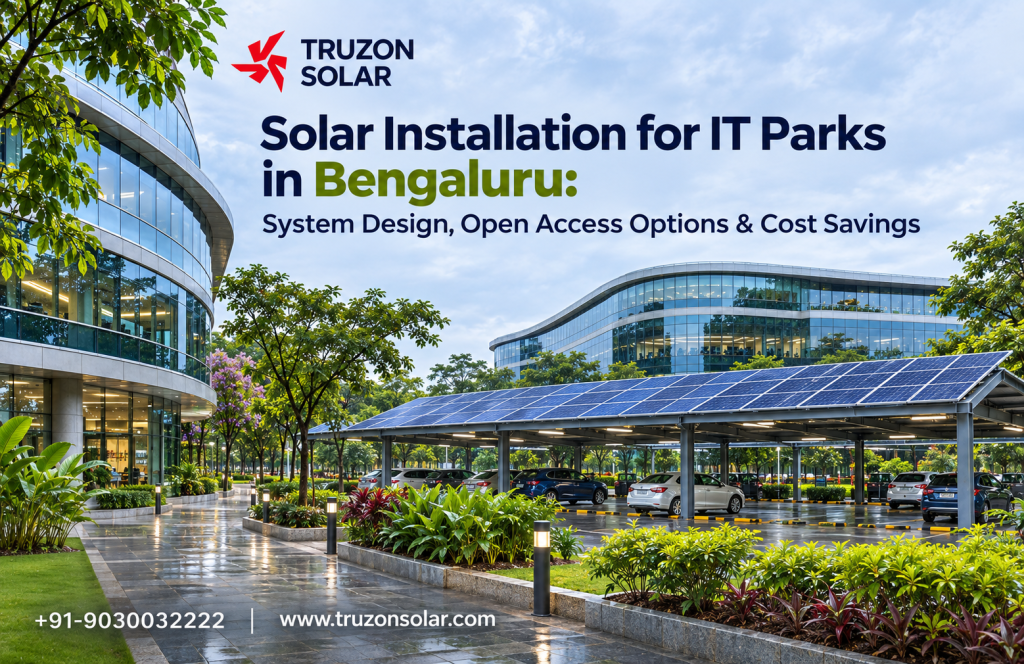
Solar carports can provide additional space when the main roof is occupied by HVAC equipment.
Rooftop Capacity and Cost
| Capacity | Indicative 2026 investment |
| 250 kW | ₹95 lakh–₹1.30 crore |
| 500 kW | ₹1.80–₹2.50 crore |
| 1 MW | ₹3.40–₹4.80 crore |
| 2 MW | Site-specific |
Cost depends on structure, voltage, cable routes, transformer changes and monitoring integration. Battery storage is not included.
For leased IT parks, investment responsibility must be decided between the property owner, facility operator and tenants. The party paying for the plant should have a clear contractual right to the resulting energy benefit.
Open Access for IT Parks in Bengaluru
When a campus has high demand but limited roof space, it may examine renewable-energy procurement from an off-site project through open access. Common structures include third-party power purchase, captive generation and group captive participation.
Open access is not simply a cheaper tariff offered by a solar developer. Its economics may include electricity charges, transmission and wheeling charges, losses, banking treatment, cross-subsidy surcharge and other regulatory costs.
Karnataka notified revised Open Access Regulations in March 2025 after legal challenges affected the earlier green-open-access framework. Eligibility, charges and procedures must therefore be checked against the current KERC orders before signing a long-term agreement.
A proposal should model:
- Landed cost of renewable electricity
- Current DISCOM energy cost
- Applicable surcharges and losses
- Contract tenure
- Minimum purchase obligation
- Generation shortfall
- Change-in-law provisions
- Exit and termination rights
Group captive arrangements may require the participating consumers to maintain prescribed ownership and consumption conditions. Failure to meet them can materially alter the financial outcome, so specialist legal and regulatory review is advisable.
Rooftop Solar Versus Open Access
Rooftop solar offers direct visibility and uses otherwise idle property space. It generally avoids the complexity of procuring electricity from a remote project, but capacity is limited by the roof.
Open access can serve a larger portion of consumption, including energy requirements far beyond rooftop potential. It involves longer contracts and greater exposure to regulatory changes.
A blended strategy may be suitable:
- Install rooftop solar for direct daytime consumption.
- Procure additional renewable energy through open access.
- Retain the grid for balancing and reliability.
- Use storage only where a defined operational benefit exists.
Cost Savings and Payback
A 1 MW rooftop plant in Bengaluru may produce roughly 14–15 lakh units annually, depending on the site and equipment. If 95% is used internally at an avoided value of ₹9 per unit, the annual gross benefit could be approximately ₹1.2–₹1.28 crore.
For a project costing ₹4 crore, simple payback may fall near three-and-a-half to five years. Financing, maintenance, tariff changes and production variation affect the actual result.
Open-access savings should be calculated from the complete landed cost, not the developer’s headline generation tariff. A low quoted energy rate may look less attractive once every applicable charge is included.
Reliability, Data Centres and Batteries
A normal grid-connected solar plant shuts down during a grid failure. It does not replace UPS systems or generators required by data centres.
Battery storage may support peak reduction, critical-load continuity or renewable-energy management, but each use case requires separate modelling. Batteries purchased without a clear operating strategy can increase costs without delivering equivalent value.
The solar-control system must be coordinated with generators, UPS equipment and the campus electrical network. Protection studies are essential for large installations.
Maintenance and Performance Management
IT parks already employ facility-management teams, making solar monitoring easier to integrate into existing operations. Daily dashboards should show generation, inverter status and faults.
Cleaning, thermal inspections, cable checks, earthing tests and inverter maintenance should be scheduled systematically. Truzon can assist with energy assessment, rooftop design, open-access comparison and performance monitoring.
The commercial proposal should distinguish guaranteed obligations from indicative generation. That single distinction can prevent disagreement after commissioning.
Read More:- Rooftop Solar for Resorts in Jaipur: Energy Requirements, Installation Process, Savings & ROI
Frequently Asked Questions
1. Can tenants share one rooftop solar plant?
Possibly, but allocation depends on metering, electricity connections, lease terms and applicable regulations. It must be designed before installation.
2. Is open access always cheaper than DISCOM electricity?
No. The complete cost includes charges, losses and contractual risks. A landed-cost comparison is necessary.
3. Does solar replace a data-centre UPS?
No. Rooftop solar reduces energy purchases but does not perform the same reliability function as a UPS and battery system.
About the Author