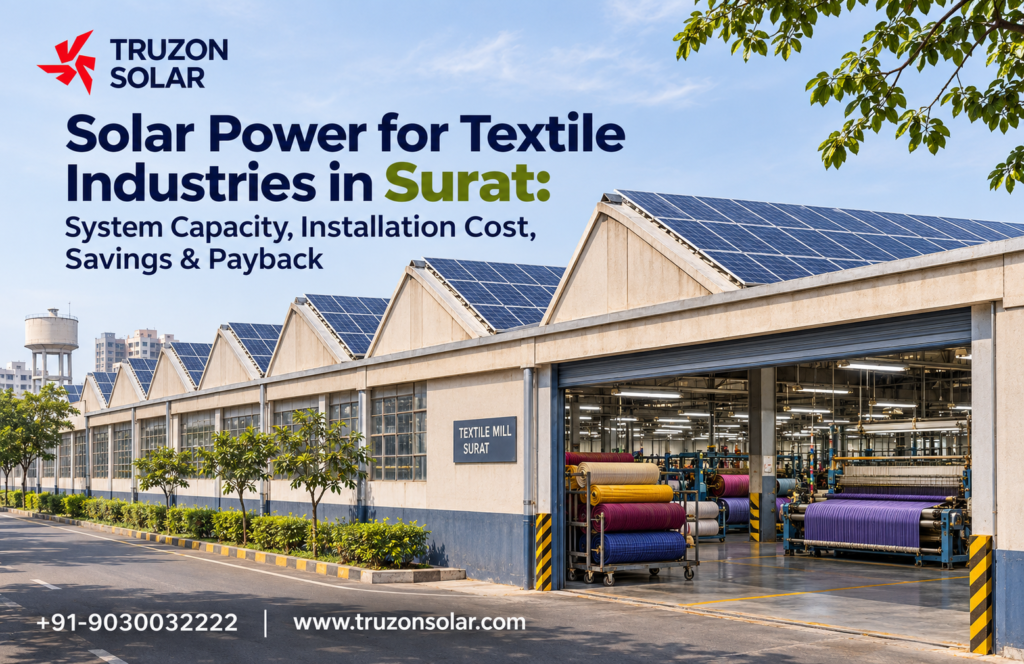

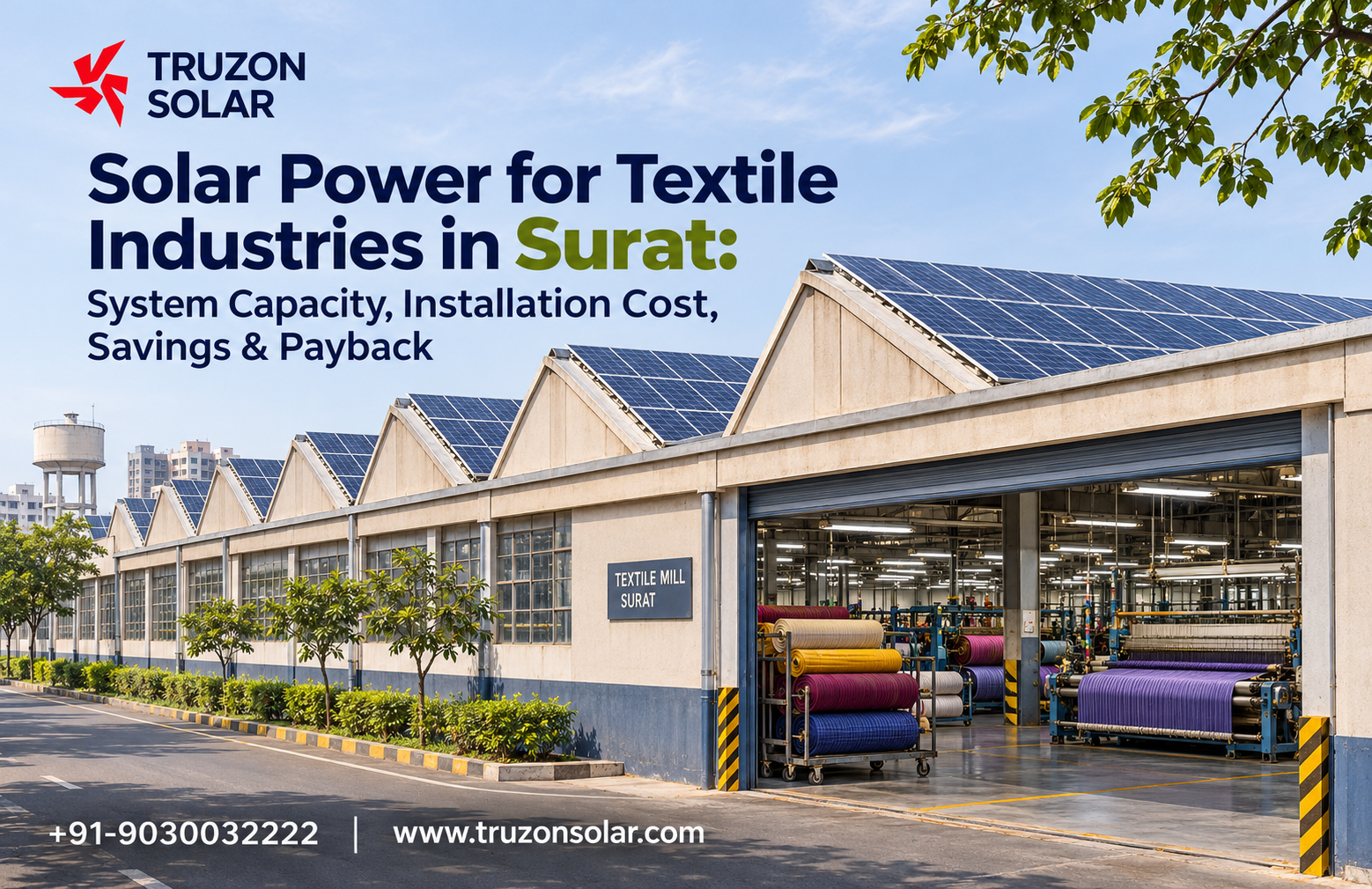
Electricity is woven into almost every stage of textile production. Motors run looms, compressors support machinery, boilers require auxiliary power, and processing units depend on pumps, dryers and ventilation. In Surat, where textile businesses often operate long shifts, even a modest rise in electricity tariffs can affect production costs.
Solar power for textile industries in Surat can reduce the electricity purchased during daylight hours. The advantage is particularly strong for units with steady daytime production, large roofs and predictable energy consumption. Solar will not replace the grid, but it can become a dependable cost-control measure for many years.
Table of Contents
- Why Solar Suits Textile Units
- Choosing System Capacity
- Roof and Design Requirements
- Installation Cost
- Savings and Payback
- Installation Process
- Maintenance
- FAQs
Why Textile Industries Are Well Suited to Solar
A textile factory typically consumes power during the same hours in which panels produce electricity. Looms, winding machines, air compressors, pumps, humidification systems and lighting create a consistent daytime base load.
In an on-grid arrangement, the solar plant supplies electricity to the factory’s internal network. Machinery uses the available solar power first, while the grid supplies the balance. Production therefore continues normally when clouds reduce generation.
A standard on-grid plant does not provide backup during a grid failure. It shuts down through anti-islanding protection. A factory requiring backup must use a separately engineered battery, generator or hybrid arrangement.
Selecting Solar Capacity for a Surat Textile Factory
Capacity should be selected from consumption data, not merely transformer size or roof availability. The installer should examine at least twelve months of bills, interval consumption, maximum demand, production shifts and weekly shutdowns.
| Approximate monthly consumption | Possible starting capacity |
| 15,000–20,000 units | 100–140 kW |
| 35,000–45,000 units | 250–300 kW |
| 70,000–85,000 units | 500–600 kW |
| Above 1.4 lakh units | 1 MW or site-specific |
These figures are only for early planning. A dyeing unit with thermal and electrical processes may have a different demand pattern from a weaving unit using power looms.
Oversizing should be avoided unless the treatment of exported electricity has been studied. The most valuable solar unit is generally one consumed within the factory because it directly avoids grid purchase at the applicable tariff.
Roof and Engineering Requirements
Textile units often have broad metal-sheet roofs, but older structures may not have been designed for additional equipment. Engineers should inspect the trusses, purlins, sheets, fasteners and corrosion before preparing the layout.
Approximately 70–100 square feet of usable roof may be required for every kilowatt. Skylights, vents, water tanks, fire pathways and future expansion zones reduce the area available for modules.
Surat’s humid conditions and industrial environment make material quality important. The design should include corrosion-resistant mounting components, suitable cable management, proper earthing, lightning protection and safe walkways.
For dyeing and processing facilities, panels should be positioned away from exhaust outlets that release vapour, lint or chemical residue.
Installation Cost of Textile-Industry Solar
Indicative 2026 investment ranges are:
| System capacity | Approximate investment |
| 100 kW | ₹42–₹55 lakh |
| 250 kW | ₹95 lakh–₹1.30 crore |
| 500 kW | ₹1.80–₹2.50 crore |
| 1 MW | ₹3.40–₹4.80 crore |
The final cost depends on module technology, inverter architecture, roof reinforcement, evacuation voltage, transformer work and cable distance. Battery storage is not included in these estimates.
Commercial and industrial textile projects should not calculate returns using residential rooftop subsidies. Their viability normally comes from electricity savings, available financing and legitimate tax treatment confirmed by the company’s adviser.
Expected Generation and Savings
A well-maintained 500 kW solar plant in Surat may generate approximately 7–8 lakh units annually. Shade, temperature, dust, equipment efficiency and shutdowns will affect actual output.
Suppose the factory productively uses 7.2 lakh units and the average avoided electricity expense is ₹9 per unit. The gross annual benefit would be about ₹64.8 lakh. After maintenance, insurance and minor repairs, the net saving would be somewhat lower.
If the plant costs ₹2.15 crore, simple payback may occur in approximately three-and-a-half to five years. Financing interest, lower utilisation and unexpected roof work could extend the period.
A realistic proposal should provide monthly generation projections. Annual output should not simply be divided equally across twelve months because weather and temperature cause seasonal variation.
Installation Without Interrupting Production
The project begins with load analysis, roof inspection and structural assessment. Engineers then prepare the module layout, cable routes, protection design, generation estimate and commercial model.
Material movement should be planned around factory operations. Electrical integration may require a controlled shutdown, which should be scheduled outside critical production hours.
Before commissioning, the team should test insulation, polarity, inverter protections, earthing and emergency isolation. The factory should receive drawings, equipment serial numbers, test reports, warranties and monitoring access.
Maintenance in a Textile Environment
Lint and airborne fibres can settle on panels and enter inverter ventilation areas. Maintenance therefore needs to reflect the production environment.
Modules should be cleaned with suitable water and non-abrasive equipment. Technicians must inspect connectors, cables, earthing, mounting fasteners and inverter filters. Remote monitoring should be reviewed daily so that a stopped inverter is not ignored for weeks.
Truzon can help textile businesses analyse energy use, assess the roof, design capacity and monitor long-term performance. A dependable proposal should explain every generation and payback assumption instead of relying on a dramatic “zero bill” promise.
Read More:- Apartment Solar Installation in Tirupati: Common-Area Power, Subsidy, Net Metering & Savings
Frequently Asked Questions
1. Can solar operate textile machinery directly?
Solar electricity joins the factory’s internal network and offsets the power used by running machinery. The grid supplies any additional requirement.
2. Will solar reduce demand charges?
It may reduce recorded demand in certain circumstances, but the result depends on the timing of peak load and applicable tariff. Energy-charge savings should be evaluated separately.
3. What payback can a textile unit expect?
A well-sized plant with high daytime use may recover its cost in roughly three-and-a-half to six years.
About the Author