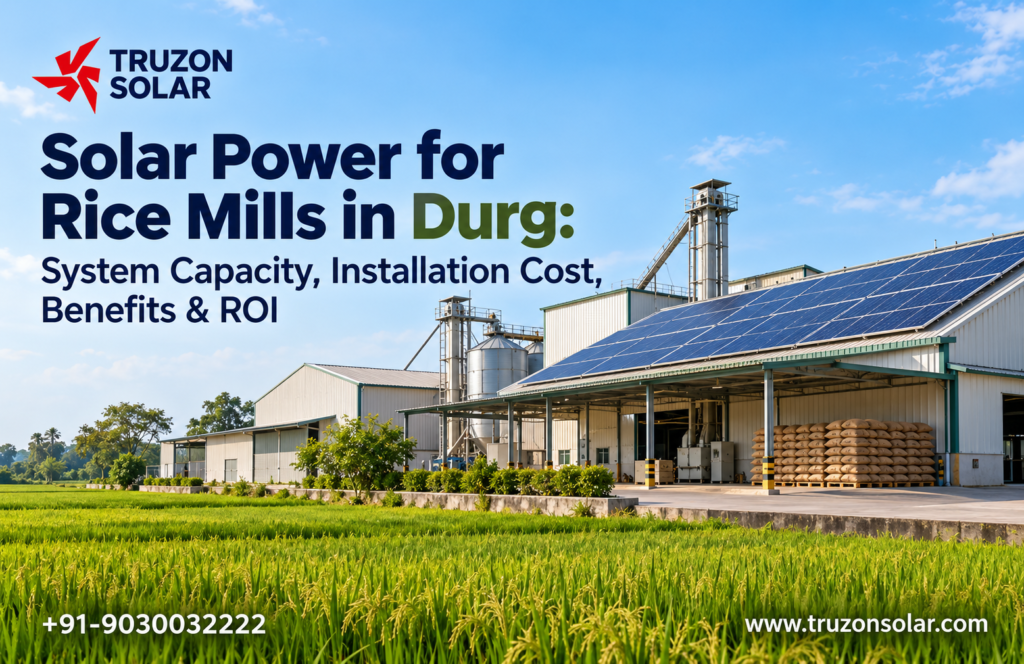

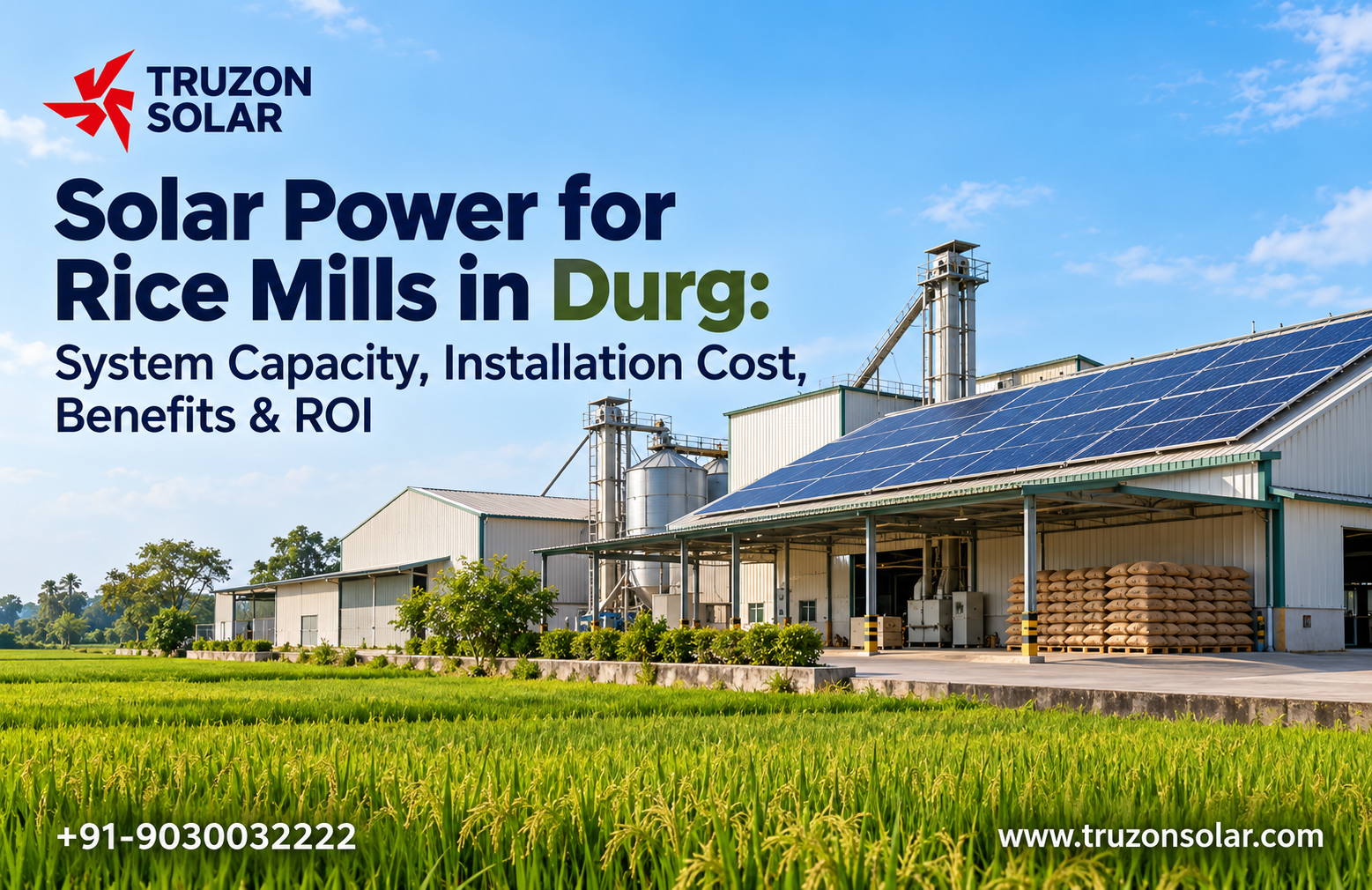
Rice milling uses electricity at several stages, from cleaning and dehusking to polishing, grading, conveying and packing. Motors operate for long hours during active production, making electricity a significant part of processing cost. For mills working mainly in daylight, solar generation can match a useful portion of the operational load.
Solar power for rice mills in Durg is therefore not just an environmental project. It can be a practical step towards controlling processing expenses and protecting margins when grid tariffs rise.
Table of Contents
- Why Rice Mills Are Suitable for Solar
- Capacity Selection
- Installation Cost
- Benefits and Savings
- ROI Calculation
- Installation Process
- Maintenance in a Dusty Environment
- FAQs
Why Solar Power Works for Rice Mills
Rice mills usually operate energy-intensive equipment during predictable shifts. Elevators, separators, hullers, polishers, graders and air-handling equipment create a substantial load. When production is active during sunny hours, solar electricity can be consumed immediately.
The grid remains connected and supplies additional power whenever the mill’s requirement exceeds solar generation. This prevents production from depending on changing sunlight.
A standard on-grid solar plant does not operate when the grid fails because mandatory protection isolates it from the network. If backup power is essential, the mill needs a coordinated design involving generators, hybrid controls or storage.
Selecting Solar Capacity for a Rice Mill
Capacity should be based on electrical data, not merely the horsepower printed on machinery. Engineers should analyse:
- Twelve months of electricity bills
- Half-hourly or interval load data
- Contract demand and maximum demand
- Operating shifts and seasonal shutdowns
- Motor-starting patterns
- Transformer capacity
- Roof and ground space
- Future production expansion
A small mill may consider 50–150 kW, while a larger processing plant may need 250 kW, 500 kW or more. The solar plant should normally remain within the permitted electrical and regulatory limits.
During harvest and procurement seasons, mill utilisation may be high. At other times, production can fall. A proper financial model must account for this seasonality so that surplus generation is not overstated.
Roof and Ground-Mount Options
Rice mills may use factory roofs, warehouse sheds or vacant land. Rooftop solar preserves ground area but requires a structural assessment. Dust vents, chimneys and material conveyors can create shade or deposit residue on nearby modules.
Ground-mounted systems are easier to access and orient, although they require secure land, fencing, drainage and additional cabling. The right option depends on the site rather than a universal rule.
Approximately 70–100 square feet per kW may be needed on a suitable roof. Ground-mounted projects generally require more total land after accounting for row spacing and access.
Installation Cost for Rice Mill Solar in Durg
| Solar capacity | Indicative 2026 investment |
| 50 kW | ₹22–₹30 lakh |
| 100 kW | ₹42–₹55 lakh |
| 250 kW | ₹95 lakh–₹1.30 crore |
| 500 kW | ₹1.80–₹2.50 crore |
| 1 MW | ₹3.40–₹4.80 crore |
These estimates exclude battery storage and major civil or transformer upgrades. The price can change according to module wattage, inverter type, structure, voltage level and distance from the interconnection point.
Rice mills are industrial consumers, so the residential PM Surya Ghar subsidy should not be assumed. The project’s viability should be established through electricity savings, available tax treatment and financing terms.
Benefits of Solar Power for Rice Mills in Durg
The most immediate benefit is a reduction in purchased daytime electricity. Solar can also offer:
- Greater visibility over long-term energy costs
- Reduced exposure to tariff increases
- Productive use of large mill or warehouse roofs
- Lower operating emissions
- Better sustainability reporting
- Support for customer or lender ESG requirements
Solar should not be sold as a promise to eliminate the entire bill. Demand charges, fixed charges, night consumption and other billing items may continue.
Savings and Return on Investment
A 500 kW system may produce approximately 7–8 lakh units annually under suitable conditions. Suppose the mill uses 85% of that electricity effectively and the average avoided value is ₹8.50 per unit. The annual gross benefit may be roughly ₹50–₹58 lakh.
If the plant costs ₹2.10 crore, simple payback could be around four years. Financing interest, maintenance, seasonal shutdowns and module degradation may extend the effective recovery period.
The model should test more than one scenario. A conservative calculation might use lower generation and fewer operating days, while an optimistic case may assume full production. Investment decisions should be based on the conservative or expected case, not the most attractive spreadsheet result.
Installation Process at an Operating Mill
Solar work must be coordinated with production because rice dust, moving equipment and vehicle traffic create additional safety concerns. The first stage includes load analysis, roof or land survey, structural review and electrical study.
The installer then prepares the layout and protection design, completes applicable applications and schedules construction. Modules, inverters, cabling, AC panels, lightning protection, earthing and monitoring equipment are installed in planned stages.
Before commissioning, the team should perform insulation, polarity, earthing, protection and inverter tests. Shutdowns for final integration should be agreed with mill management in advance to avoid interrupting an important production batch.
Maintenance in a Rice-Mill Environment
Rice husk and processing dust can settle on modules and reduce sunlight reaching the cells. Cleaning frequency should therefore be based on actual soiling rather than a generic monthly schedule.
Water used for cleaning should not leave heavy mineral deposits. Dry brushes that may scratch the module glass should be avoided. Workers need fall protection and proper access routes.
Electrical inspections should cover loose terminals, cable damage, hot spots, inverter ventilation, earthing and lightning protection. Monitoring data must be compared with weather and expected production so that abnormal losses are identified early.
Truzon can help rice mills develop a system around production hours, seasonal demand and available space. Equipment selection matters, but accurate capacity planning and dependable maintenance usually have a greater influence on lifetime returns.
Read More:- Warehouse Solar Installation in Bilaspur: Roof Requirements, System Cost, Savings & Payback
Frequently Asked Questions
1. Can solar run heavy rice-mill motors?
Solar can supply part of the electricity used by motors while the plant is generating. The grid supplies the balance and supports motor-starting requirements according to the electrical design.
2. Is a battery compulsory for a rice mill?
No. Most industrial cost-saving projects are on-grid systems without batteries. Storage is considered when backup needs justify the additional investment.
3. What is the usual payback period?
A well-designed rice-mill solar plant may achieve simple payback in approximately four to six years. Actual results depend on operating days, tariff, self-consumption, generation and financing.
About the Author