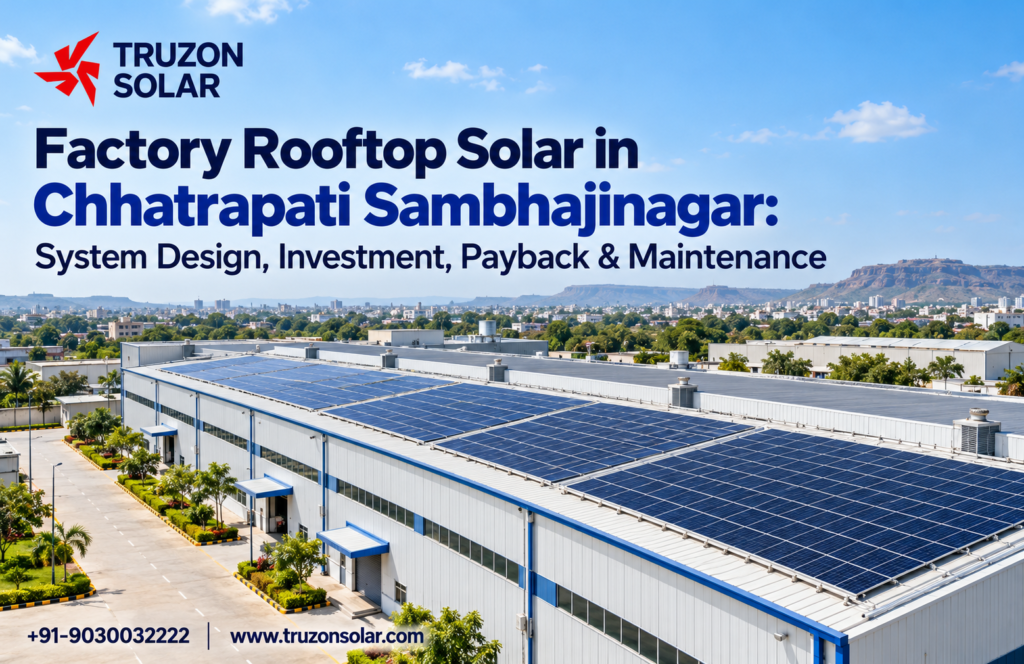

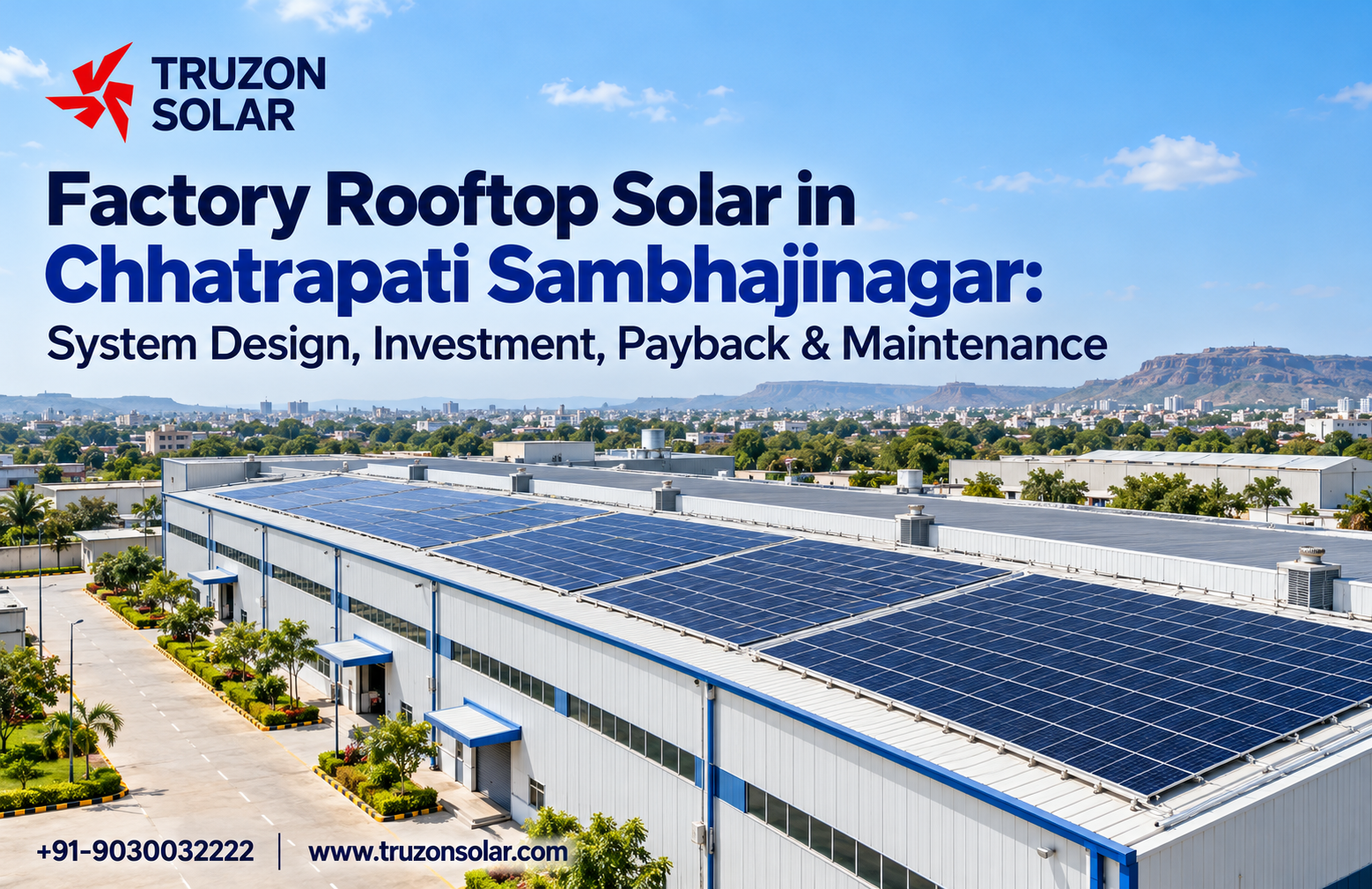
Factories in Chhatrapati Sambhajinagar usually consume the most electricity during the same hours in which solar panels produce power. CNC machines, compressors, pumps, assembly lines, ventilation systems and process equipment create a steady daytime load. This consumption pattern makes factory rooftop solar in Chhatrapati Sambhajinagar financially attractive for many manufacturing units.
The city’s industrial estates and manufacturing clusters contain large roof areas, but size alone does not guarantee a successful project. A good industrial solar plant must fit the factory’s demand pattern, roof condition and electrical infrastructure.
Table of Contents
- Why Factories Are Suitable for Solar
- Industrial Solar System Design
- Investment Estimates
- Savings and Payback
- Installation Stages
- Maintenance Requirements
- Installer Selection
- FAQs
Why Factory Rooftop Solar Works Well
Residential consumption often rises after sunset, whereas factory consumption is generally concentrated during working hours. Solar electricity generated at noon can therefore be consumed immediately by machinery and supporting equipment.
This direct consumption is valuable because it reduces electricity purchased at the applicable industrial tariff. The factory continues receiving grid power when solar generation falls, and a standard on-grid plant normally shuts down during an outage unless a compatible backup arrangement has been designed.
Solar should be viewed as an energy-cost project, not as a replacement for every electrical system in the factory.
Designing Factory Rooftop Solar in Chhatrapati Sambhajinagar
The design begins with twelve months of electricity bills and, preferably, interval load data. Engineers study contract demand, recorded maximum demand, operating shifts, weekly shutdowns and seasonal production changes.
A factory consuming 1.5 lakh units monthly does not automatically need a system designed to produce the same number of units. If production stops frequently or demand falls sharply on holidays, an oversized plant may export more electricity than anticipated.
Roof construction is equally important. Industrial premises commonly use metal sheets, reinforced concrete or a combination of both. The survey should check:
- Age and condition of roofing sheets
- Purlin spacing and structural strength
- Skylights, vents and smoke outlets
- Future expansion areas
- Safe maintenance pathways
- Shadow from chimneys and equipment
- Cable route to the electrical room
Hot equipment or chemical fumes may require special positioning and material selection.
Capacity and Roof Area
An industrial solar plant generally requires 70–100 square feet per kW, depending on module efficiency and layout.
| Available usable roof | Possible system capacity |
| 10,000 sq. ft. | 100–130 kW |
| 25,000 sq. ft. | 250–325 kW |
| 50,000 sq. ft. | 500–650 kW |
| 1,00,000 sq. ft. | 1–1.3 MW |
These figures are preliminary. Fire routes, edge clearances and structural limitations can lower the final capacity.
Factory Solar Investment in 2026
Large systems generally achieve a lower cost per kilowatt because engineering and mobilisation expenses are distributed across greater capacity.
| Capacity | Indicative investment |
| 100 kW | ₹42–₹55 lakh |
| 250 kW | ₹95 lakh–₹1.30 crore |
| 500 kW | ₹1.80–₹2.50 crore |
| 1 MW | ₹3.40–₹4.80 crore |
Prices vary with module technology, inverter architecture, structure, voltage level, roof repairs and evacuation work. Battery storage is not included in these broad estimates.
Central residential rooftop subsidy should not be assumed for a factory project. Commercial and industrial consumers typically evaluate solar through electricity savings, financing options, tax treatment and the chosen ownership model.
Solar Savings and Payback
A 500 kW factory rooftop system may generate approximately 7–8 lakh units in a year under favourable conditions. If 90% of this energy is effectively used at an avoided cost of ₹9 per unit, the gross annual benefit could be around ₹57–₹65 lakh after considering normal conversion losses and usage patterns.
A project costing ₹2.15 crore might therefore achieve a simple payback in roughly three-and-a-half to five years. This illustration is not a guaranteed return. Module degradation, tariff changes, curtailment, production holidays, interest and maintenance will affect actual results.
For companies that do not want to invest capital, a RESCO or operating-expenditure model may be considered. Under such an arrangement, a third party owns the plant and supplies solar electricity under a contracted tariff. Ownership, roof rights and exit conditions must be reviewed carefully.
Industrial Solar Installation Process
Implementation normally starts with load analysis and roof inspection. The engineering team then prepares the layout, single-line diagram, generation estimate and financial model.
Once approvals are in place, installation may include roof reinforcement, walkways, lifelines, module structures, DC cabling, inverters, AC panels, earthing and lightning protection. Work permits must be coordinated with factory safety and production teams.
Commissioning should include insulation tests, protection checks, inverter testing, meter verification and monitoring configuration. The final handover file should contain drawings, equipment serial numbers, warranties and test reports.
Maintenance of Factory Rooftop Solar
Industrial dust can reduce output faster than it does on a residential terrace. The cleaning schedule should reflect local dust, water quality and manufacturing activity rather than follow an arbitrary calendar.
Routine maintenance includes:
- Cleaning panels with suitable water and equipment
- Checking loose connections and hot spots
- Inspecting cables for damage
- Testing earthing and protection systems
- Reviewing inverter alarms
- Comparing actual and expected generation
- Checking the roof for leakage or corrosion
Remote monitoring should be reviewed daily. A failed inverter left unnoticed for several weeks can cost more in lost generation than a maintenance contract.
Truzon can help factories plan industrial solar around their operating load, roof limitations and investment objectives. The proposal should contain a realistic generation model instead of an inflated payback claim.
Read More:– Solar for Housing Societies in Mumbai 2026: Installation Cost, Shared Savings, Net Metering & ROI
Frequently Asked Questions
1. Can solar operate factory machines directly?
Solar power joins the factory’s internal electrical network through the approved design. Machines use available solar electricity first, while the grid supplies any shortfall.
2. Will an on-grid plant work during a power cut?
Normally, no. Anti-islanding protection shuts it down when the grid fails. Backup operation requires a separately engineered hybrid or storage system.
3. How long does industrial solar take to recover its cost?
Many well-utilised projects may recover their investment in approximately three to six years, depending on tariff, generation, financing and daytime consumption.
About the Author