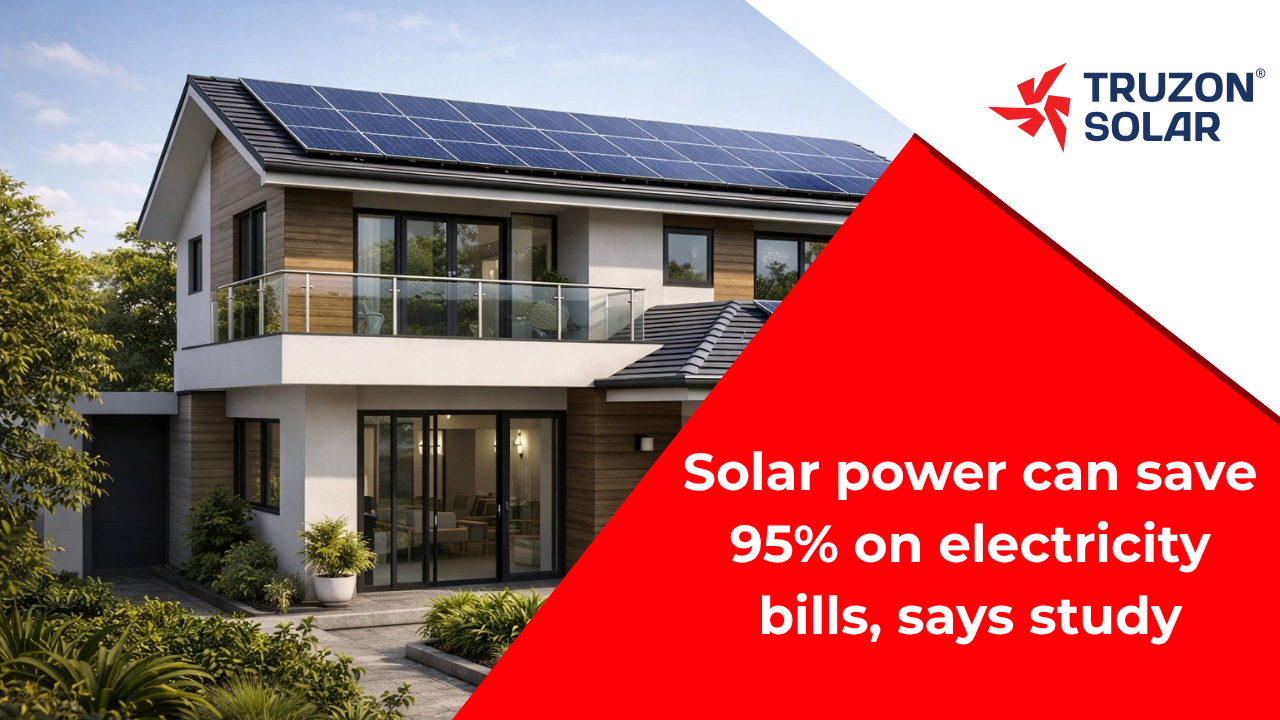
Electricity bills in India have been climbing for years, and most households have no real way to control that cost — until they generate their own power. A landmark study by the Council on Energy, Environment and Water (CEEW) put a hard number on just how much rooftop solar can save: up to 95% on lifetime electricity costs for households that own a rooftop system, and up to 35% for those who simply subscribe to a shared community solar plant.
Here’s what the study found, why it matters, and what it means if you’re considering solar for your own home.
What the CEEW Study Actually Found
The research — “Scaling Rooftop Solar: Powering India’s Renewable Energy Transition with Households and DISCOMs” — was conducted by CEEW researchers Neeraj Kuldeep, Selna Saji, and Kanika Chawla, in partnership with BSES Yamuna Power Limited (BYPL), the electricity distribution company serving East and Central Delhi. It was released at the CEEW Renewable Energy Dialogue in 2018 and remains one of the most cited pieces of research on residential solar economics in India.
The key findings:
- Households that own a rooftop solar system can save up to 95% on their electricity bills, calculated over the 25-year lifetime of a typical system.
- Households buying power through a community solar subscription — without owning any hardware themselves — can still save up to 35%.
- Solar system costs had already fallen 27% year-on-year over the preceding three years, making the economics increasingly attractive for both households and businesses.
- Despite a 30% government subsidy at the time, adoption remained slow: India had installed only about 400 MW of residential rooftop solar nationwide, with just 60 MW in Delhi.
The study also identified the real barriers holding households back — high upfront capital cost, limited access to financing, low consumer awareness, disputes over roof ownership, and the long-term commitment involved in a 25-year rooftop lock-in. None of these are technology problems; they’re business-model problems, which is exactly what the CEEW–BYPL research set out to solve.
Three Business Models Designed to Fix the Adoption Gap
To get around these barriers, the CEEW–BYPL collaboration proposed three utility-led models, each aimed at a different type of resident:
- Community Solar Model — Ideal for apartment complexes and gated communities. A shared rooftop solar plant is installed on common space, and costs and generated units are split among residents based on their ownership share.
- On-Bill Financing Model — Designed for individual homeowners. The cost of the solar system is recovered gradually through the savings it generates on the electricity bill itself, lowering the barrier of a large upfront payment.
- Solar Partner’s Model — Built for renters and residents without direct roof access. It lets them subscribe to solar power generated elsewhere — for instance, on unused warehouse or government building rooftops — without needing to own or install anything.
As P.R. Kumar, CEO of BYPL, put it at the time, the collaboration created “fit-for-purpose” business models specifically because a large share of BYPL’s customer base sits in the residential segment — the exact group that had been slowest to adopt solar despite the clear savings on offer.
Why This Matters Even More in 2026
Since this study was published, the economics have only improved further in solar’s favour:
- Panel and system costs have continued to fall, while efficiency has improved — meaning the 95% savings figure from 2018 is, if anything, conservative by today’s standards.
- Subsidy support has expanded. Schemes like the central government’s rooftop solar subsidy programs now offer meaningfully higher support for residential systems than the 30% available when this study was conducted.
- State-level policies have caught up. Delhi, for instance, has since moved to eliminate bills entirely for solar-adopting households even in higher consumption slabs — a shift the 2018 CEEW research effectively predicted was coming as business models matured.
- Net metering is now standard across most states, allowing households to feed surplus solar power back into the grid and offset costs even further.
The Bottom Line
The CEEW study confirmed what solar companies had been saying for years, backed by independent, peer-reviewed data: rooftop solar isn’t a lifestyle choice, it’s a financial one. A 95% reduction in your electricity costs over 25 years, even after accounting for installation and maintenance, is not a marginal saving — it’s a fundamental change in a household’s biggest recurring utility expense.
If you’re weighing whether solar makes sense for your home, the honest answer — backed by this research — is that the real question isn’t whether it saves money, but which ownership or financing model fits your situation. Whether you own your roof outright, live in an apartment complex, or rent, there’s now a model designed for you.
Ready to see what your own savings could look like? Talk to our solar experts at Truzon Solar for a free rooftop assessment and a customised savings estimate for your home.
Source – CEEW Full Publication
About the Author