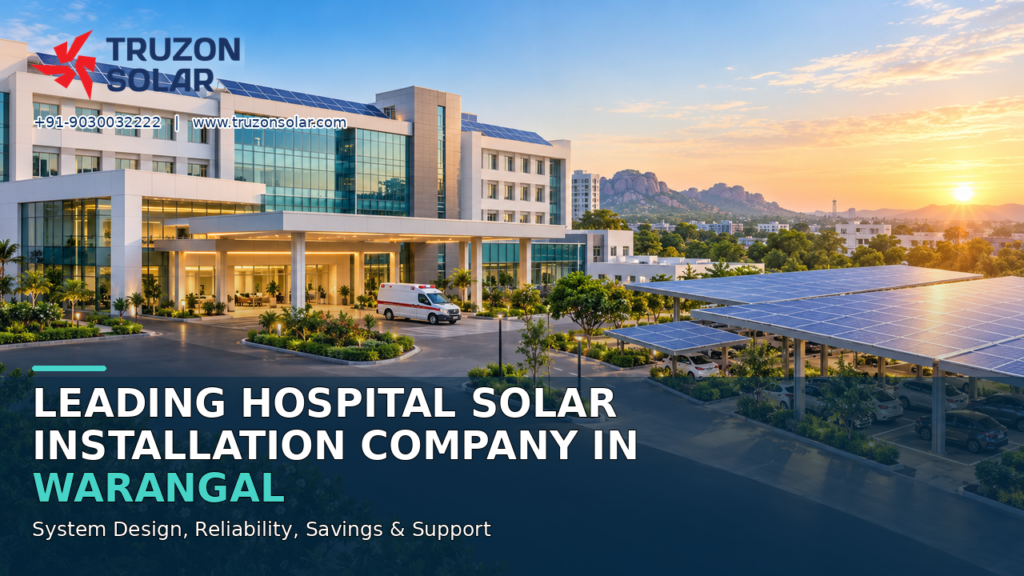

Hospitals need electricity constantly, but loads differ in importance. Theatres, ICUs, laboratories, refrigeration, lifts, cooling and offices create different demands.
A leading hospital solar installation company in Warangal must reduce grid consumption without disturbing critical services or backup systems. Truzon Solar combines load assessment, coordinated engineering and safe installation.
Table of Contents
- Why Solar Is Suitable for Hospitals
- Hospital Load Assessment
- Solar System Design
- Reliability and Backup Coordination
- Installation Process and Safety
- Electricity Savings and Payback
- Maintenance and Monitoring
- Why Choose Truzon Solar?
- Frequently Asked Questions
Why Choose a Leading Hospital Solar Installation Company in Warangal?
Hospitals maintain substantial daytime demand. Cooling, diagnostics, laboratories, kitchens, laundries and offices can directly consume solar generation.
An on-grid system uses solar first, while the grid supplies shortfalls. Surplus may be exported under applicable DISCOM rules.
A standard on-grid plant shuts down during outages and does not replace generators, UPS systems or batteries. This must be explained before design.
Hospital Load Assessment Before Solar Design
Total bills do not identify critical or interruptible loads. Engineers should study operating hours, maximum demand and seasonal changes.
The load assessment may separate:
- Critical medical equipment
- Operation theatres and ICUs
- Diagnostic and laboratory loads
- HVAC and ventilation systems
- Pharmacy and medical refrigeration
- Water pumps and treatment systems
- Lifts and common-area lighting
- Kitchens, laundries and administrative offices
New wards, imaging equipment, cooling or laboratories can materially change future demand.
Capacity planning should review twelve months of bills and involve facility, electrical and finance teams.
The leading hospital solar installation company in Warangal should distinguish energy-saving goals from emergency-power requirements before recommending equipment or financial returns.
System Design by a Leading Hospital Solar Installation Company in Warangal
Selecting the Correct Capacity
Capacity should match daytime demand, sanctioned load, roof area and net-metering rules. Oversizing may create poorly adjusted exports.
| Solar capacity | Estimated monthly generation | Approximate roof area |
| 25kW | 2,750–3,250 units | 2,000–2,500 sq. ft. |
| 50kW | 5,500–6,500 units | 4,000–5,000 sq. ft. |
| 100kW | 11,000–13,000 units | 8,000–10,000 sq. ft. |
| 250kW | 27,500–32,500 units | Based on final layout |
Weather, temperature, orientation, shade, dust and equipment availability affect generation.
Roof and Structural Planning
Hospital roofs may contain tanks, ducts, HVAC units and exhausts. Layouts must preserve walkways, fire access and maintenance space.
Structural checks address added weight, wind load, fragile sections and waterproofing concerns.
Electrical Engineering
Design covers inverters, cables, earthing, surge protection, isolators and interconnection. Existing generator, UPS and emergency arrangements must be understood.
Engineers coordinate these elements with the hospital’s electrical team and equipment suppliers.
A leading hospital solar installation company in Warangal also checks whether cable routes, inverter rooms and isolation points remain accessible without entering clinical zones.
Reliability and Backup Coordination
Even a short interruption may affect clinical work, patient comfort or temperature-sensitive materials.
Solar output changes with sunlight and is not guaranteed backup. An on-grid plant disconnects when the grid fails.
Backup may require a hybrid system or batteries. Size batteries around defined critical loads and duration, not total connected load.
Solar, grid supply, generators, UPS equipment and batteries must be mapped together. Protection settings and changeover logic require testing.
Installation Process for Hospital Solar
Detailed Site Survey
Engineers inspect panels, transformer information, roofs, cables, shadows and access. Existing diagrams and load records are reviewed.
Design Approval and Work Planning
The hospital reviews capacity, layout, interconnection and safety. Work is scheduled around clinical activity and restricted zones.
Controlled Material Movement
Material movement must not block ambulances, fire routes, entrances or patients. Work areas require barricades.
Installation and Testing
Technicians install structures, modules, inverters, cables, earthing and protection. Testing covers voltage, insulation, safety and generation.
Handover and Training
Facility staff receive drawings, warranties and monitoring access, and learn to identify alarms.
During commissioning, the leading hospital solar installation company in Warangal should verify monitoring data against readings and explain alarm escalation to facility staff.
This controlled approach protects hospital operations during installation.
Savings with a Leading Hospital Solar Installation Company in Warangal
Savings depend on generation, tariff, direct consumption and net metering. Hospitals often have strong daytime self-consumption.
A 100kW plant may generate 1.32–1.56 lakh annual units. At ₹8 per unit, estimated benefit may be ₹10.56–₹12.48 lakh.
A 250kW plant may produce 3.30–3.90 lakh annual units, worth an estimated ₹26.40–₹31.20 lakh.
These figures are illustrative. Weather, tariffs, billing, shade, availability and maintenance affect results.
Institutional plants may recover cost in four to seven years, depending on installed cost and energy value. ROI assumptions should be visible.
Maintenance and Technical Support
Maintenance must follow hospital safety and infection-control practices. Restrict roof access and avoid disrupting air intakes, sensitive areas or patients.
Clean panels every 15–30 days using plain water and soft tools while following rooftop safety procedures.
Monitor generation and alarms. A continuing decline may indicate dirt, shade, loose connections or inverter trouble.
Inspect clamps, structures, cables, earthing, lightning protection, isolators and panels. Thermography can identify overheating in larger installations.
Unresolved faults reduce savings and complicate facility management. Clear escalation contacts, service records and warranty coordination are important.
After handover, a leading hospital solar installation company in Warangal remains valuable for preventive maintenance, performance reviews, warranty support and fault investigation.
Why Truzon Is a Leading Hospital Solar Installation Company in Warangal
Truzon Solar reviews consumption, operating patterns, backup and site conditions. Support covers engineering, installation, documentation, monitoring and maintenance.
The aim is dependable generation that works with existing infrastructure. Truzon Solar provides transparent planning, controlled execution and continued support.
Read More: Best School Solar Installation Company in Hyderabad: Cost, Capacity, Savings & Maintenance
Frequently Asked Questions
1. Can rooftop solar run critical hospital equipment during a power cut?
A standard on-grid system cannot; backup requires a properly engineered hybrid, battery, UPS or generator arrangement.
2. What solar capacity is suitable for a hospital?
Capacity depends on daytime demand, sanctioned load, roof area and expansion plans, so detailed load analysis is essential.
3. How often should hospital solar panels be cleaned?
Panels may generally be cleaned every 15–30 days, depending on dust, weather and site conditions.
About the Author