
- Refer & Earn
- Get Expert Suggestion
- Download Brochure
Welcome to Truzon Solar
We provide the best solar solutions for your home.
Ground Mounted Solar Systems: When They Outperform Rooftop Options
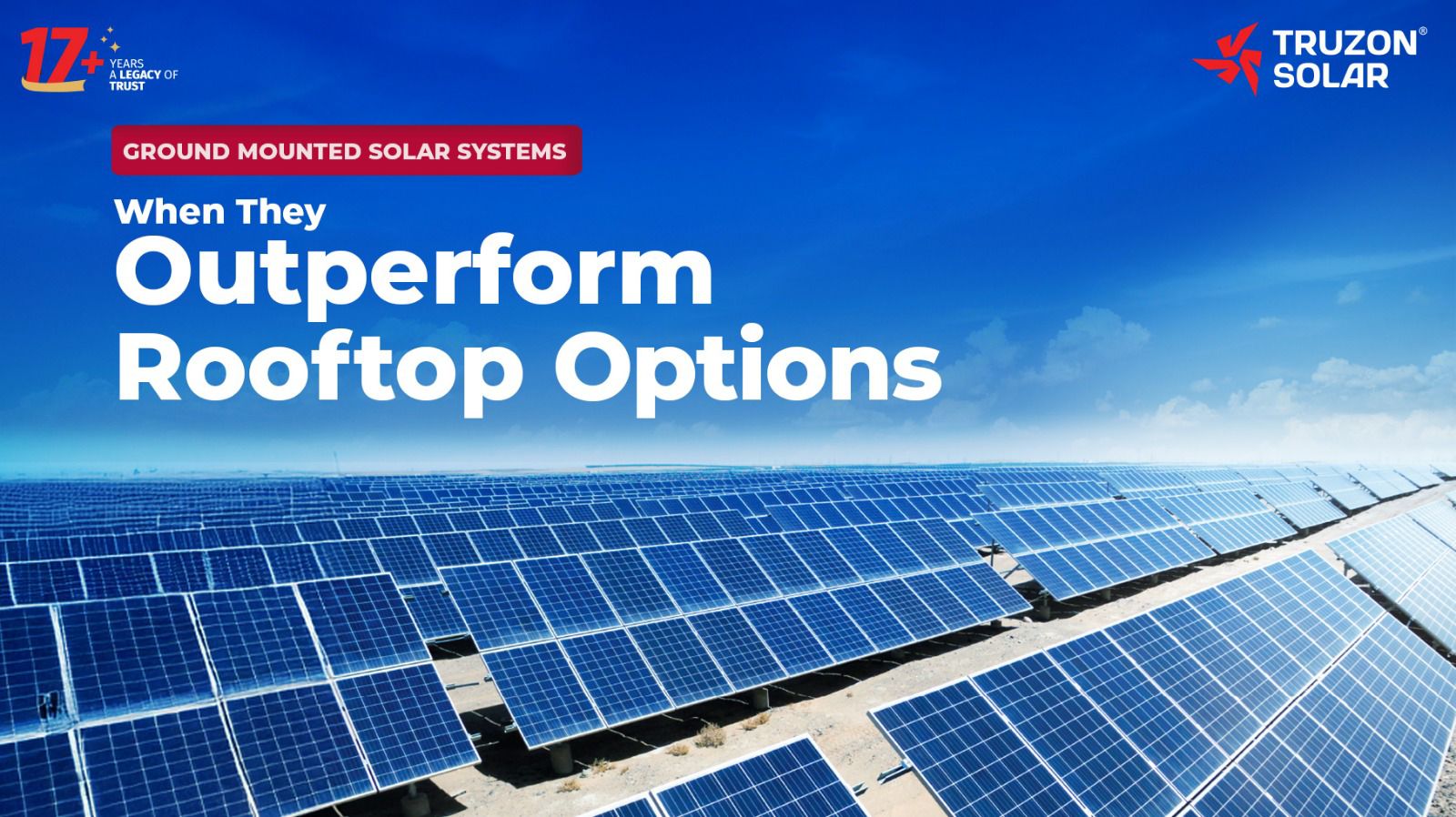
Ground mounted systems can be a better choice for businesses
When it comes to clean energy conversations, solar can be considered as a whole bouquet of solutions. And with changing energy needs and land dynamics, many businesses are looking beyond rooftops for more viable options that offer scale, efficiency, and long-term flexibility.
One such option is Ground Mounted Solar system, designed for needs where rooftops may not be enough.
While rooftop solar works beautifully for homes and small commercial units, there are situations where ground-based setups deliver stronger returns, better performance, and more operational control, especially when the demand is significant
So let’s decode this in details:
Space as the biggest constraint
Rooftops have over obvious limitation: size
This becomes very critical for businesses who consume a lot of energy, but don’t have roof structures that are strong, wide, and shade free enough to support the required demand. Structural limitations, equipment placement, ventilation systems, and future expansion plans often restrict usable space that they can actually spare.
In such a scenario, ground mounted solar becomes a practical and scalable alternative. Instead of adjusting energy goals to fit space constraints, businesses can design solar energy plants that fulfil their consumption needs and create real savings and opportunities to scale seamlessly.
And for businesses that have the acreage, it becomes a very ideal choice, indeed
When Energy Demand Is High
For manufacturing units, textile plants, warehouses, educational campuses, and large commercial complexes, energy consumption runs throughout the day, and the quantum of demand is always significant.
Ground mounted solar gives them the choice to build higher-capacity plants without structural compromises. Since the installation is built on open land, it can accommodate large arrays that can generate significant volumes.
This makes a difference not just in reducing bills, but in stabilising operational costs long term. Businesses with consistent daytime load benefit the most, because the energy produced is consumed almost instantly, reducing grid dependence dramatically.
This is how ground based systems deliver impact and scale, effortlessly.
For maximal panel efficiency
Unlike rooftop setups, ground installations allow greater flexibility in orientation and tilt.
Panels can be positioned at the optimal angle to capture maximum sunlight throughout the year. In some cases, tracking systems can also be integrated to follow the sun’s movement, improving overall output.
A well-executed ground mounted solar installation ensures panels are not compromised by uneven roof surfaces, parapet shadows, or space constraints. Instead, they are aligned precisely to maximise performance, and small gains in terms of parameters like sunlight received, often translate into substantial gains in the long run.
Easier maintenance and access
When it comes to effective solar value chains, maintenance is a factor that is often overlooked.
This becomes very crucial especially with regards to rooftop systems because in industrial environments, factors like safety clearances, working heights, and structural layouts make regular monitoring, access and servicing difficult.
Of course, today certain companies like Truzon Solar offer systems that comes with a digitised smart maintenance suite, but in certain circumstances that might just not be enough.
This is where ground mounted solar arrays come into the picture. Cleaning, inspections, and repairs can be conducted much more efficiently, leading to greater resilience and lesser chances of a downtime
Accessibility also improves safety and efficiency benchmarks. Technicians can work at ground level without complex arrangements, leading to faster turnarounds. And in the long run, this directly improves overall productivity and performance.
Making the most out of the land available
Many institutions, factories, and campuses possess unused or underutilized land parcels. Instead of leaving this land idle, it can be converted into a productive energy asset with ground mounted solar.
A thoughtfully planned ground mounted solar installation transforms open land into a long-term revenue-saving engine. The plant not only offsets electricity bills but also increases the overall asset value of the property it possesses.
Thus, for businesses looking at sustainability as as strategic advantages, this becomes the perfect win-win, unlocking capital while enhancing the carbon footprint and ESG posture at the same time.
Unused land becomes the main character here, enabling many businesses to go significantly green.
Enabling seamless scale-up
When it comes to scale, rooftop might not be the best proposition, as it is always constrained by a number of key variables, like design of the factory or office, and how much roof space is available at any given moment.
With ground mounted solar, on the other hand, expansion becomes truly simpler. Additional panels can be integrated into the layout as energy requirements increase. This flexibility makes it ideal for enterprises planning phased capacity growth.
Ground systems offer that wiggle room for growth, and for many companies, that’s an advantage worth acquiring
When Structural Integrity becomes a Concern
Not every building is designed to carry additional load.
Older industrial sheds, warehouses with lightweight roofing sheets, and certain commercial structures may not be suitable for heavy panel installations. Reinforcing roofs increases cost and complexity.
In such cases, shifting to land-based deployment avoids structural risk altogether. A properly engineered ground mounted solar installation stands independently, supported by its own mounting structures designed specifically for load-bearing stability.
This reduces civil complications and protects building integrity.
Comparing Rooftop and Ground-Based Systems
This remains an excellent solution for many homes and smaller businesses. It uses existing space efficiently and requires minimal additional land.
However, when:
● Energy demand is high
● Roof space is constrained
● And there is availability of unused land
A ground mounted solar setup often proves more efficient and scalable.
The choice here is not about one being better than the other; rather it is always pre-determined by use cases. If a facility needs large volume, they might opt for a combination of both.
The ultimate decision is always guided by viability.
Financial Perspective
From a cost standpoint, ground systems may involve additional civil work and land preparation. However, these upfront considerations are often offset by:
● Higher generation capacity
● Better efficiency due to optimal orientation
● Easier maintenance and scalability.
Over time, the improved performance of a large-scale plant can generate substantial savings, especially for power-intensive industries.
Such a situation favour businesses that think beyond immediate installation cost and consider the broader picture.
The Long-Term View
Solar is a long-term investment. The structure you choose today will define performance for decades.
A well-designed Ground Mounted Solar system delivers scale, stability, and operational control where rooftops may fall short. And today companies like Truzon Solar, offer solutions that can be customised to the last bit. So for enterprises with ambitious growth plans or high power dependency, the ability to generate large volumes of clean energy reliably becomes a USP that they can’t miss.
Ultimately, solar decisions should align with your growth strategy, not just your available roof space.
Conclusion
Rooftop solar is efficient, practical, and widely adopted. But when energy demand increases, when scale becomes critical, and when land is available, ground-based systems step ahead, providing flexibility and reliability, at scale.
The smartest solar choice here is tone that fits your operational reality today and your ambitions tomorrow.
And sometimes, that means looking beyond the roof.
Frequently Asked Questions
1. Why should businesses looking to scale consider ground-mounted solar solutions?
Ground-mounted solar offers higher capacity, optimal panel orientation, and easier scalability compared to rooftop systems, making it ideal for businesses planning expansion. With better land utilization and energy yield optimization, it becomes a long-term infrastructure asset rather than just a cost-saving measure. Partners like Truzon Solar design systems that grow alongside business demand.
Why shouldn’t initial setup cost be the only factor when choosing a ground-mounted solar partner?
2. Upfront cost is only one part of the equation; system design, component quality, durability, and lifecycle performance ultimately determine ROI. A lower initial investment can result in higher maintenance and lower output over time. Working with experienced partners such as Truzon Solar ensures long-term efficiency and financial predictability.
3. How can India’s climate be an advantage for ground-mounted solar systems?
India’s high solar irradiation and availability of open land create strong generation potential for ground-mounted systems. When engineered to manage heat and dust effectively, these climatic conditions significantly enhance annual energy output. With optimized design approaches like those adopted by Truzon Solar, businesses can convert sunlight into consistent performance gains.
4. Why does component quality matter in a ground-mounted solar installation?
Ground-mounted systems face continuous exposure to heat, wind, dust, and moisture, making high-quality modules, mounting structures, and inverters essential for long-term efficiency. Inferior components can reduce output and shorten system lifespan. Providers like Truzon Solar prioritize quality and engineering precision to ensure durable, high-performing installations.



.png)


